
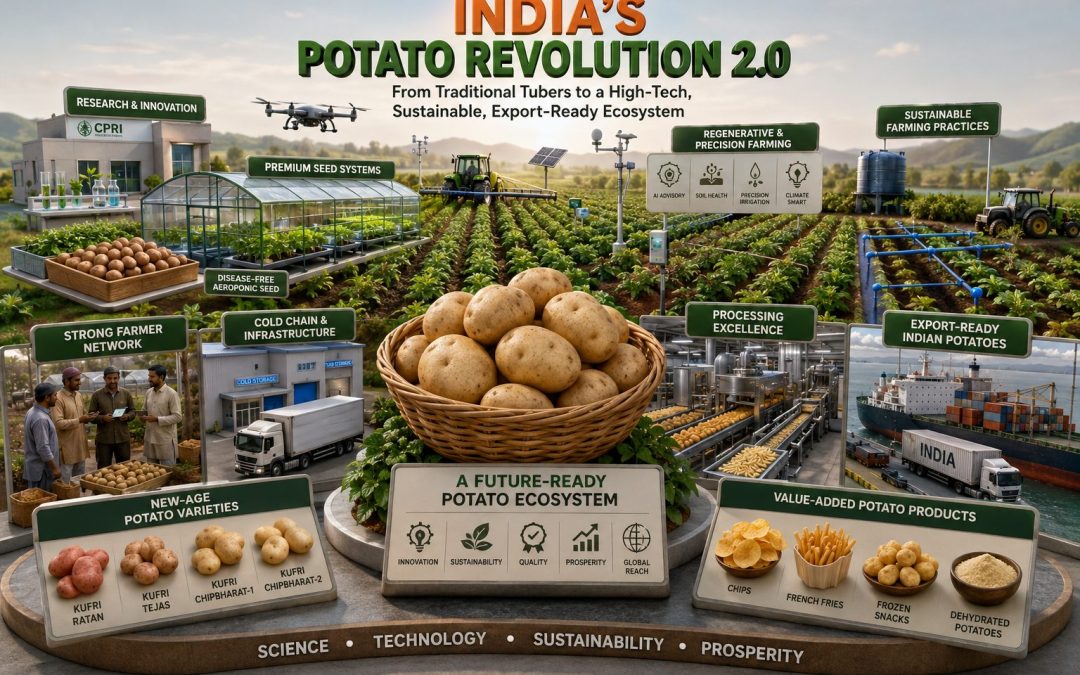
Potato Revolution 2.0: From Traditional Tubers to a High-Tech, Sustainable, Export-Ready Ecosystem
How Public Institutions, Seed Innovators, Processors, and Regenerative Farming Models Are Quietly Reshaping One of India’s Most Important Crops
The India potato revolution is rapidly transforming the India potato industry from a traditional commodity-driven sector into a high-tech, sustainability-focused, processing-oriented, and export-ready agricultural ecosystem. Driven by scientific innovation, advanced seed systems, regenerative potato farming, AI-supported agronomy, and large-scale investments in potato processing infrastructure, India is now entering a new era in potato cultivation and value-chain development.
India has long been recognised as the world’s second-largest potato producer, with annual production crossing approximately 58–58.6 million tonnes during 2024–25. Major potato-growing states, including Uttar Pradesh, West Bengal, Bihar, Punjab, and Gujarat,t continue to dominate cultivation, while new investments in frozen potato exports, potato farming technology, and organised seed systems are strengthening India’s position in global agricultural markets.
For decades, however, the Indian potato industry struggled with deep structural inefficiencies, including:
- Price volatility
- Fragmented supply chains
- Disease-prone seed systems
- High post-harvest losses
- Weak export competitiveness
- Low processing penetration
Today, the Indian potato revolution is being powered by a rare convergence of public research institutions, potato seed companies, food processors, agritech firms, exporters, and sustainability-focused farming initiatives.
This transformation includes:
- Climate-resilient potato varieties developed by ICAR-CPRI
- Expansion of cold-chain and processing infrastructure
- Professional potato seed companies are introducing disease-free planting systems
- Regenerative potato farming and precision irrigation
- AI-driven crop advisory and digital traceability systems
- Rapid growth in frozen potato exports in India
- Expansion of India’s potato processing industry
For agribusiness leaders, processors, exporters, policymakers, investors, and farmers, the Indian potato revolution is no longer just about higher production volumes. It is increasingly becoming one of the most strategically important agricultural value chains in India’s evolving food economy.
The Public Foundation: CPRI and India’s Scientific Backbone
At the centre of India’s potato transformation stands the ICAR–Central Potato Research Institute (CPRI), Shimla.
For decades, CPRI has provided the scientific foundation for India’s potato economy through:
- Variety development
- Disease management research
- Seed multiplication systems
- Agronomic innovation
- Climate adaptation research
- Farmer extension programs
In 2025, the Ministry of Agriculture notified several important potato varieties developed through CPRI research.
Newly Notified Potato Varieties
Kufri Ratan
- High-yielding red-skinned table potato
- Yield potential of approximately 37–39 tonnes per hectare
- Strong storability and consumer acceptance
- Suitable for commercial table markets
Kufri Tejas
- Heat-tolerant variety suited for plains
- Designed for rising temperature conditions
- Helps maintain yield stability under climate stress
Kufri Chipbharat-1 and Kufri Chipbharat-2
- Developed specifically for India’s growing processing industry
- Low reducing sugars and high dry matter
- Better frying quality with lower oil absorption
- Improved colour retention for chip manufacturing
These varieties complement the established Kufri Chipsona series, which helped build India’s organised potato processing ecosystem.
Government Schemes Accelerating Potato Ecosystem Growth
India’s potato transformation is also closely linked to policy support and infrastructure investment.
Operation Greens (TOP)
Initially launched for Tomato-Onion-Potato stabilisation, Operation Greens now supports:
- Farmer-Producer Organisations (FPOs)
- Cold-chain infrastructure
- Processing clusters
- Transportation and logistics
- Value-chain integration
- Reduction of post-harvest losses
The scheme has strengthened linkages between farmers, processors, aggregators, and exporters.
National Horticulture Board (NHB)
NHB support has accelerated investment in:
- Cold storages
- Drip irrigation
- Mechanization
- Seed infrastructure
- Precision farming systems
- Cluster development
State-Level Potato Ecosystems
Uttar Pradesh
- Aeroponic seed infrastructure
- Processing-linked cultivation
- Market intervention support
Bihar
- Expansion of processing varieties such as Lady Rosetta
- Seed subsidy programs
- Cold-storage investments
Punjab
- Certified seed multiplication systems
- Advanced irrigation adoption
- Mechanised farming support
Gujarat
- Emergence as India’s frozen potato processing hub
- Strong processor-farmer integration
- Export-oriented potato value chains
APEDA and India’s Frozen Potato Export Push
India’s frozen potato exports have expanded significantly over the last few years. Support from APEDA is helping Indian companies improve:
- Export quality standards
- Market access
- Supply-chain traceability
- International certifications
Indian frozen potato products are increasingly reaching:
- Middle Eastern markets
- Southeast Asia
- Japan
- Select European destinations
As global food inflation and supply diversification reshape international trade, India is positioning itself as an emerging alternative supplier in the frozen potato segment.
Professional Seed Systems: The Real Structural Shift
One of the most transformative developments in India’s potato industry is the professionalisation of seed systems.
Historically, farmers depended heavily on saved tubers or informal seed channels, leading to:
- Viral degeneration
- Inconsistent yields
- Disease transmission
- Poor storage performance
- Quality variability
Today, organised seed companies are fundamentally changing the economics of potato cultivation.
Mahindra HZPC: Building India’s Premium Seed Ecosystem
Mahindra HZPC — the joint venture between Mahindra Agri Solutions and Dutch potato leader HZPC — has emerged as one of India’s most influential organised potato seed companies.
Established in 2014, the company focuses on advanced seed systems supported by:
- Tissue culture propagation
- Aeroponic seed production
- Virus-free minitubers
- Strict generation control
- Professional agronomy support
- Proprietary processing and table varieties
Its infrastructure in Mohali and grower networks across Punjab, Uttar Pradesh, and Gujarat represent a major shift toward industrial-grade seed quality.
At the Global Potato Summit 2025, Mahindra HZPC showcased several advanced varieties tailored for Indian conditions.
Processing Varieties
Taurus
- High dry matter
- Excellent frying quality
- Targeted toward premium chip manufacturing
Alverstone and Quintera
- Developed for French fry processing
- Uniform tuber shape
- Better shelf life and processing recovery
Table Varieties
Colomba
- Attractive skin finish
- Early maturity
- Strong consumer acceptance
Sifra, SunRed, and Sunita
- Disease resistance
- Climate adaptability
- Strong yield performance
Mahindra HZPC’s importance lies not merely in varietal launches but in demonstrating how professional seed systems can improve consistency across the value chain — benefiting farmers, processors, retailers, and exporters alike.
Technico, ITC, and the Expansion of Organised Seed Networks
Technico, associated with ITC’s agri ecosystem, has also played an important role in:
- Tissue culture propagation
- Contract seed multiplication
- Processing-linked cultivation systems
- Farmer advisory services
In parallel, state governments and agricultural universities are investing in:
- Aeroponic seed facilities
- Disease-free mini-tuber production
- Advanced seed multiplication systems
- Farmer training programs
These efforts are gradually reducing dependence on low-quality informal seed channels.
The Rise of Regenerative Potato Farming
Another major shift underway is the adoption of regenerative agriculture practices within potato cultivation.
Traditionally, potato farming has been resource-intensive due to:
- High water consumption
- Heavy fertilizer use
- Intensive pesticide dependency
- Soil degradation risks
Today, processors and agritech companies are increasingly promoting regenerative models focused on:
- Soil health improvement
- Reduced chemical usage
- Efficient irrigation systems
- Carbon footprint reduction
- Biodiversity enhancement
PepsiCo’s Sustainable Farming Initiatives
PepsiCo has expanded sustainable potato sourcing programs in Punjab, Gujarat, and Uttar Pradesh through:
- Precision irrigation
- AI-based crop advisory
- Water-use optimization
- Soil testing programs
- Farmer training initiatives
The company’s contract farming ecosystem has become one of India’s most advanced potato sourcing models.
McCain Foods India
McCain has invested heavily in Gujarat-based farmer ecosystems supporting frozen French fry manufacturing.
Its sustainability programs increasingly focus on:
- Drip irrigation adoption
- Reduced water consumption
- Mechanized farming
- Crop monitoring technologies
- Farmer profitability enhancement
HyFun Foods and HyFarm
HyFun Foods and its farming platform HyFarm are emerging as major players in India’s frozen potato export ecosystem.
The company is investing in:
- Traceable procurement systems
- Regenerative farming pilots
- Export-grade quality systems
- AI-supported farm management
- Sustainability-focused sourcing
India’s Potato Processing Boom
India’s potato processing industry is growing far faster than fresh potato consumption.
Demand is expanding rapidly across:
- Potato chips
- Frozen French fries
- Quick-service restaurants (QSRs)
- Frozen snacks
- Retail packaged foods
Major companies shaping this ecosystem include:
- PepsiCo
- McCain Foods India
- HyFun Foods
- ITC
- Balaji Wafers
- Farm Frites India
- Iscon Balaji Foods
- Regional snack manufacturers
Processing-linked farming has introduced:
- Assured procurement
- Quality-linked pricing
- Technical advisory support
- Better market predictability for farmers
This model is gradually helping stabilise farmer incomes compared to open-market volatility.
True Potato Seed (TPS): The Next Frontier
Among the most promising innovations is the growing interest in True Potato Seed (TPS) technology.
Unlike traditional bulky seed tubers, TPS offers:
- Lower transportation costs
- Reduced disease transmission
- Easier storage
- Better scalability
- Potential suitability for climate-resilient agriculture
While large-scale commercialisation in India is still evolving, TPS could become one of the most disruptive innovations in the potato sector over the next decade.
Research institutions, startups, and seed companies are increasingly investing in this space.
Challenges Still Facing India’s Potato Sector
Despite remarkable progress, significant structural challenges remain:
- Fragmented landholdings
- Limited farmer awareness in some regions
- Cold-chain gaps
- Export quality inconsistencies
- Climate volatility
- Water stress
- Dependence on informal markets
- Price fluctuations during bumper harvests
Long-term sustainability will require continued coordination between:
- Government institutions
- Research organizations
- Seed companies
- Processors
- Exporters
- Farmer producer organizations
- Agritech startups
Conclusion: India’s Potato Industry Is Entering a New Era
India’s potato revolution is no longer defined merely by acreage or production volume. The sector is now entering a far more sophisticated phase driven by science, sustainability, seed innovation, processing integration, and export competitiveness.
What makes this transformation especially significant is the collaborative nature of the ecosystem. Public institutions such as CPRI are strengthening the scientific foundation, while private companies like Mahindra HZPC, PepsiCo, McCain, HyFun, ITC, and others are building scalable commercial ecosystems around farmers.
At the same time, regenerative agriculture, precision farming, aeroponic seed systems, AI-led advisory tools, and export-oriented processing are pushing India’s potato value chain toward global standards.
If this momentum continues, India may not only remain one of the world’s largest potato producers — it could emerge as one of the most technologically advanced, sustainability-focused, and globally competitive potato ecosystems of the future.
The next chapter of India’s agricultural transformation may well be written through a crop that has quietly sat on Indian plates for generations.
Disclaimer
This article is intended solely for informational, educational, and industry-discussion purposes. The information presented is based on publicly available reports, industry developments, research publications, government notifications, and market observations available at the time of writing.
Mention of any company, institution, product, technology, or brand does not constitute endorsement, advertisement, investment advice, or commercial solicitation. Readers are advised to independently verify technical, financial, regulatory, and commercial information before making business or investment decisions.
Neither the publisher nor the author shall be responsible for any loss, claim, or liability arising from the use of the information contained in this article.
