
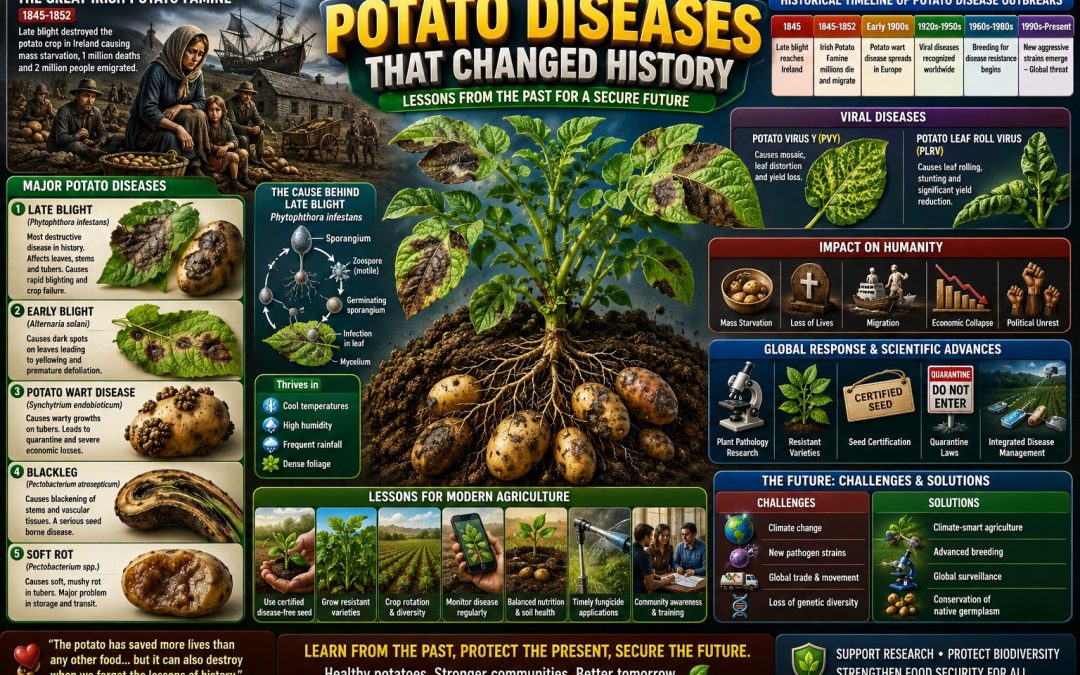
Potato Diseases That Changed History: Lessons from the Past
Author’s Note
As a writer passionate about food heritage, traditional agriculture, and crop history, I have often encountered stories where a single plant shaped the destiny of nations. Few crops illustrate this better than the potato. While preparing this article, I explored historical records, agricultural research, and scientific studies that reveal how potato diseases influenced famine, migration, economics, and modern agricultural science. This article brings together those lessons to help readers understand why the history of potato diseases remains relevant today.
The Shadow of the Tuber: A Story of Triumph and Tragedy
In the autumn of 1845, Irish farmers walked into fields that had promised a season of abundance. Only days earlier, their potato plants appeared healthy and productive. Yet almost overnight, leaves turned black, stems wilted, and a strange rot began spreading through the soil.
Families who depended entirely on potatoes for food watched helplessly as their harvest disappeared before their eyes.
What followed became one of the greatest humanitarian disasters in modern history. The disease responsible, now known as late blight, triggered the Irish Potato Famine and transformed the course of history.
More than a century and a half later, the story remains a powerful reminder of how vulnerable human societies can be when a vital food crop falls victim to disease.
The history of potato diseases is not merely an agricultural story. It is a story of resilience, scientific discovery, migration, survival, and the enduring importance of biodiversity.
Quick Facts About Historical Potato Diseases
| Fact | Details |
|---|---|
| Most destructive potato disease | Late Blight (Phytophthora infestans) |
| Most famous outbreak | Irish Potato Famine (1845–1852) |
| Estimated deaths | More than 1 million |
| Estimated emigration | 1.5–2 million people |
| Major lesson | Avoid monoculture and preserve crop diversity |
| Modern solutions | Resistant varieties, certified seed, disease monitoring |
Table of Contents
- Preface
- Why Potatoes Became So Important
- Importance of Potato Diseases in History
- Major Historical Potato Diseases
- Understanding Late Blight
- The Great Irish Potato Famine
- Economic and Social Consequences
- Potato Wart Disease and Quarantine History
- Viral Diseases and Their Impact
- Blackleg and Soft Rot Outbreaks
- Historical Timeline of Potato Disease Outbreaks
- Scientific Advances in Disease Management
- Global Agricultural Impact
- Lessons for India
- Climate Change and Emerging Threats
- Lessons for Modern Potato Cultivation
- Frequently Asked Questions
- Conclusion
- References
- Disclaimer
Preface
The potato is one of the world’s most important food crops. It feeds hundreds of millions of people and plays a critical role in food security across continents.
Yet throughout history, potato diseases have repeatedly demonstrated how fragile agricultural systems can become when a staple crop faces biological threats.
From devastating famines to scientific breakthroughs, the story of potato diseases offers valuable lessons about resilience, biodiversity, and sustainable farming.
Understanding these historical potato diseases is essential not only for historians but also for modern farmers, policymakers, researchers, and consumers.
Why Potatoes Became So Important
The potato originated in the Andes Mountains of South America, where Indigenous communities cultivated it for thousands of years.
Following its introduction to Europe during the sixteenth century, the crop spread rapidly because of its remarkable productivity.
Several characteristics made potatoes highly valuable:
- High yields from relatively small areas of land.
- Ability to grow in poor soils.
- Excellent nutritional value.
- Adaptability to cool climates.
- Reliable production under diverse conditions.
By the nineteenth century, potatoes had become a staple food throughout much of Europe.
In Ireland, entire families depended heavily on potatoes because the crop could provide sufficient calories and nutrition from small plots of land.
While this dependence brought food security during good years, it also created significant vulnerability when disease appeared.
Importance of Potato Diseases in History
The history of potato diseases extends far beyond agriculture.
Major disease outbreaks have influenced:
- Population growth and decline.
- Migration patterns.
- International trade.
- Government policies.
- Agricultural research.
- Food security strategies.
The lessons learned from potato disease outbreaks continue to shape modern farming systems and disease management programmes around the world.
Major Historical Potato Diseases
Several potato diseases have played important roles in agricultural history.
1. Late Blight (Phytophthora infestans)
The most destructive potato disease ever recorded.
Responsible for:
- The Irish Potato Famine.
- Massive crop failures worldwide.
- Billions of dollars in agricultural losses.
2. Potato Wart Disease (Synchytrium endobioticum)
A serious soil-borne disease capable of surviving in the soil for decades.
Consequences included:
- International quarantine regulations.
- Restrictions on seed movement.
- Significant economic losses.
3. Blackleg Disease
A bacterial disease that causes stem decay and seed-piece rot.
Effects include:
- Reduced yields.
- Poor plant establishment.
- Storage losses.
4. Potato Virus Y (PVY)
One of the most economically important potato viruses.
Symptoms include:
- Mosaic patterns on leaves.
- Yield reduction.
- Quality deterioration.
5. Potato Leaf Roll Virus (PLRV)
Historically responsible for severe reductions in productivity across many potato-growing regions.
Understanding
Late Blight and the Pathogen Behind It
The organism responsible for late blight is Phytophthora infestans.
Although often described as a fungus, it actually belongs to a group of organisms known as oomycetes or water moulds.
The pathogen thrives under:
- Cool temperatures.
- High humidity.
- Frequent rainfall.
- Dense crop canopies.
Symptoms include:
- Dark lesions on leaves.
- White growth on leaf undersides.
- Stem collapse.
- Tuber rot.
- Rapid destruction of entire fields.
Under favourable weather conditions, a healthy crop can be devastated within a matter of days.
This extraordinary ability to spread rapidly is one reason late blight became such a feared disease throughout agricultural history.
The Great Irish Potato Famine (1845–1852)
No discussion of potato diseases can be complete without examining the Irish Potato Famine, one of the most devastating agricultural disasters in human history.
By the early nineteenth century, a large proportion of Ireland’s rural population relied heavily on potatoes for daily sustenance. Many farming families cultivated small plots of land and depended almost entirely on a single potato variety known as the Lumper.
Although productive, the Lumper possessed very limited genetic diversity and offered little resistance to disease.
When late blight arrived in 1845, the consequences were catastrophic.
Fields that appeared healthy at the beginning of the season rapidly deteriorated. Plants blackened and collapsed. Potatoes stored for winter consumption rotted in homes, barns, and storage pits.
The disease returned repeatedly over the following years, destroying harvest after harvest.
For millions of people, the potato was not simply a crop. It was their primary source of food. As harvests failed, widespread hunger spread across the countryside.
The Irish Potato Famine became a defining moment in agricultural, social, and political history.
Human Cost of the Famine
The suffering caused by the famine remains difficult to comprehend.
Historical estimates suggest:
- More than one million people died from starvation and famine-related diseases.
- Approximately 1.5 to 2 million people emigrated during and after the crisis.
- Countless families were displaced.
- Entire communities disappeared.
- Population decline continued for decades.
Ships carrying desperate emigrants crossed the Atlantic toward North America, Canada, and Australia.
Many never returned.
The famine permanently altered Ireland’s demographic structure and left a legacy that continues to influence Irish society and culture today.
Economic Consequences of Potato Disease Outbreaks
While the human tragedy often receives the greatest attention, the economic consequences were equally profound.
The destruction of potato crops resulted in:
- Massive reductions in agricultural production.
- Loss of income for farming households.
- Increased food prices.
- Reduced labour opportunities.
- Growing rural poverty.
- Increased dependence on imported food.
In modern terms, the economic losses caused by the Irish Potato Famine would amount to billions of dollars.
The event demonstrated how a plant disease can destabilise entire economies and disrupt national development.
Political and Social Impact
The famine reshaped political discussions throughout Ireland and beyond.
Key consequences included:
Changes in Land Ownership
The crisis intensified debates regarding land tenure, tenant rights, and agricultural reform.
Government Intervention
Questions emerged about the responsibility of governments during food crises.
Mass Migration
The large-scale movement of people reshaped communities in North America, Britain, Australia, and other regions.
Public Health Awareness
The famine highlighted the close relationship between agriculture, nutrition, disease, and human well-being.
The event remains one of history’s clearest examples of how crop failure can trigger widespread social transformation.
Why Monoculture Increased Vulnerability
One of the most important lessons from the history of potato diseases is the danger of monoculture.
Monoculture occurs when a large area is planted with a single crop variety possessing similar genetic characteristics.
In nineteenth-century Ireland, dependence on a limited number of potato varieties created ideal conditions for disaster.
When late blight arrived, nearly every field became vulnerable.
There was little genetic resistance within the crop population.
As a result, the disease spread rapidly and caused widespread destruction.
Modern agricultural systems continue to face similar risks when diversity is neglected.
Today, scientists strongly advocate maintaining genetic diversity as a safeguard against future disease outbreaks.
Potato Wart Disease and the Rise of Quarantine Measures
Although late blight remains the most famous potato disease, other pathogens have also shaped agricultural history.
One notable example is potato wart disease, caused by Synchytrium endobioticum.
This disease produces abnormal wart-like growths on potato tubers and can survive in soil for decades.
Its persistence made eradication extremely difficult.
As outbreaks spread during the early twentieth century, governments responded by implementing:
- Quarantine regulations.
- Restrictions on seed movement.
- Field inspections.
- Disease monitoring programmes.
These measures became the foundation of modern plant health systems used around the world today.
Viral Diseases and Their Historical Importance
The twentieth century brought increased recognition of viral diseases affecting potatoes.
Two particularly significant pathogens were:
Potato Virus Y (PVY)
PVY causes:
- Mosaic symptoms.
- Reduced plant vigour.
- Lower yields.
- Poor tuber quality.
Potato Leaf Roll Virus (PLRV)
PLRV is associated with:
- Leaf rolling.
- Stunted growth.
- Significant productivity losses.
The spread of these viruses highlighted the importance of clean planting material and led to the development of certified seed programmes.
These programmes remain among the most effective tools for reducing disease transmission.
Blackleg and Soft Rot: Hidden Threats
Not all historically important potato diseases receive widespread public attention.
Blackleg and soft rot diseases have quietly caused substantial losses for generations.
These bacterial diseases affect:
- Seed potatoes.
- Growing plants.
- Stored tubers.
Symptoms include:
- Stem blackening.
- Tissue decay.
- Soft, foul-smelling rot.
- Reduced storage life.
In some regions, losses from bacterial diseases have rivalled those caused by more widely known pathogens.
Their history underscores the importance of sanitation, careful storage practices, and high-quality seed stock.
Historical Timeline of Major Potato Disease Outbreaks
Before the 1500s
Indigenous communities in the Andes manage local potato diseases through traditional farming practices.
1500s–1700s
Potatoes spread from South America to Europe and later to other parts of the world.
1845
Late blight appears in Ireland and causes extensive crop destruction.
1845–1852
The Irish Potato Famine resulted in widespread mortality and emigration.
Early 1900s
Potato wart disease triggers international quarantine measures.
1920s–1950s
Scientists identify major potato viruses and begin organised seed certification programmes.
1960s–1980s
Expansion of breeding programmes focused on disease resistance.
1990s–Present
New strains of late blight emerge, prompting global monitoring efforts.
Today
Climate change and global trade continue to influence the spread of potato diseases worldwide.
Scientific Advances Inspired by Historical Potato Diseases
Many modern agricultural innovations emerged as direct responses to devastating disease outbreaks.
Important advances include:
- Development of plant pathology as a scientific discipline.
- Disease-resistant breeding programmes.
- Certified seed production systems.
- Improved fungicides.
- Integrated pest management strategies.
- Molecular diagnostic tools.
- Disease forecasting models.
These developments have dramatically improved the ability of farmers to manage disease risks.
Nevertheless, history reminds us that continuous vigilance remains essential.
The Global Legacy of Potato Diseases
The impact of historical potato diseases extends far beyond individual farms.
These outbreaks influenced:
- Agricultural policy.
- Food security planning.
- International trade regulations.
- Biodiversity conservation.
- Scientific research priorities.
- Public awareness of crop health.
Few plant diseases have left such a lasting mark on human civilisation.
The lessons learned continue to guide efforts to build resilient agricultural systems capable of feeding a growing global population.
Lessons for India and the Himalayan Region
India is among the world’s leading potato-producing nations, with millions of farmers depending on the crop for income, nutrition, and livelihood security.
Potatoes are cultivated across diverse agro-climatic regions, including:
- Uttar Pradesh
- West Bengal
- Punjab
- Bihar
- Gujarat
- Himachal Pradesh
- Uttarakhand
In the Himalayan states, potato cultivation plays a particularly important role because the crop adapts well to cooler temperatures and mountainous conditions.
However, the lessons of historical potato diseases remain highly relevant.
Farmers in these regions continue to face challenges from:
- Late blight
- Early blight
- Viral diseases
- Bacterial diseases
- Changing weather patterns
Historical outbreaks remind us that sustainable potato production depends on vigilance, diversity, and scientific support.
The Role of Research in Protecting Potato Crops
The fight against potato diseases has benefited enormously from scientific research.
Research institutions across the world continue to study disease-resistant varieties, improved management practices, and emerging threats.
In India, potato research programmes have contributed significantly to:
- Disease-resistant varieties
- Improved seed production
- Disease surveillance systems
- Farmer training programmes
- Climate-resilient cultivation practices
Modern potato farming increasingly relies on scientific knowledge that was developed in response to historical disease outbreaks.
The hardships experienced by previous generations have helped create stronger agricultural systems for the future.
The Importance of Genetic Diversity
One of the clearest lessons from the Irish Potato Famine and other disease outbreaks is the importance of genetic diversity.
A genetically diverse crop population provides a natural buffer against disease.
When multiple varieties are cultivated:
- Disease spread may be slower.
- Some plants may possess resistance.
- Yield losses may be reduced.
- Farmers face lower overall risk.
Today, scientists conserve thousands of potato varieties and wild relatives in gene banks around the world.
These valuable genetic resources serve as insurance against future disease threats.
Protecting biodiversity is therefore not merely an environmental concern but an essential component of food security.
Climate Change and Emerging Disease Threats
Climate change is altering agricultural conditions worldwide, including those affecting potato production.
Scientists have observed several trends that may influence future disease outbreaks:
Changing Rainfall Patterns
Increased rainfall and prolonged humidity can create favourable conditions for diseases such as late blight.
Rising Temperatures
Warmer temperatures may alter disease distribution and encourage the emergence of new pathogen strains.
Extreme Weather Events
Floods, droughts, and unusual weather patterns can stress crops and increase disease susceptibility.
Expansion of Disease Ranges
Pathogens may spread into regions that were previously unsuitable for their survival.
As climate conditions continue to change, disease monitoring and adaptation strategies will become increasingly important.
Modern Technologies Fighting Potato Diseases
Farmers today have access to technologies that would have seemed unimaginable during the nineteenth century.
These include:
- Satellite-based crop monitoring.
- Drone-assisted field scouting.
- Precision agriculture tools.
- Disease forecasting models.
- Molecular diagnostics.
- Artificial intelligence-assisted disease detection.
- Climate-based early warning systems.
These technologies enable farmers to identify disease problems earlier and respond more effectively.
Although challenges remain, modern agriculture possesses powerful tools for reducing the impact of disease outbreaks.
What Historical Potato Diseases Teach Us Today
The history of potato diseases offers lessons that extend far beyond agriculture.
These events remind us that:
- Food security should never be taken for granted.
- Biodiversity is essential for resilience.
- Scientific research saves lives.
- Disease surveillance is critical.
- Sustainable farming practices matter.
- Global cooperation strengthens agricultural security.
The blackened potato fields of nineteenth-century Ireland continue to teach lessons that remain relevant in the twenty-first century.
History repeatedly demonstrates that prevention is far less costly than recovery.
Practical Lessons for Modern Potato Growers
Farmers seeking to reduce disease risks can benefit from several proven practices:
Use Certified Seed
Certified seed reduces the risk of introducing diseases into the field.
Rotate Crops
Crop rotation helps break disease cycles and improve soil health.
Select Resistant Varieties
Disease-resistant cultivars provide an additional layer of protection.
Monitor Fields Regularly
Early detection often prevents major outbreaks.
Improve Field Hygiene
Removing infected plant material can reduce pathogen survival.
Follow Weather-Based Advisories
Disease forecasting systems help farmers take timely preventive action.
Preserve Diversity
Growing multiple varieties can reduce vulnerability to catastrophic losses.
Frequently Asked Questions (FAQs)
What is the most destructive potato disease in history?
Late blight caused by Phytophthora infestans is widely regarded as the most destructive potato disease ever recorded.
What caused the Irish Potato Famine?
The famine was triggered primarily by repeated outbreaks of late blight that destroyed potato harvests between 1845 and 1852.
Why were Irish farmers so vulnerable?
Many families depended heavily on a limited number of potato varieties with little disease resistance, such as Himalayan potato varieties.
Is late blight still a problem today?
Yes. Late blight continues to affect potato production worldwide and remains a major concern for farmers.
What is potato wart disease?
It is a serious soil-borne disease that causes wart-like growths on potato tubers and can persist in soil for many years.
Are potato viruses still important?
Yes. Viral diseases continue to reduce yields and remain a challenge for seed certification programmes.
How can farmers protect potatoes from disease?
Using certified seed, resistant varieties, crop rotation, field monitoring, and integrated disease management practices can significantly reduce risks.
How has climate change affected potato diseases?
Climate change may increase disease pressure by altering temperature, humidity, and rainfall patterns that favour pathogen development.
Why is genetic diversity important?
Genetic diversity helps reduce vulnerability by ensuring that not all plants respond identically to disease outbreaks.
What is the biggest lesson from potato disease history?
The greatest lesson is that resilient agricultural systems require diversity, research, preparedness, and continuous vigilance.
Conclusion
The story of potato diseases is one of the most powerful examples of how agriculture and human history are deeply interconnected.
From the devastating late blight epidemic that triggered the Irish Potato Famine to the emergence of viral, bacterial, and soil-borne diseases in later years, potato disease outbreaks have repeatedly demonstrated the fragility of food systems.
Yet this history is not solely a story of tragedy.
It is also a story of resilience, scientific progress, and adaptation.
The lessons learned from past outbreaks have transformed agricultural science, inspired disease-resistant breeding programmes, strengthened quarantine systems, and improved food security around the world.
Today, as climate change, global trade, and evolving pathogens create new challenges, the experiences of the past remain more relevant than ever.
The fields that once suffered devastating losses continue to remind us that sustainable agriculture depends on diversity, research, innovation, and responsible stewardship of natural resources.
By studying the history of potato diseases, we not only honour the experiences of those who endured these crises but also equip ourselves to build a more resilient agricultural future for generations to come.
Call to Action
Did you find this article informative?
Share it with farmers, students, researchers, gardeners, and anyone interested in agricultural history and food security. Understanding the lessons of the past can help protect the harvests of the future.
For more in-depth articles on traditional foods, crop history, sustainable agriculture, Himalayan farming, and forgotten food heritage, continue exploring Madhusavara.com.
Suggested References and Further Reading
For readers interested in exploring this subject further, consider consulting publications and resources from:
- Food and Agriculture Organisation (FAO)
- International Potato Centre (CIP)
- Central Potato Research Institute (CPRI)
- Historical studies on the Irish Potato Famine
- Academic publications on plant pathology and potato disease management
- Agricultural extension publications and certified seed guidelines
Disclaimer
This article is intended solely for educational, historical, and informational purposes. Every effort has been made to ensure accuracy; however, agricultural conditions, disease prevalence, cultivation practices, and management recommendations vary by region, climate, and farming system.
Readers should consult qualified agronomists, plant pathologists, agricultural universities, local agricultural departments, and recognised research institutions before making cultivation or disease-management decisions.
The information presented in this article should not be considered professional agricultural, scientific, legal, or financial advice.
Madhusavara.com, the author, editors, and contributors make no representations or warranties regarding the completeness, reliability, or suitability of the information provided and shall not be responsible for any loss, damage, expense, crop failure, business interruption, or consequences arising from reliance on this content.
Readers are encouraged to verify information independently and seek professional guidance appropriate to their specific circumstances.
Author: Madhu Savara
