
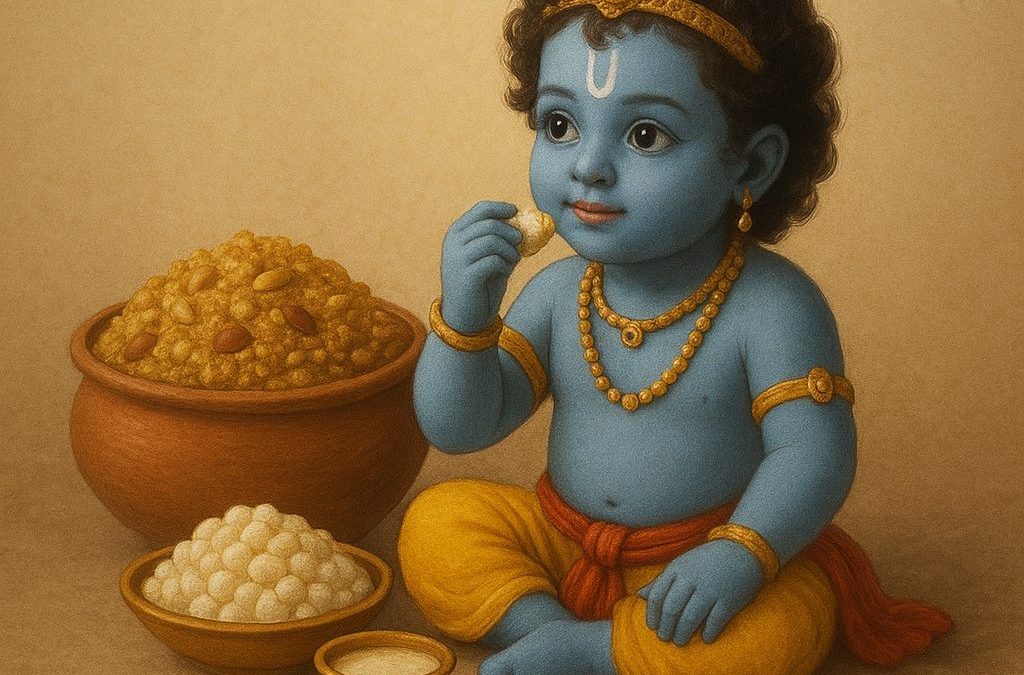
Janmashtami: Faith, Fasting, and Krishna’s Divine Prasad
the stillness of midnight’s hour,
When the world lay wrapped in dark despair,
A cry of a newborn lit Mathura’s walls,
A promise of hope, a divine repair.
O Gopala, O butter-thief divine,
In every heart, Your flute shall shine.
Janmashtami is not a date, but a call,
Where bhakti binds You — the Lord of all.
Preface
Janmashtami is not merely a date on the calendar. It is the sacred moment when time itself pauses to celebrate the birth of Lord Krishna, the eternal cowherd, the beloved of Vrindavan, the destroyer of Kansa, and the friend of every soul seeking light.
I, Madhu Savara, write this not as a food blogger, but as a humble devotee who has tasted Krishna’s grace through bhakti, scriptures, and prasadam. My journey with Krishna is one of both faith and flavour. In my kitchen, I do not cook food — I prepare offerings. On Janmashtami, every grain, every drop of ghee, every note of a bhajan resonates with His presence.
Origin of Janmashtami
Janmashtami commemorates the midnight birth of Lord Krishna in Mathura, more than 5,000 years ago, as narrated in the Bhagavata Purana. Born to Devaki and Vasudeva in the prison of Kansa, Krishna came into this world amidst chains, yet no prison could bind Him. Vasudeva carried the infant across the Yamuna, whose waters parted, leading Him to Gokul, where Nanda and Yashoda embraced Him as their own.
This origin is not just a story of birth; it is a symbol of divine hope: even in the darkest night, light descends to guide humanity.
Significance of Janmashtami
Every ritual of Janmashtami carries layers of meaning. The fasting (vrat) is not merely a dietary discipline; it is symbolic of surrendering worldly indulgence so that the heart may become a vessel for Krishna. The midnight celebrations remind us that when ignorance is at its peak, divinity arrives. The chanting of the Gita tells us that dharma may falter, but Krishna restores it.
Janmashtami is the festival where the flute of Krishna does not just sing in Vrindavan; it sings in every corner of the world where His name is remembered.
A Lok Gatha of Krishna
In the Braj region, one folk song narrates:
“Yashoda Maiya tied her Kanha with a rope for stealing butter,
Yet the rope fell two fingers short, again and again.
One finger was her effort, the other was His grace —
And only when both met, the knot was tied.”
This lok gatha is not just a tale for children. It is the eternal truth of bhakti: without our effort, we cannot reach Him; without His grace, we cannot bind Him.
Why People Keep Vrat on Janmashtami
The vrat of Janmashtami is an act of tapasya. Devotees abstain from grains and heavy foods, surviving on fruits, milk, and sattvik preparations. The hunger of the body becomes fuel for the soul’s remembrance of Krishna. The fast is broken at midnight, the moment of Krishna’s appearance, with prasad that purifies and energises.
Practices Followed During Vrat
- No grains or onion-garlic: Only sattvik food is offered.
- Abhishek of Krishna: With milk, curd, honey, ghee, and gangajal.
- Bhajans and kirtans: The air resonates with “Hare Krishna Hare Rama.”
- Jhanki (tableaus): Depicting Krishna’s childhood leelas.
- Midnight aarti: Bells, conches, and lamps celebrate His divine birth.
Temples and Celebrations Worldwide
- Mathura & Vrindavan (India): The very soil sings His name.
- Dwarka (India): Dwarkadhish temple, where Krishna ruled as king.
- Puri Jagannath (India): The Rath Yatra is Krishna’s eternal chariot ride.
- ISKCON Temples (Worldwide): From Vrindavan to New York, London to Sydney, Janmashtami is celebrated with grandeur and devotion, drawing millions into Krishna consciousness.
The Role of ISKCON
The International Society for Krishna Consciousness (ISKCON) has carried Krishna’s name to the farthest corners of the globe. In Times Square, Janmashtami is celebrated with the same fervour as in Vrindavan. Their temples echo with kirtans, Bhagavad Gita discourses, and distribution of Krishna prasad to thousands. ISKCON has transformed Janmashtami into not just an Indian festival, but a global wave of bhakti.
Prasad of Janmashtami: Panjiri
The heart of Janmashtami’s feast lies in its prasad. Among many offerings, Panjiri stands out — a sattvik preparation of wheat flour roasted in ghee, sweetened with sugar, enriched with dry fruits, and perfumed with cardamom. In Ayurveda, Panjiri is considered a healer: it strengthens digestion, balances energy, and revives the body after a fast. But beyond health, it carries devotion — every spoonful is a spoonful of bhakti.
Authentic Panjiri Recipe for Janmashtami
Ingredients
- Whole wheat flour – 1 cup
- Pure cow ghee – ½ cup
- Powdered sugar – ½ cup
- Almonds – 10–12 (chopped)
- Cashews – 8–10 (chopped)
- Raisins – 2 tbsp
- Makhana (foxnuts) – ½ cup (roasted and crushed)
- Cardamom powder – ½ tsp
- Dry coconut – 2 tbsp (grated)
Utensils Required
- Heavy-bottomed kadai
- Wooden ladle
- Mixing bowl
- Airtight container
Preparation Time: 10 minutes
Cooking Time: 20 minutes
Serving Size: 4–5 devotees
Method
- Heat ghee in a heavy-bottomed kadai.
- Add wheat flour and roast slowly till it turns golden and aromatic.
- Stir in almonds, cashews, makhana, raisins, and coconut. Roast lightly.
- Remove from the flame and let it cool for a few minutes.
- Mix in powdered sugar and cardamom powder.
- Offer to Krishna at midnight before distributing as prasad.
Nutritional Value (per serving ~50g)
- Calories: 210
- Protein: 4g
- Carbohydrates: 28g
- Fats: 9g (healthy, from ghee and nuts)
- Fibre: 2g
Allergen Information
- Contains wheat (gluten).
- Contains nuts (almonds, cashews).
- Substitute wheat flour with amaranth or singhara flour for a gluten-free vrat version.
Tips and Variations
- Replace sugar with jaggery for a deeper taste.
- Add gond (edible gum) for strength.
- Vegan option: Use cold-pressed coconut oil instead of ghee.
- For American kitchens, quinoa flour can replace wheat for a unique twist.
Storage
Panjiri keeps well in an airtight container for 10–12 days at room temperature. Always use a dry spoon to preserve freshness.
Things to Avoid in Prasad
- Never add garlic, onion, or processed refined flour.
- Avoid preparing prasad in aluminium utensils — use brass, steel, or clay for purity.
- Do not taste before offering — the first morsel belongs only to Krishna.
Conclusion
Janmashtami is more than a festival. It is the eternal reminder that the Divine walks among us, plays with us, steals butter, and yet gives us the nectar of the Gita. The fasts, the kirtans, the temples, and the Panjiri are not isolated rituals but strands of one garland — a garland we place at Krishna’s feet.
In every bite of prasad, in every midnight aarti, in every whispered “Hare Krishna,” the Lord is reborn in our hearts.
This Janmashtami, let us fast with faith, feast with devotion, and remember: Krishna does not need our offerings, but He smiles when we offer with love.
🙏 In bhakti and flavour,
Madhu Savara
