
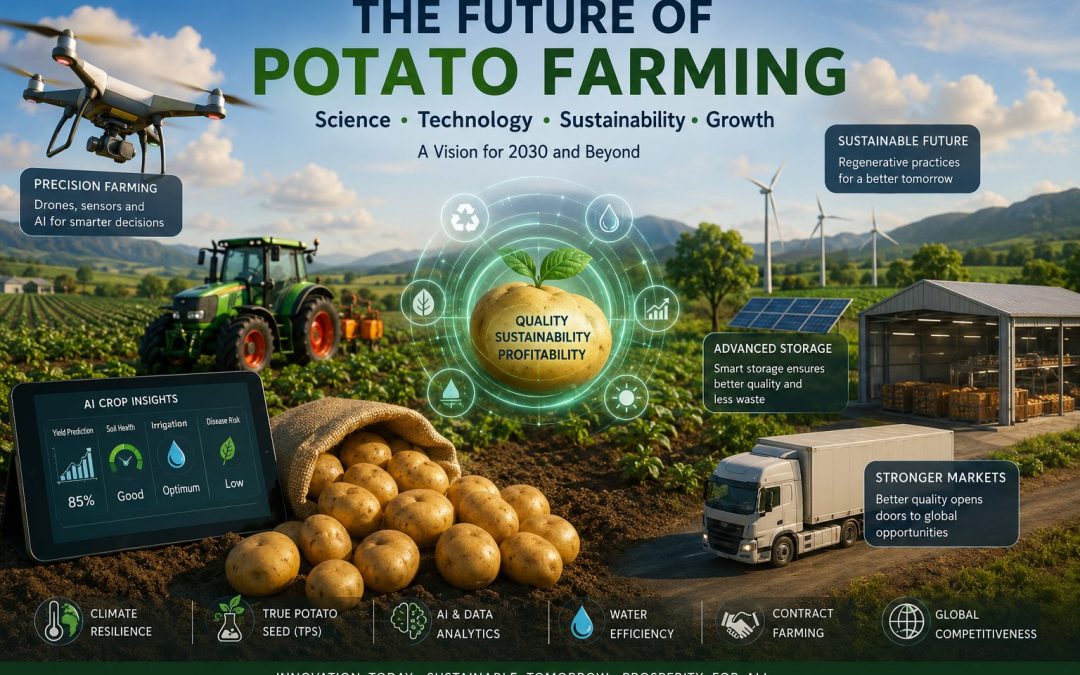
The Future of Potato Farming (Part 1)
The Hidden Quality Crisis Reshaping the Global Potato Industry.
Subject Orientation
For decades, potato farming success was measured largely by one number: yield. If production increased, farmers celebrated, traders were satisfied, policymakers reported success, and the industry moved forward.
Today, however, a profound transformation is taking place beneath the soil and beyond the farm gate.
The Future of Potato Farming is no longer defined solely by how many tonnes are harvested per hectare. Increasingly, it is being determined by Potato Quality, storage performance, processing suitability, sustainability, and climate resilience.
Across the world, processors are reporting greater variability in raw material quality. Cold storage operators are encountering new storage challenges. Exporters are facing stricter requirements. Food companies are under pressure to reduce carbon footprints. Researchers are racing to develop climate-resilient potato varieties.
Many of these changes remain invisible to consumers.
Yet they are quietly reshaping one of the world’s most important food crops.
Why This Matters to Every Stakeholder
The emerging potato quality challenge extends far beyond farmers.
Every stakeholder in the potato value chain is affected.
| Stakeholder | Why It Matters |
| Farmers | Quality penalties, lower prices, and rejection risks |
| Processors | Reduced recovery rates and higher manufacturing costs |
| Seed Companies | Need for climate-resilient and processing-focused varieties |
| Cold Storage Operators | Greater storage complexity and quality deterioration risks |
| Exporters | Increasing international quality requirements |
| Food Companies | Supply chain reliability and sustainability concerns |
| Policymakers | Food security, rural livelihoods, and agricultural competitiveness |
What once appeared to be a production challenge is rapidly becoming a supply-chain challenge affecting every participant in the potato economy.
Editor’s Note
This article is Part 1 of a special three-part series examining how climate change, sustainability requirements, technological innovation, and changing market expectations are reshaping the global potato industry.
Series Overview
Part 1: The Hidden Quality Crisis Reshaping the Global Potato Industry (Current Article)
Part 2: How Science, AI and Sustainability Are Transforming Potato Farming
Part 3: The Race to 2030: Who Will Win the Future of Potato Farming?
Table of Contents
- Preface
- India’s Potato Industry at a Crossroads
- Global Warning Signs
- Climate Change and Potatoes
- The Hidden Potato Quality Crisis
- Why Yield No Longer Tells the Full Story
- Dry Matter in Potatoes
- Fry Colour and Processing Performance
- Why Potatoes Are Becoming Sweeter During Storage
- Heat Stress and Potato Physiology
- Hollow Heart: The Invisible Threat
- Black Spot Bruising and Internal Defects
- Disease Pressure in a Changing Climate
- Why Processors Reject More Loads Despite Good Yield
- The Economics of Potato Quality
- What This Means for Indian Farmers
- A Transformation That Is Only Beginning
- Conclusion
- Frequently Asked Questions
- Continue Reading This Series
- References and Further Reading
- Disclaimer
Preface
Potatoes are among the most important food crops on Earth.
They support millions of farmers, feed billions of consumers, and provide raw materials for one of the world’s fastest-growing food-processing sectors.
From fresh consumption and frozen French fries to chips, flakes, starch, and dehydrated products, potatoes occupy a critical position in modern food systems.
India is among the world’s largest potato-producing nations and continues to expand its role in processing, exports, and value-added products.
Yet despite increasing production, a new challenge is emerging.
The challenge is not necessarily growing more potatoes.
The challenge is growing better potatoes.
India’s Potato Industry at a Crossroads
The Indian potato sector is entering a decisive phase of development.
Several major trends are converging simultaneously:
- Rapid expansion of potato processing
- Rising demand for frozen foods
- Growth of quick-service restaurants
- Increasing export ambitions
- Climate-related production risks
- Water scarcity concerns
- Sustainability requirements from multinational companies
Historically, much of India’s potato production was destined for fresh consumption.
Today, processors are demanding potatoes with highly specific characteristics.
The result is a shift from volume-driven agriculture to quality-driven agriculture.
This shift may define the Future of Potato Farming more than any other factor.
Global Warning Signs
The challenges facing potatoes are not limited to India.
Across North America, Europe, China, and South Asia, growers and processors are increasingly reporting concerns regarding:
- Heat stress
- Water shortages
- Quality variability
- Storage complications
- Sustainability pressures
Leading potato-producing nations are investing heavily in:
- Climate-resilient varieties
- Precision agriculture
- Water-efficient irrigation
- Digital crop monitoring
- AI-assisted quality forecasting
Researchers increasingly believe that climate resilience may become as important as productivity during the coming decades.
Climate Change and Potatoes
The relationship between Climate Change and Potatoes is becoming increasingly significant.
Potatoes thrive under relatively cool conditions. Even moderate increases in temperature can influence:
- Tuber initiation
- Starch formation
- Sugar metabolism
- Water-use efficiency
- Disease pressure
- Storage behaviour
One of the most concerning trends is rising nighttime temperatures.
Potato plants rely on cooler nights to convert sugars into starch efficiently.
When temperatures remain elevated during the night, starch accumulation may decline, and quality characteristics can be affected.
The result is a crop that may appear successful in the field but perform poorly during storage or processing.
The Hidden Potato Quality Crisis
Many growers still evaluate success primarily through yield.
Processors evaluate success differently.
For a processor, quality parameters are often more important than production volume.
These include:
- Dry matter content
- Sugar levels
- Fry colour
- Internal defects
- Storage stability
- Uniformity
A crop that produces exceptional yields may still fail to meet processor requirements.
This disconnect is creating a hidden quality crisis throughout the potato value chain.
Why Yield No Longer Tells the Full Story
Historically, higher yields have usually translated into higher profits.
Today, that relationship is changing.
A farmer producing a slightly smaller crop with excellent processing characteristics may outperform a farmer producing a larger crop with poor quality.
Modern processors increasingly reward:
- Consistency
- Processing suitability
- Quality stability
- Storage performance
rather than production volume alone.
This represents a fundamental shift in industry economics.
Dry Matter in Potatoes: The New Gold Standard
Among all quality parameters, Dry Matter in Potatoes has become one of the most important.
Dry matter refers to the portion of the potato remaining after water is removed.
Higher dry matter generally results in:
- Better French fry quality
- Higher chip recovery
- Lower oil absorption
- Improved texture
- Greater processor profitability
For processors, dry matter is directly linked to manufacturing efficiency.
Unfortunately, environmental stress can interfere with starch accumulation and reduce dry matter levels.
As climate variability increases, maintaining optimal dry matter is becoming a growing challenge.
Fry Colour: The Quality Parameter Consumers Never See
Consumers rarely think about fry colour.
Processors think about it every day.
Ideal fries and chips should be:
- Golden
- Uniform
- Attractive
- Consistent
Excessive sugar accumulation causes darker products during frying.
This creates several problems:
- Reduced consumer acceptance
- Brand consistency concerns
- Higher rejection rates
- Increased manufacturing costs
Maintaining desirable Fry Colour is becoming increasingly challenging as climatic conditions become less predictable.
Why Potatoes Are Becoming Sweeter During Storage
One of the most significant quality concerns facing the Potato Processing Industry is sugar accumulation during storage.
Several factors contribute:
- Temperature fluctuations
- Heat stress
- Physiological ageing
- Storage management challenges
When potatoes experience stress, starch may be converted into reducing sugars.
The consequences include:
- Dark fry colour
- Lower chip recovery
- Reduced processing efficiency
- Greater rejection rates
This issue is attracting increasing attention from processors worldwide.
Heat Stress and Potato Physiology
Heat stress affects potatoes in ways that extend far beyond yield.
Potential impacts include:
- Reduced dry matter
- Greater sugar accumulation
- Tuber deformities
- Lower storage performance
- Increased physiological disorders
In many cases, these effects remain invisible until after harvest.
This makes heat stress particularly challenging for growers and processors.
Hollow Heart: The Invisible Threat
Hollow heart is a physiological disorder characterised by internal cavities within potato tubers.
Affected potatoes often appear normal externally.
However, processors may discover defects only after cutting.
Consequences include:
- Lower marketability
- Increased waste
- Reduced processor confidence
- Economic losses
Climate-related growth fluctuations may increase the incidence of hollow heart in some regions.
Black Spot Bruising and Internal Defects
Black spot bruising occurs when internal tissues become damaged and discoloured.
This problem often remains hidden until potatoes are peeled or processed.
Effects include:
- Increased sorting costs
- Quality downgrades
- Reduced processor satisfaction
- Greater waste generation
As quality standards become stricter, internal defects are receiving increased attention.
Disease Pressure in a Changing Climate
Quality challenges are not the only concern.
Climate change may also influence disease patterns.
Key threats include:
Late Blight
One of the most destructive potato diseases globally.
Early Blight
Often associated with plant stress and environmental variability.
Bacterial Wilt
A significant challenge in many potato-growing regions.
Viral Diseases
Can reduce yield, quality, and seed health.
Managing disease pressure will become increasingly important in climate-resilient potato production systems.
Why Processors Reject More Loads Despite Good Yield
Many farmers ask a simple question:
“If my yield is excellent, why was my crop rejected?”
The answer lies in processor requirements.
Processors evaluate:
- Dry matter
- Fry colour
- Sugar content
- Internal defects
- Uniformity
- Storage stability
A visually impressive crop may still fail processing standards.
This explains why rejection rates may rise even during years of strong production.
The Economics of Potato Quality
Quality problems have significant economic consequences.
For Farmers
- Lower prices
- Contract penalties
- Rejected consignments
For Processors
- Reduced recovery rates
- Higher oil consumption
- Increased sorting costs
- Greater production losses
For Cold Storage Operators
- Storage deterioration
- Weight loss
- Sugar accumulation challenges
For Exporters
- Quality-related shipment risks
- Stricter buyer requirements
- Potential loss of market access
Quality has become an economic issue, not merely a technical one.
What This Means for Indian Farmers
Indian growers are entering a new agricultural reality.
Future success will increasingly depend upon:
- Understanding processor requirements
- Managing quality proactively
- Improving water-use efficiency
- Adopting climate-smart practices
- Selecting suitable varieties
- Monitoring storage performance
Farmers who adapt early may enjoy significant competitive advantages.
Those who focus exclusively on yield may face increasing challenges.
A Transformation That Is Only Beginning
The issues discussed in this article represent only the first layer of a much larger transformation.
Researchers, seed developers, processors, food companies, technology firms, and policymakers are investing heavily in solutions designed to address emerging quality and sustainability challenges.
Many of the most important changes are occurring behind the scenes.
Consumers may never notice shifts in dry matter, sugar accumulation, fry colour, or storage behaviour.
Processors, exporters, and food companies certainly do.
The next decade may witness more change in potato farming than the previous three decades combined.
Conclusion
The Future of Potato Farming is no longer defined solely by production.
It is increasingly defined by Potato Quality, climate resilience, sustainability, and processing performance.
The interaction between Climate Change and Potatoes is reshaping Dry Matter in Potatoes, Fry Colour, storage behaviour, disease pressure, and processing suitability.
For growers, processors, exporters, storage operators, researchers, and policymakers, understanding these trends is no longer optional.
The potato industry is not simply facing a production challenge.
It is facing a quality revolution.
In Part 2, we will examine how science, technology, public institutions, and private companies are responding to these challenges and helping shape the next generation of potato farming.
Frequently Asked Questions
Why is potato quality becoming more important than yield?
Processors increasingly require potatoes with specific quality characteristics such as dry matter, sugar levels, and fry colour. High yields alone may not guarantee profitability.
What is dry matter in potatoes?
Dry matter refers to the solid content remaining after water is removed. Higher dry matter generally improves processing performance.
Why do potatoes become sweeter during storage?
Stress, temperature fluctuations, and physiological changes can convert starch into sugars, affecting processing quality.
How does climate change affect potatoes?
Climate change can influence temperature, rainfall patterns, disease pressure, water availability, storage behaviour, and processing quality.
Why are processors rejecting more potato loads?
Processors assess multiple quality factors, including fry colour, dry matter, sugar levels, and internal defects. A crop may have an excellent yield but still fail processing standards.
Continue Reading This Special Series
Part 1
The Hidden Quality Crisis Reshaping the Global Potato Industry (Current Article)
Part 2
How Science, AI and Sustainability Are Transforming Potato Farming (Coming Next)
Part 3
The Race to 2030: Who Will Win the Future of Potato Farming? (Coming Next)
References and Further Reading
- Central Potato Research Institute (CPRI), India
- Indian Council of Agricultural Research (ICAR)
- International Potato Centre (CIP), Peru
- Food and Agriculture Organisation (FAO)
- State Agricultural Universities
- Potato Association publications
- Peer-reviewed potato agronomy and processing research
- Sustainability reports published by leading potato processors and food companies
Disclaimer
This article is intended solely for educational, informational, research, and industry-awareness purposes. The information presented is based on publicly available agricultural knowledge, scientific observations, industry trends, and expert discussions. Agricultural performance varies according to climate, geography, soil conditions, management practices, market dynamics, regulatory requirements, and technological adoption. Readers should consult qualified agronomists, agricultural scientists, extension officers, processors, and industry experts before making farming, storage, investment, procurement, or business decisions. The author and publisher assume no responsibility or liability for any losses, damages, claims, or consequences arising directly or indirectly from reliance on the information contained herein.
