
Note
This article concludes our three-part series on the Future of Potato Farming.
Part 1 examined the hidden potato quality crisis.
Part 2 explored the scientific, technological, and sustainability solutions emerging across the industry.
Part 3 looks ahead to 2030 and asks a critical question:
Who will be best positioned to succeed in the next era of potato farming?
Table of Contents
- The Decade That Could Redefine Potato Farming
- Why 2030 Matters
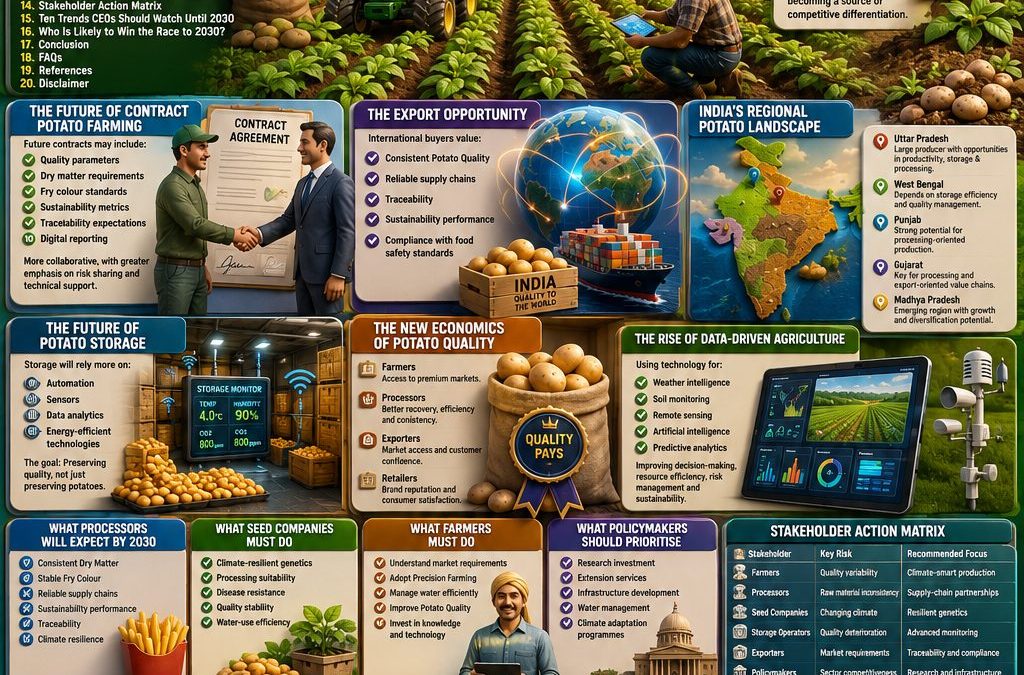
- The Future of Contract Potato Farming
- The Export Opportunity
- Sustainability as a Competitive Advantage
- India’s Regional Potato Landscape
- The Future of Potato Storage
- The New Economics of Potato Quality
- The Rise of Data-Driven Agriculture
- What Processors Will Expect by 2030
- What Seed Companies Must Do
- What Farmers Must Do
- What Policymakers Should Prioritise
- Stakeholder Action Matrix
- Ten Trends CEOs Should Watch Until 2030
- Who Is Likely to Win the Race to 2030?
- Conclusion
- FAQs
- References
- Disclaimer
The Decade That Could Redefine Potato Farming
The potato industry has undergone many transformations over the past century.
Mechanisation changed labour requirements.
Improved varieties increased productivity.
Cold storage expanded market opportunities.
Food processing created entirely new value chains.
However, the decade leading to 2030 may prove even more transformative.
Climate change, sustainability expectations, technological innovation, and changing consumer behaviour are converging at an unprecedented pace.
The winners of the next decade may not necessarily be those who produce the most potatoes.
They may be those who produce the most adaptable, sustainable, and high-quality potatoes.
Why 2030 Matters
The year 2030 has become an important benchmark for governments, food companies, investors, and sustainability programmes.
Many organisations have established targets related to:
- Carbon emissions
- Water efficiency
- Sustainable sourcing
- Supply-chain resilience
- Climate adaptation
As these commitments mature, their impact will increasingly reach farms and agricultural supply chains.
The potato sector will not be exempt.
The Future of Contract Potato Farming
Contract Potato Farming is likely to evolve significantly over the coming years.
Traditional contracts often focused primarily on acreage and yield.
Future agreements may increasingly include:
- Quality parameters
- Dry matter requirements
- Fry colour standards
- Sustainability metrics
- Traceability expectations
- Digital reporting
Contracts may also become more collaborative, with greater emphasis on risk sharing and technical support.
For farmers, this could create both opportunities and responsibilities.
The Export Opportunity
Export markets represent one of the most promising opportunities for the potato sector.
However, export competitiveness increasingly depends on more than production volume.
International buyers are often interested in:
- Consistent Potato Quality
- Reliable supply chains
- Traceability
- Sustainability performance
- Compliance with food safety standards
Countries and companies that can meet these expectations may gain a competitive advantage in global markets.
Sustainability as a Competitive Advantage
For many years, sustainability was often viewed primarily as a corporate responsibility initiative.
Today, it is becoming a business strategy.
Companies are increasingly evaluated on:
- Carbon footprint
- Water use
- Environmental impact
- Supply-chain resilience
This shift is influencing procurement decisions, investor expectations, and consumer perceptions.
Sustainability is increasingly becoming a source of competitive differentiation.
India’s Regional Potato Landscape
Different regions of India are likely to face different opportunities and challenges.
Uttar Pradesh
A major potato-producing state with significant influence on national production.
Key opportunities include productivity improvements, storage modernisation, and processing expansion.
West Bengal
An important potato-growing region with strong production capacity and market significance.
Future competitiveness may depend on storage efficiency and quality management.
Punjab
Well positioned for processing-oriented potato production due to infrastructure and technological adoption.
Gujarat
Increasingly important for processing and export-oriented potato value chains.
Madhya Pradesh
An emerging region with opportunities for expansion and diversification.
Regional strengths will play an important role in shaping future growth.
The Future of Potato Storage
Potato Storage is expected to become increasingly sophisticated.
Future storage systems may rely more heavily on:
- Automation
- Sensors
- Data analytics
- Energy-efficient technologies
The goal will not simply be preserving potatoes but preserving quality.
As quality requirements become stricter, storage management will become more strategic.
The New Economics of Potato Quality
Quality is increasingly influencing profitability throughout the value chain.
Farmers
Quality may determine access to premium markets.
Processors
Quality affects recovery rates, production efficiency, and product consistency.
Exporters
Quality influences market access and customer confidence.
Retailers
Quality supports brand reputation and consumer satisfaction.
The economic value of quality is likely to continue increasing.
The Rise of Data-Driven Agriculture
Agriculture is becoming increasingly data-driven.
Future potato production systems may utilise:
- Weather intelligence
- Soil monitoring
- Remote sensing
- Artificial intelligence
- Predictive analytics
These technologies may help improve:
- Decision-making
- Resource efficiency
- Risk management
- Sustainability performance
The integration of data into farming practices is expected to accelerate.
What Processors Will Expect by 2030
Processors may increasingly prioritise:
- Consistent Dry Matter in Potatoes
- Stable Fry Colour
- Reliable supply chains
- Sustainability performance
- Traceability
- Climate resilience
The ability to consistently meet these expectations may become a major competitive advantage.
What Seed Companies Must Do
Seed companies play a crucial role in the Future of Potato Farming.
Key priorities include:
- Climate-resilient genetics
- Processing suitability
- Disease resistance
- Quality stability
- Water-use efficiency
Innovation in seed systems may influence industry performance for decades.
What Farmers Must Do
Future success is likely to depend on:
- Understanding market requirements
- Adopting Precision Farming in Potatoes
- Managing water efficiently
- Improving Potato Quality
- Investing in knowledge and technology
Adaptability may become one of the most valuable skills in agriculture.
What Policymakers Should Prioritise
Policymakers can support industry development through:
- Research investment
- Extension services
- Infrastructure development
- Water management initiatives
- Climate adaptation programmes
Public-private collaboration may become increasingly important.
Stakeholder Action Matrix
| Stakeholder | Key Risk | Recommended Focus |
| Farmers | Quality variability | Climate-smart production |
| Processors | Raw material inconsistency | Supply-chain partnerships |
| Seed Companies | Changing climate | Resilient genetics |
| Storage Operators | Quality deterioration | Advanced monitoring |
| Exporters | Market requirements | Traceability and compliance |
| Policymakers | Sector competitiveness | Research and infrastructure |
Ten Trends CEOs Should Watch Until 2030
- Quality premiums replacing volume premiums.
- Increased use of AI in agriculture.
- Greater sustainability reporting requirements.
- Expansion of precision farming technologies.
- Climate-resilient variety development.
- Growth of processing-oriented potato production.
- Stronger traceability systems.
- Modernisation of storage infrastructure.
- Expansion of export opportunities.
- Greater collaboration across the value chain.
Who Is Likely to Win the Race to 2030?
The winners may include:
Farmers Who Focus on Quality
Rather than pursuing yield alone.
Processors Who Invest in Partnerships
Building stronger relationships with growers.
Seed Companies That Innovate
Developing resilient and high-performing varieties.
Storage Operators Who Modernise
Protecting quality throughout the supply chain.
Exporters Who Embrace Sustainability
Meeting evolving international expectations.
Policymakers Who Support Innovation
Creating environments that encourage adaptation and competitiveness.
Success is likely to depend on collaboration rather than isolated action.
Conclusion
The Future of Potato Farming will be shaped by a combination of climate resilience, Potato Quality, sustainability, innovation, and market responsiveness.
The interaction between Climate Change and Potatoes, evolving processor requirements, changing consumer expectations, and technological progress is creating both challenges and opportunities.
The potato industry has repeatedly demonstrated its ability to adapt.
The next chapter will require that same spirit of innovation and collaboration.
Those who invest in knowledge, quality, sustainability, and resilience today may be best positioned to thrive tomorrow.
The race to 2030 has already begun.
Frequently Asked Questions
Will quality become more important than yield?
Quality and yield will both remain important, but many markets increasingly reward consistent quality.
Why is sustainability becoming a business requirement?
Investors, consumers, retailers, and regulators increasingly expect environmental responsibility.
How can farmers prepare for the future?
By improving quality management, adopting appropriate technologies, and understanding market requirements.
Why are processors investing in long-term partnerships?
Stable relationships can help improve consistency, quality, and supply-chain resilience.
What role will technology play?
Technology is expected to support decision-making, efficiency, risk management, and sustainability.
References and Further Reading
- Central Potato Research Institute (CPRI)
- Indian Council of Agricultural Research (ICAR)
- International Potato Center (CIP)
- Food and Agriculture Organization (FAO)
- State Agricultural Universities
- Public sustainability reports from major food and processing companies
- Peer-reviewed agricultural and potato-industry research
Disclaimer
This article is intended solely for educational, informational, research, and industry-awareness purposes. The information presented reflects current trends, publicly available knowledge, and professional observations. Agricultural outcomes vary according to climate, geography, market conditions, technology adoption, and management practices. Readers should consult qualified professionals before making farming, investment, procurement, or business decisions. Neither the author nor the publisher assumes responsibility for actions taken based on this article.
