
Note
This article is Part 2 of our three-part series on the Future of Potato Farming.
In Part 1, we explored how climate change, storage challenges, fry colour issues, dry matter fluctuations, and quality deterioration are creating a hidden crisis across the potato value chain.
In Part 2, we examine the institutions, technologies, and industry leaders working to address these challenges.
Table of Contents
- Why Solutions Matter
- The Growing Role of Science
- CPRI and India’s Potato Future
- ICAR and Climate-Resilient Agriculture
- International Potato Centre (CIP)
- Agricultural Universities and Innovation
- The Rise of True Potato Seed (TPS)
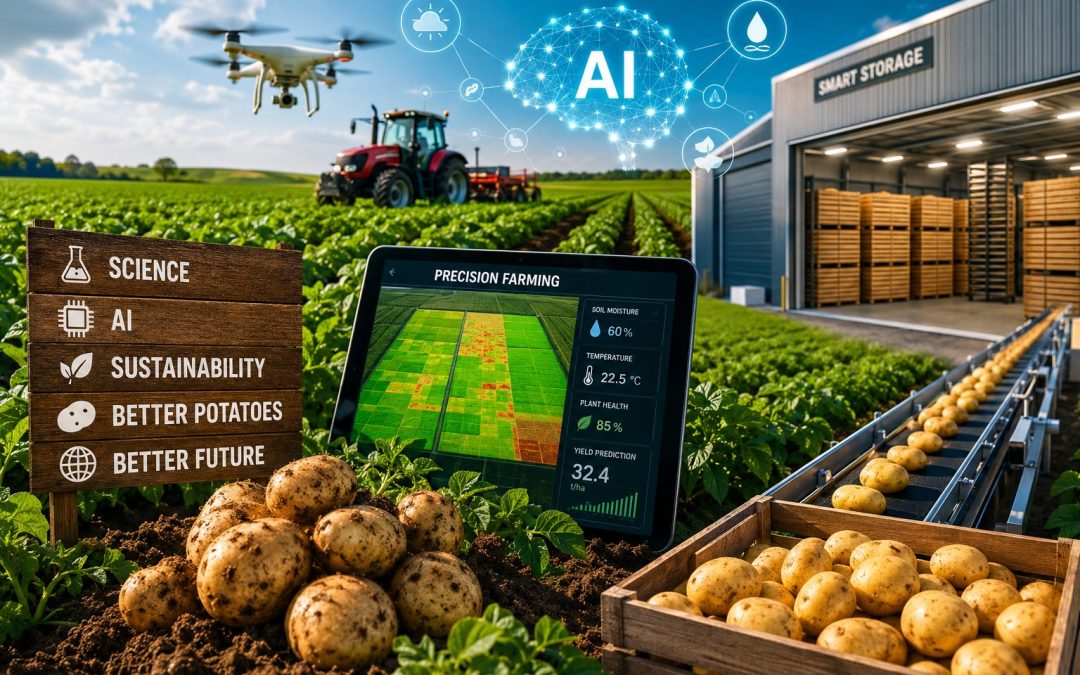
- Precision Farming in Potatoes
- Artificial Intelligence and Quality Prediction
- Potato Storage Reinvented
- Water Scarcity and Smart Irrigation
- Regenerative Agriculture
- Carbon Footprint Pressures
- PepsiCo’s Potato Strategy
- McCain Foods and Regenerative Farming
- HyFun Foods and Processing Growth
- Technico and Seed Innovation
- Why Sustainability Is Becoming a Business Requirement
- What This Means for Farmers
- Conclusion
- FAQs
- Continue Reading the Series
- References
- Disclaimer
Why Solutions Matter
Part 1 demonstrated that quality challenges are becoming increasingly important.
The encouraging news is that the potato industry is not standing still.
Researchers, food companies, technology firms, and agricultural institutions are investing heavily in solutions designed to improve:
- Potato Quality
- Climate resilience
- Water efficiency
- Storage performance
- Sustainability
- Processing consistency
The future will belong to those who adapt fastest.
The Growing Role of Science
Modern potato farming increasingly depends on science.
The industry is moving beyond traditional practices toward:
- Data-driven decisions
- Climate-resilient genetics
- Precision irrigation
- Artificial intelligence
- Sustainability monitoring
The potato farm of 2030 may look very different from that of 2020.
CPRI and India’s Potato Future
The Central Potato Research Institute (CPRI) remains one of India’s most important potato research organisations.
Its work includes:
Variety Development
Developing varieties with:
- Improved processing quality
- Better Dry Matter in Potatoes
- Disease resistance
- Climate resilience
Seed Technology
Improving access to healthy planting material.
Agronomic Research
Helping growers improve productivity and sustainability.
As climate pressures increase, CPRI’s role is likely to become even more important.
ICAR and Climate-Resilient Agriculture
The Indian Council of Agricultural Research (ICAR) supports research aimed at:
- Climate adaptation
- Water-use efficiency
- Sustainable farming
- Improved crop management
Many future solutions to Climate Change and Potatoes will emerge from collaborative efforts involving ICAR and partner institutions.
International Potato Centre (CIP)
The International Potato Centre (CIP), headquartered in Peru, is one of the world’s leading potato research organisations.
CIP focuses on:
- Heat-tolerant varieties
- Drought resilience
- Disease resistance
- Sustainable farming systems
Its work is increasingly relevant as climate-related risks intensify globally.
Agricultural Universities and Innovation
State agricultural universities play an essential role in:
- Field testing
- Variety evaluation
- Farmer training
- Climate adaptation research
Institutions in Punjab, Uttar Pradesh, West Bengal, and other potato-growing regions contribute significantly to industry knowledge.
The Rise of True Potato Seed (TPS)
One of the most exciting developments in potato farming is True Potato Seed (TPS).
Traditionally, potatoes are planted using seed tubers.
TPS uses botanical seed instead.
Potential advantages include:
- Lower transportation costs
- Reduced disease transmission
- Easier storage
- Greater scalability
While challenges remain, TPS could become increasingly important in future potato production systems.
Precision Farming in Potatoes
Precision Farming in Potatoes is rapidly becoming a necessity.
Technologies include:
- GPS-guided equipment
- Variable-rate applications
- Soil sensors
- Drone monitoring
- Satellite imagery
Benefits include:
- Better resource efficiency
- Reduced input costs
- Improved quality management
- Enhanced sustainability
Artificial Intelligence and Quality Prediction
Artificial intelligence may transform the potato industry more than any other technology.
AI systems can analyse:
- Weather data
- Soil conditions
- Crop imagery
- Historical performance
to predict:
- Yield
- Dry matter
- Fry colour
- Storage behaviour
before harvest.
This could fundamentally change decision-making across the Potato Processing Industry.
Potato Storage Reinvented
Traditional Potato Storage methods are evolving.
Modern facilities increasingly use:
- Automated temperature control
- Digital monitoring
- Sensor networks
- Predictive analytics
These systems help reduce:
- Quality deterioration
- Sugar accumulation
- Weight loss
Storage technology is becoming a strategic competitive advantage.
Water Scarcity and Smart Irrigation
Water scarcity represents one of the greatest long-term challenges for Processing Potatoes in India.
Solutions include:
- Drip irrigation
- Soil moisture monitoring
- Precision scheduling
- Water-use benchmarking
Future success may depend as much on water efficiency as yield.
Regenerative Agriculture
Regenerative agriculture is attracting growing attention.
Practices include:
- Cover cropping
- Reduced soil disturbance
- Improved soil health
- Enhanced biodiversity
Potential benefits include:
- Better resilience
- Improved water retention
- Reduced environmental impact
Many leading food companies increasingly support these approaches.
Carbon Footprint Pressures
Large food companies face increasing pressure from:
- Consumers
- Investors
- Regulators
- Retail chains
Many organisations are adopting:
- Net-zero targets
- ESG commitments
- Sustainable sourcing requirements
These pressures are gradually reaching the farm level.
PepsiCo’s Potato Strategy
PepsiCo depends on a reliable supply of processing-quality potatoes.
Its priorities include:
- Fry colour consistency
- Sustainable sourcing
- Water efficiency
- Grower support
The company increasingly uses technology and agronomic advisory systems to help farmers meet quality expectations.
McCain Foods and Regenerative Farming
McCain Foods has publicly highlighted:
- Regenerative agriculture
- Climate resilience
- Carbon reduction
- Sustainable supply chains
These priorities reflect broader trends affecting the global potato sector.
HyFun Foods and Processing Growth
As a major processor of frozen potato products, HyFun Foods depends on:
- Stable quality
- Consistent dry matter
- Reliable supply chains
Climate-related quality variability represents a significant business challenge.
Technico and Seed Innovation
Technico is among the companies contributing to advances in potato seed systems.
Key areas include:
- Improved genetics
- Processing varieties
- Disease management
- Quality consistency
Seed innovation may become one of the most important drivers of future industry performance.
Why Sustainability Is Becoming a Business Requirement
Sustainability is no longer merely a public relations topic.
Increasingly, it influences:
- Procurement decisions
- Export opportunities
- Investor confidence
- Consumer trust
Companies throughout the value chain are adapting accordingly.
What This Means for Farmers
Future success may depend on:
- Technology adoption
- Quality management
- Water efficiency
- Climate resilience
- Sustainability awareness
Farmers who embrace innovation may be better positioned to benefit from changing market requirements.
Conclusion
The Future of Potato Farming will be shaped not only by climate challenges but also by the industry’s ability to innovate.
Institutions such as CPRI, ICAR, and CIP, together with private-sector leaders including PepsiCo, McCain, HyFun, and Technico, are helping create solutions for a rapidly changing world.
Technologies such as True Potato Seed, Precision Farming in Potatoes, artificial intelligence, advanced Potato Storage systems, and regenerative agriculture may play a critical role in improving Potato Quality, sustainability, and profitability.
The future belongs to those who can combine science, technology, and practical farming knowledge to produce potatoes that meet the expectations of processors, consumers, and global markets.
In Part 3, we will examine how exports, contract farming, regional opportunities, sustainability requirements, and changing business models may determine who wins the race to 2030.
Frequently Asked Questions
What is True Potato Seed (TPS)?
TPS uses botanical seeds rather than seed tubers and may offer advantages in storage, transport, and disease management.
How can AI help potato farmers?
AI can help predict yield, quality, storage performance, and management needs using data from weather, soil, and crop monitoring systems.
Why are food companies interested in regenerative agriculture?
Because it may improve soil health, resilience, sustainability performance, and long-term supply-chain stability.
What role does CPRI play?
CPRI researches potato varieties, seed systems, agronomy, processing quality, and climate resilience.
Why is sustainability becoming more important?
Investors, regulators, retailers, and consumers increasingly expect food companies to demonstrate environmental responsibility.
Continue Reading This Special Series
Part 1
The Hidden Quality Crisis Reshaping the Global Potato Industry
Part 2
How Science, AI and Sustainability Are Transforming Potato Farming (Current Article)
Part 3
The Race to 2030: Who Will Win the Future of Potato Farming? (Coming Next)
References and Further Reading
- Central Potato Research Institute (CPRI)
- Indian Council of Agricultural Research (ICAR)
- International Potato Centre (CIP)
- Food and Agriculture Organisation (FAO)
- Agricultural university publications
- Sustainability reports from major potato processors
- Publicly available industry research and agronomic literature
Disclaimer
This article is intended solely for educational, informational, and industry-awareness purposes. Readers should consult qualified agricultural professionals, researchers, and industry experts before making farming, investment, storage, or business decisions. Agricultural outcomes vary according to local conditions, management practices, climate, market dynamics, and regulatory requirements. Neither the author nor the publisher assumes responsibility for decisions made based on this article.
