
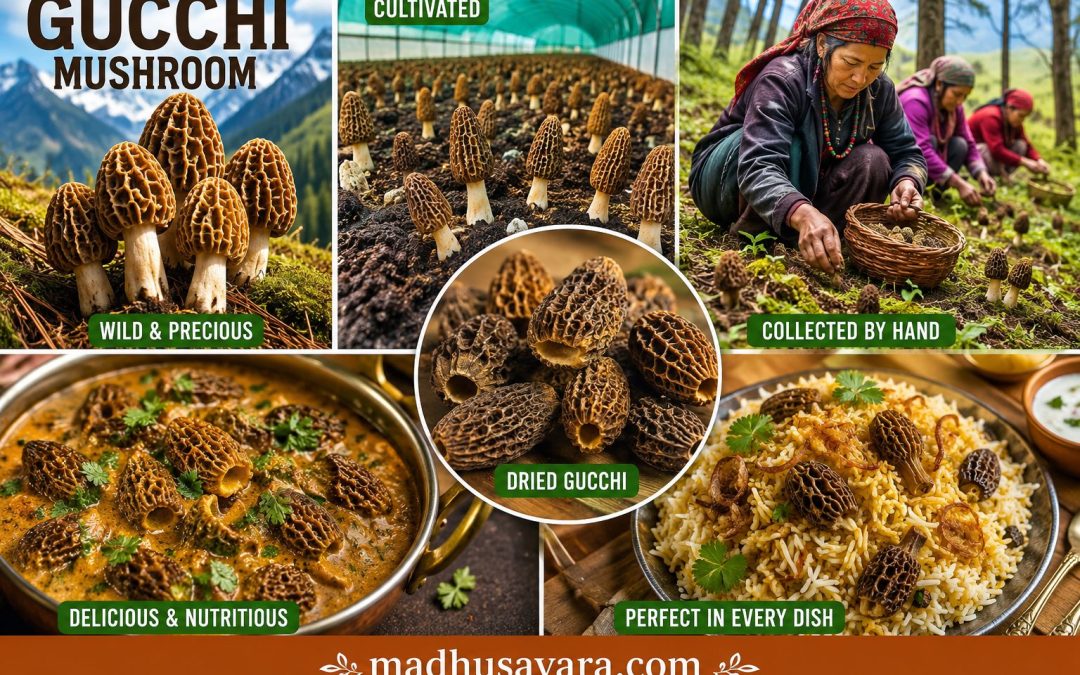
A Himalayan Treasure Hidden in the Forest
As winter slowly withdraws from the mighty Himalayas and the snow begins melting under the warmth of spring sunshine, a unique transformation takes place in the forests of Himachal Pradesh, Jammu & Kashmir, and Uttarakhand.
Villagers carrying traditional bamboo baskets set out before sunrise, walking through pine-covered slopes, cedar forests, and moist mountain valleys. Their eyes remain fixed on the forest floor, searching carefully among fallen leaves and decomposing organic matter.
They are not searching for precious stones or hidden treasures.
They are searching for Gucchi Mushroom, one of nature’s rarest and most valuable gifts.
For centuries, the arrival of the Gucchi season has been eagerly awaited by Himalayan communities. The mushroom not only brings additional income to rural households but also carries cultural significance, culinary prestige, and ecological importance.
Known globally as the Morel Mushroom, Gucchi is regarded as one of the finest edible fungi available in nature. Its distinctive honeycomb appearance, earthy aroma, exceptional taste, and limited availability have made it highly sought after by chefs, food enthusiasts, and researchers alike.
Just as Lingri (Fiddlehead Fern) is celebrated as one of the Himalaya’s most famous wild vegetables, Gucchi Mushroom is recognised as one of the Himalaya’s most prized wild edible forest treasures.
Table of Contents
- Preface
- What is Gucchi Mushroom?
- Scientific Classification
- Origin and History
- Why is Gucchi Mushroom Famous?
- Scientific Species of Gucchi Mushroom
- Physical Characteristics
- Natural Habitat
- Where is Gucchi Mushroom Found?
- Distribution in India
- Ideal Growing Conditions
- Why is Gucchi Mushroom So Expensive?
- Wild Gucchi vs Cultivated Morels
- Can Gucchi Mushroom Be Cultivated?
- Nutritional Value
- Health Benefits
- Medicinal Significance
- Traditional Himalayan Knowledge
- Cultural Significance
- Harvesting Methods
- Processing, Drying and Storage
- Conclusion of Part 1
Preface
Nature often creates wonders that science struggles to replicate. Gucchi Mushroom is one such marvel.
Despite modern agricultural advancements, researchers across the world continue to face challenges in producing Gucchi consistently under controlled conditions. This rarity has contributed significantly to its reputation and economic value.
Today, Gucchi Mushroom stands at the intersection of biodiversity, traditional knowledge, nutrition, gastronomy, and rural livelihoods. It is not merely a mushroom; it is an important component of the Himalayan heritage.
This article aims to provide scientifically accurate, practical, and comprehensive information about Gucchi Mushroom while preserving the cultural and ecological significance attached to it.
What is Gucchi Mushroom?
Gucchi Mushroom is a wild edible fungus belonging to the genus Morchella, commonly known throughout the world as the Morel Mushroom.
Unlike ordinary cultivated mushrooms, Gucchi typically grows naturally in forest ecosystems under specific environmental conditions.
It is recognised for:
- Honeycomb-shaped cap
- Distinct earthy aroma
- Rich umami flavour
- High nutritional value
- Limited seasonal availability
- Premium market price
Because of its rarity and culinary excellence, Gucchi is frequently served in luxury hotels and gourmet restaurants.
Scientific Classification
| Classification | Details |
|---|---|
| Kingdom | Fungi |
| Division | Ascomycota |
| Class | Pezizomycetes |
| Order | Pezizales |
| Family | Morchellaceae |
| Genus | Morchella |
| Common Name | Gucchi Mushroom |
| International Name | Morel Mushroom |
Unlike plants, mushrooms belong to the Kingdom Fungi and obtain nutrients through decomposition of organic matter.
Origin and History
Morel mushrooms have been consumed for centuries across Asia, Europe, and North America.
In India, Gucchi Mushroom has traditionally been collected from Himalayan forests by local communities living in remote mountain regions.
Historically, dried Gucchi was used:
- During festivals
- At family celebrations
- As a valuable trade commodity
- In traditional mountain cuisine
As transportation and trade networks improved, Gucchi began reaching larger markets and eventually attracted international attention.
Today, it is recognised as one of India’s most prestigious wild edible forest products.
Why is Gucchi Mushroom Famous?
Several factors contribute to the fame of Gucchi Mushroom.
1. Rare Natural Occurrence
The mushroom appears only under specific environmental conditions and for a limited period each year.
2. Exceptional Taste
Its rich, earthy flavour and meaty texture make it highly desirable in gourmet cuisine.
3. Premium Market Value
Limited availability and strong demand contribute to its high market price.
4. Nutritional Richness
It contains valuable nutrients, minerals, and bioactive compounds.
5. Cultural Importance
For Himalayan communities, Gucchi represents both tradition and livelihood.
Scientific Species of Gucchi Mushroom
The term “Gucchi” generally refers to several species within the genus Morchella.
Important species include:
Morchella esculenta
Often called the Yellow Morel, this is among the most widely recognised species.
Morchella conica
Characterised by a darker and more conical appearance.
Morchella elata
Known for its elongated structure and distinctive texture.
Morchella deliciosa
A valued edible species appreciated for its flavour.
Morchella angusticeps
Found in suitable forest ecosystems and considered a premium edible morel.
While subtle differences exist among species, all are highly valued edible mushrooms.
Physical Characteristics
Gucchi Mushroom possesses several unique identifying features.
Honeycomb Cap
The cap displays a network of ridges and pits resembling a honeycomb.
Hollow Interior
A genuine morel is hollow from the tip of the cap to the base of the stem.
Colour
Colour may vary from:
- Light brown
- Yellow-brown
- Grey-brown
- Dark brown
depending on species and environmental conditions.
Texture
The mushroom has a firm yet delicate texture when cooked.
Aroma
A pleasant earthy aroma is one of its most prized characteristics.
Natural Habitat
Gucchi Mushroom grows naturally in:
- Pine forests
- Cedar forests
- Oak forests
- Fir forests
- Mixed temperate woodlands
It is commonly associated with:
- Decaying organic matter
- Moist soil
- Snowmelt regions
- Mountain ecosystems
The exact ecological relationships remain an active area of scientific research.
Where is Gucchi Mushroom Found?
Globally, morels occur in:
- India
- Nepal
- Pakistan
- China
- Turkey
- France
- Germany
- Italy
- Canada
- United States
However, Himalayan Gucchi enjoys a particularly strong reputation due to its quality and natural origin.
Distribution in India
India’s major Gucchi-producing regions are concentrated in the Himalayas.
Himachal Pradesh
Important areas include:
- Kullu
- Manali
- Chamba
- Kangra
- Mandi
- Shimla
Jammu & Kashmir
Major collection regions include:
- Kupwara
- Baramulla
- Anantnag
- Pahalgam
- Doda
Uttarakhand
Significant areas include:
- Chamoli
- Uttarkashi
- Pithoragarh
- Rudraprayag
These regions provide ideal climatic and ecological conditions.
Ideal Growing Conditions
Although scientists continue studying Gucchi ecology, several conditions are considered favourable.
| Factor | Preferred Condition |
|---|---|
| Altitude | 1,500–3,500 metres |
| Temperature | Cool spring climate |
| Moisture | Moderate to high |
| Soil | Organic-rich |
| Forest Type | Temperate forests |
| Season | Spring |
Snowmelt followed by moderate temperatures appears particularly important.
Why is Gucchi Mushroom So Expensive?
One of the most common questions about Gucchi concerns its high market value.
Limited Availability
The mushroom appears only during a short season.
Wild Harvesting
Most premium Gucchi is collected from forests rather than farms.
Difficult Collection
Collectors often travel long distances through rugged mountain terrain.
Strong Demand
Luxury restaurants and speciality food markets create substantial demand.
Complex Cultivation
Reliable commercial production remains challenging.
Together, these factors contribute to its premium status.
Wild Gucchi vs Cultivated Morels
| Feature | Wild Gucchi | Cultivated Morel |
|---|---|---|
| Availability | Seasonal | Controlled |
| Aroma | Strong | Moderate |
| Flavour | Rich | Comparatively Milder |
| Price | Premium | Lower |
| Supply | Limited | Increasing |
| Consumer Preference | Very High | Moderate |
Wild-harvested Gucchi continues to command the highest prices.
Can Gucchi Mushroom Be Cultivated?
This remains one of the most fascinating questions in mushroom science.
Researchers in several countries, including China and India, have made progress in controlling morel cultivation.
However:
- Environmental requirements are complex.
- Yield consistency remains difficult.
- Commercial scalability continues to be challenging.
As a result, wild Gucchi still dominates premium markets.
Nutritional Value of Gucchi Mushroom
Gucchi Mushroom is valued not only for its flavour but also for its nutritional composition.
Major Nutrients Present
| Nutrient | Significance |
|---|---|
| Protein | Supports body tissues |
| Dietary Fibre | Supports digestion |
| Potassium | Important mineral |
| Iron | Essential micronutrient |
| Phosphorus | Bone and cellular functions |
| Copper | Supports enzyme systems |
| Zinc | Important trace mineral |
| Antioxidants | Cellular protection |
| Vitamin D Precursors | Nutritional value |
Its nutrient profile contributes significantly to its reputation as a premium food.
Health Benefits of Gucchi Mushroom
Rich Source of Protein
Contains more protein than many commonly consumed vegetables.
Supports Digestive Health
Dietary fibre contributes to digestive wellness.
Provides Essential Minerals
Contains iron, potassium, phosphorus, zinc, and copper.
Rich in Antioxidants
Contains compounds associated with protection against oxidative stress.
Supports Balanced Nutrition
Offers a combination of nutrients with relatively low fat content.
Valuable for Diverse Diets
Can be included in vegetarian and non-vegetarian meal plans.
Medicinal Significance
Researchers have investigated morels for:
- Antioxidant properties
- Bioactive compounds
- Nutritional supplementation
- Immune-supportive potential
However, Gucchi Mushroom should be regarded primarily as a nutritious food rather than a medicine.
No mushroom should be used as a substitute for professional medical care.
Traditional Himalayan Knowledge
One of the most remarkable aspects of Gucchi is the traditional knowledge associated with its collection.
For generations, local communities have learned:
- Where mushrooms are likely to emerge
- Appropriate harvesting periods
- Sustainable collection practices
- Drying techniques
- Storage methods
This knowledge has been passed down through families and remains invaluable today.
Cultural Significance
In many Himalayan communities, Gucchi is more than a forest product.
It represents:
- Traditional heritage
- Seasonal celebration
- Community knowledge
- Economic opportunity
- Connection with nature
Its collection often involves entire families and remains an important cultural activity.
Harvesting Methods
Harvesting generally occurs between:
- March
- April
- May
Collectors carefully search forest floors and remove mature mushrooms without causing unnecessary ecological disturbance.
Responsible harvesting is essential for long-term sustainability.
Processing, Drying and Storage
After collection:
Cleaning
Forest debris is removed carefully.
Drying
Mushrooms are naturally dried to reduce moisture content.
Sorting
Products are graded according to quality and size.
Storage
Dried mushrooms are stored in airtight containers.
Proper storage helps preserve flavour, aroma, and shelf life.
Market Price of Gucchi Mushroom
One of the first questions people ask about Gucchi Mushroom is its price.
Unlike common mushrooms that are cultivated throughout the year, Gucchi is a seasonal forest product with limited availability. Consequently, its market value can be significantly higher than that of ordinary edible mushrooms.
The price of Gucchi depends upon:
- Quality and grade
- Size of mushrooms
- Drying quality
- Seasonal availability
- Domestic demand
- Export demand
- Supply from the Himalayan regions
Freshly harvested Gucchi generally commands a lower price than properly dried and graded mushrooms, as drying reduces moisture and concentrates flavour while increasing shelf life.
Premium-quality dried Gucchi often fetches exceptionally high prices in speciality food markets.
Global Demand for Gucchi Mushroom
The demand for Gucchi Mushroom extends far beyond India.
International chefs appreciate it for:
- Rich earthy flavour
- Distinct aroma
- Culinary versatility
- Premium status
- Natural wild origin
Gourmet restaurants across the world use morels in:
- Luxury soups
- Premium sauces
- Fine-dining preparations
- Continental cuisine
- Special tasting menus
Its limited availability increases its desirability among culinary professionals.
Export Potential of Gucchi Mushroom
Gucchi Mushroom represents one of the most promising niche export products from the Himalayan region.
Major Importing Regions
- United States
- Canada
- France
- Germany
- Italy
- Switzerland
- United Kingdom
- Japan
- Singapore
- United Arab Emirates
Why International Buyers Prefer Gucchi
International buyers are attracted to:
- Himalayan origin
- Wild-harvested authenticity
- Premium quality
- Distinct flavour
- Natural production system
The words “Wild Himalayan Morel” carry significant value in international gourmet food markets.
Opportunities for Export Growth
Future export growth may be achieved through:
- Improved grading systems
- Scientific packaging
- Organic certification
- Better supply chain management
- Direct export channels
- Premium branding
As global demand for speciality foods continues to rise, Gucchi Mushroom remains well-positioned for export growth.
Impact of Gucchi Mushroom on Rural Villagers and Mountain Communities
Gucchi Mushroom is not merely a forest product.
For thousands of Himalayan families, it is a seasonal source of livelihood.
Many remote villages have limited economic opportunities due to:
- Difficult terrain
- Harsh climate
- Limited industrial development
- Small landholdings
The annual Gucchi season provides a valuable opportunity to earn supplementary income.
How Gucchi Supports Household Income
Income generated from Gucchi sales is frequently used for:
- Children’s education
- Healthcare expenses
- Household necessities
- Agricultural inputs
- Livestock maintenance
- Emergency savings
In some villages, a successful harvesting season can make a significant difference to annual household earnings.
Role of Women in Gucchi Collection
Women contribute substantially to the Gucchi economy.
Their participation includes:
- Forest collection
- Cleaning
- Sorting
- Drying
- Storage
- Local marketing
Women play an important role in preserving traditional knowledge regarding sustainable harvesting and post-harvest handling.
Employment Generation Through the Gucchi Value Chain
The economic benefits of Gucchi extend beyond collectors.
The value chain supports:
- Forest collectors
- Local traders
- Transporters
- Processors
- Exporters
- Retailers
- Hospitality businesses
This creates employment opportunities across multiple sectors.
Contribution to the Himalayan Economy
Gucchi contributes to:
Rural Development
Supports economic activity in remote mountain regions.
Sustainable Forest-Based Livelihoods
Encourages responsible use of forest resources.
Premium Agricultural Trade
Generates value through specialised food markets.
Tourism and Gastronomy
Enhances the appeal of Himalayan cuisine.
Environmental Importance of Gucchi Mushroom
Healthy Gucchi populations often indicate:
- Biodiverse ecosystems
- Healthy forest soils
- Functional nutrient cycles
- Stable ecological conditions
Fungi play an essential role in natural ecosystems by helping decompose organic matter and recycle nutrients.
Climate Change and Conservation Challenges
The future of Gucchi Mushroom depends upon the health of the Himalayan ecosystems.
Several challenges are emerging:
Rising Temperatures
Changing temperature patterns may affect suitable habitats.
Reduced Snowfall
Snowmelt is believed to influence morel fruiting.
Forest Degradation
Loss of habitat can negatively impact populations.
Forest Fires
Increasing fire incidents may affect fungal diversity.
Unsustainable Harvesting
Excessive collection can reduce future productivity.
Conservation and responsible harvesting are essential for long-term sustainability.
True Morels vs False Morels
Correct identification is extremely important.
| Feature True | True Morel (Gucchi) | False Morel |
|---|---|---|
| Interior | Completely Hollow | Often Partially Filled |
| Cap Pattern | Honeycomb | Brain-like |
| Culinary Use | Widely Consumed | Some Species Potentially Toxic |
| Commercial Value | Very High | Low |
Only properly identified mushrooms should be consumed.
Gucchi Mushroom vs Button Mushroom
| Feature | Gucchi | Button Mushroom |
| Availability | Rare | Common |
| Cultivation | Difficult | Easy |
| Price | Very High | Low |
| Flavour | Rich and Earthy | Mild |
| Market Position | Premium | Mass Market |
Gucchi Mushroom vs Oyster Mushroom
| Feature | Gucchi | Oyster Mushroom |
| Rarity | Extremely Rare | Common |
| Price | Premium | Affordable |
| Aroma | Strong | Mild |
| Culinary Prestige | Exceptional | Moderate |
Gucchi Mushroom vs Shiitake Mushroom
| Feature | Gucchi | Shiitake |
| Origin | Himalayan Forests | East Asia |
| Availability | Seasonal | Widely Cultivated |
| Price | Higher | Moderate |
| Market Segment | Luxury | Premium |
Gucchi Mushroom vs Lion’s Mane Mushroom
| Feature | Gucchi | Lion’s Mane |
| Rarity | Higher | Moderate |
| Culinary Reputation | Exceptional | Excellent |
| Traditional Use | Culinary | Culinary and Wellness |
Gucchi Mushroom vs Matsutake Mushroom
Both are among the world’s most prized edible mushrooms.
| Feature | Gucchi | Matsutake |
| Region | Himalayas | Japan |
| Aroma | Earthy | Spicy and Aromatic |
| Market Value | Premium | Premium |
| Availability | Seasonal | Seasonal |
Gucchi Mushroom vs Truffles
Although truffles are technically fungi rather than mushrooms, they are often compared with Gucchi.
| Feature | Gucchi | Truffle |
| Appearance | Above Ground | Underground |
| Harvesting | Forest Search | Trained Animals |
| Culinary Status | Luxury | Luxury |
Buying Guide: How to Purchase Genuine Gucchi
When purchasing Gucchi Mushroom:
✔ Check for a honeycomb cap.
✔ Ensure the mushroom is hollow.
✔ Verify aroma and appearance.
✔ Purchase from reputable sellers.
✔ Avoid excessively cheap products.
✔ Inspect for mould and moisture damage.
Common Mistakes Buyers Make
- Ignoring authenticity
- Purchasing damp mushrooms
- Improper storage
- Buying from unreliable sources
- Failing to inspect quality
Frequently Asked Questions
Why is Gucchi Mushroom expensive?
It is rare, seasonal, largely wild-harvested, and difficult to cultivate consistently.
Is Gucchi Mushroom vegetarian?
Yes. It is an edible fungus and is commonly used in vegetarian cuisine.
Which state produces the most Gucchi?
Himachal Pradesh and Jammu & Kashmir are among the most important producing regions.
Can Gucchi be cultivated?
Limited cultivation is possible, but large-scale production remains challenging.
Is Gucchi healthy?
It contains protein, fibre, minerals, and antioxidants.
Why is Gucchi called Himalayan Gold?
Because of its rarity, economic value, and importance to mountain communities.
How long can dried Gucchi be stored?
When properly dried and stored in airtight conditions, it can remain usable for extended periods.
Is Gucchi exported?
Yes. It is traded in both domestic and international markets.
Can Gucchi be frozen?
Yes, after proper cleaning and preparation.
Is Gucchi a vegetable?
No. It belongs to the Kingdom Fungi.
Call to Action
Have you ever tasted Gucchi Mushroom or witnessed its collection in the Himalayas?
Share your experience in the comments and join the growing community of readers exploring India’s remarkable mountain foods.
For more expert guides on Himalayan vegetables, wild edibles, traditional foods, spices, herbs, and agricultural treasures, continue exploring Madhusavara.com.
Conclusion
Gucchi Mushroom stands as one of the most remarkable edible treasures produced by the Himalayas. Its rarity, exceptional flavour, nutritional richness, cultural heritage, and economic significance distinguish it from almost every other edible mushroom.
For Himalayan communities, Gucchi represents much more than food. It symbolises traditional knowledge, seasonal livelihoods, and a deep connection with nature. Every mushroom collected reflects generations of ecological understanding passed from one family to another.
As demand continues to grow in domestic and international markets, protecting Himalayan forests and promoting sustainable harvesting practices become increasingly important. Conserving Gucchi Mushroom means conserving biodiversity, supporting rural livelihoods, and preserving a valuable part of India’s natural and cultural heritage.
Few foods tell a story as compelling as Gucchi Mushroom—a story of mountains, forests, tradition, resilience, and nature’s extraordinary generosity.
Disclaimer
This article is intended solely for educational, informational, agricultural, and culinary awareness purposes. Nutritional values, prices, availability, and cultivation outcomes may vary depending on species, environmental conditions, harvesting practices, processing methods, and market factors. Wild mushroom identification should only be undertaken by qualified experts, as some species may resemble edible morels while being unsuitable for consumption. This article does not constitute medical, nutritional, agricultural, legal, or professional advice. Readers should consult appropriate professionals before making dietary, cultivation, harvesting, or health-related decisions.
