
Author’s Note
Every region of India carries memories that cannot be preserved in books alone. They live in village kitchens, family recipes, harvest festivals, and foods that sustained generations long before packaged products entered our lives.
During my travels and conversations with farmers, homemakers, elders, and food enthusiasts, I have often encountered ingredients that were once common but are now difficult to find even in their native regions. Many younger Indians have never heard their names, let alone tasted them.
This article is my humble attempt to document some of these lost foods of India before they disappear from public memory. Each food mentioned here deserves a dedicated study, and Madhusavara.com will soon publish detailed individual articles on all of them.
— Madhu Savara
When Every Village Had Its Own Superfood
There was a time when food in India was deeply connected to geography. Mountain communities depended upon hardy grains that could survive harsh winters. Desert families mastered the art of cooking with drought-resistant plants. Tribal communities harvested nutritious foods from forests without disturbing the ecological balance. Coastal regions perfected fermentation techniques that modern nutrition science now celebrates.
Food was seasonal, local, and meaningful.
A grandmother in Himachal Pradesh knew which wild herb would flavour a winter meal. A farmer in Rajasthan understood which desert fruit could survive years of drought. Families in Uttarakhand relied upon grains that modern supermarkets rarely stock today.
Yet as agriculture became commercialised and diets became standardised, many of these traditional Indian foods slowly disappeared from dining tables.
The story of these forgotten Indian foods is not merely about nostalgia. It is about biodiversity, sustainability, nutrition, and cultural heritage.
Table of Contents
- Why India Is Losing Traditional Foods
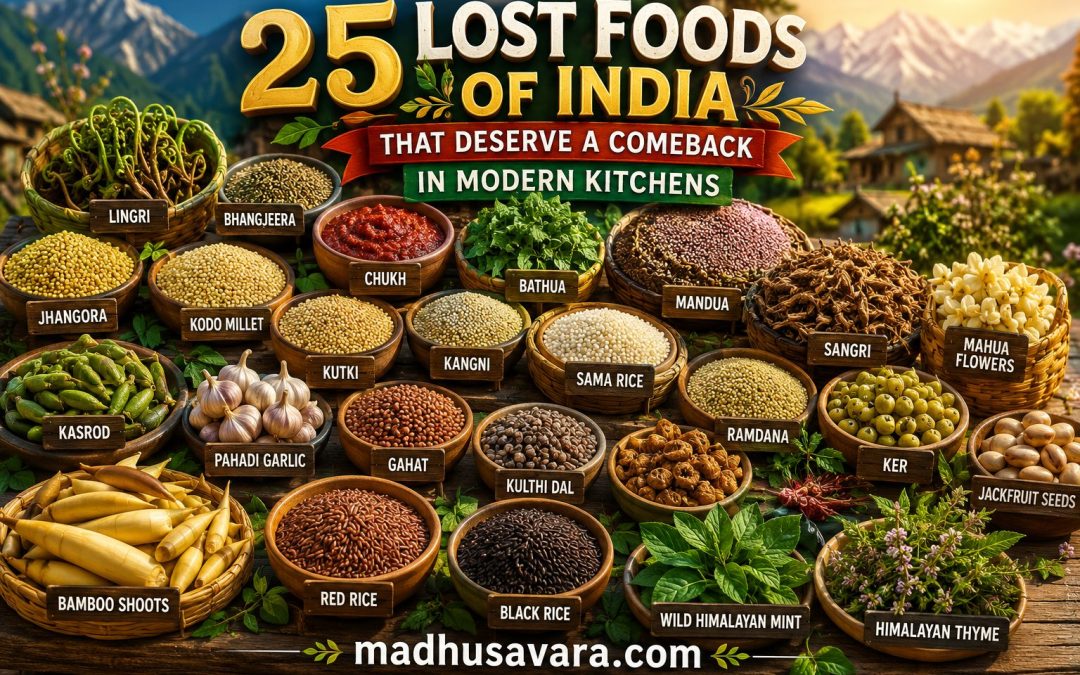
- 25 Lost Foods of India
- Nutritional and Cultural Significance
- Threats to India’s Food Heritage
- How These Foods Can Be Revived
- Future Research on Madhusavara.com
- Frequently Asked Questions
- Conclusion
- Disclaimer
Why India Is Losing Traditional Foods
Several factors have contributed to the decline of the indigenous foods of India.
The Green Revolution transformed food production and improved food security, but it also encouraged the cultivation of a smaller number of high-yield crops. Urbanisation changed eating habits. Processed foods became widely available. Traditional farming knowledge was not always passed to younger generations.
As a result, thousands of local food traditions gradually weakened.
Ironically, many ancient Indian foods now being rediscovered by nutritionists were once considered ordinary village foods.
1. Bhangjeera – The Forgotten Himalayan Seed
Found primarily in the hills of Himachal Pradesh and Uttarakhand, Bhangjeera has been valued for generations for its rich, nutty flavour and remarkable versatility.
Traditionally, villagers roasted the seeds and used them in chutneys, spice blends, and festive dishes. Long before the term “superfood” became fashionable, mountain communities recognised its nutritional importance.
Today, Bhangjeera remains largely unknown outside Himalayan regions despite its immense culinary potential. Its revival could help preserve local farming traditions while introducing modern consumers to an authentic traditional superfood of India.
2. Lingri – The Wild Fern of the Himalayas
Lingri, also known as fiddlehead fern, emerges briefly during the Himalayan spring. For generations, families collected these young fern shoots from forests and transformed them into pickles, stir-fries, and seasonal delicacies.
In many mountain households, the arrival of Lingri marked a change in seasons.
However, urban migration and changing food habits have reduced its popularity. Few ingredients capture the relationship between Himalayan communities and nature as beautifully as Lingri.
Its unique flavour and cultural significance make it one of the most fascinating lost foods of India.
3. Chukh – Himachal’s Traditional Chilli Preserve
Long before commercial sauces occupied supermarket shelves, Himachali households prepared Chukh.
Made from chillies, local spices, and traditional preservation methods, Chukh represented culinary ingenuity born from necessity.
Every family had its own recipe and method of preparation.
Today, Chukh remains known mainly within parts of Himachal Pradesh. Wider awareness could help preserve an important aspect of regional food heritage while supporting local artisans who continue to prepare it using traditional techniques.
4. Bathua – The Winter Green We Forgot
Many Indians remember Bathua from childhood meals prepared by their grandparents.
This leafy winter vegetable once appeared regularly in parathas, saag, raita, and traditional village meals. Rich in flavour and deeply connected to seasonal eating, Bathua represented a time when people consumed what nature provided rather than what markets supplied year-round.
As dietary habits changed, Bathua gradually disappeared from urban kitchens.
Its return could encourage healthier seasonal eating and reconnect families with India’s agricultural traditions.
5. Mandua – The Millet That Sustained Mountains
Known in many regions as finger millet, Mandua sustained generations living in difficult terrains where other crops struggled.
Farmers appreciated its resilience, while households valued its ability to provide nourishment during long winters.
Before polished rice and refined flour became dominant, Mandua was a dietary staple across large parts of the Himalayas.
Today, nutrition experts increasingly recognise the importance of traditional grains. Mandua’s comeback demonstrates how ancient Indian foods can contribute to modern dietary diversity.
6. Jhangora – The Grain of Simplicity
Jhangora, or barnyard millet, was once a common sight in hill agriculture.
Easy to cultivate and remarkably adaptable, it became a foundation of traditional mountain diets. Families prepared porridges, festive dishes, and everyday meals using this humble grain.
The rise of commercial cereals gradually reduced their popularity.
Yet Jhangora remains a shining example of how indigenous foods of India evolved in harmony with local environmental conditions.
7. Kodo Millet – A Survivor Through Centuries
Among India’s oldest cultivated grains, Kodo Millet has survived changing climates, shifting agricultural systems, and evolving food preferences.
Its resilience made it invaluable for communities facing uncertain rainfall and difficult growing conditions.
Despite its historical significance, Kodo Millet disappeared from many mainstream diets during the twentieth century.
Its revival reflects growing recognition that sustainable agriculture may depend upon preserving traditional crops rather than replacing them.
8. Kutki Millet – The Hidden Treasure of Traditional Agriculture
Kutki has long been cultivated by farming communities who understood its value as a reliable and nutritious crop.
Unlike many modern food products promoted through advertising, Kutki earned its reputation through generations of practical experience.
Today, awareness remains limited outside regions where it has traditionally been grown.
As interest in heritage foods of India increases, Kutki deserves renewed attention from farmers, consumers, and researchers alike.
9. Kangni Millet – The Forgotten Golden Grain
Kangni, often known as foxtail millet, was once a familiar crop across many parts of India. Long before polished rice became the dominant staple, families relied upon Kangni to prepare nourishing meals that sustained them through demanding agricultural seasons.
Farmers appreciated its ability to grow with relatively limited resources, while households valued its versatility in traditional cooking. However, changing agricultural priorities gradually pushed Kangni to the margins.
Today, as conversations around sustainable agriculture gain momentum, Kangni stands as an excellent example of how forgotten Indian foods can contribute to both nutritional diversity and environmental resilience.
10. Sama Rice – The Grain of Tradition and Faith
Despite its name, Sama Rice is not actually rice. It is a traditional millet that has played an important role in Indian culinary and religious practices for centuries.
Many families continue to consume Sama during fasting periods, yet its broader culinary potential often remains overlooked. Historically, communities appreciated its adaptability and ability to grow under challenging conditions.
As one of the indigenous foods of India, Sama demonstrates how traditional food systems were designed to meet both nutritional and cultural needs.
Its revival could help modern consumers rediscover the wisdom embedded within India’s food heritage.
11. Ramdana – The Sacred Grain
Known in some regions as amaranth, Ramdana occupies a unique position in Indian food traditions.
The tiny seeds have been cultivated and consumed for generations, particularly in hilly regions where agricultural diversity was essential for survival. Villagers transformed Ramdana into laddoos, porridges, flatbreads, and festive dishes.
Unlike heavily processed modern snacks, Ramdana represented simple nourishment rooted in local agriculture.
Today, this ancient Indian food is slowly returning to public attention, yet it still deserves far greater recognition among consumers seeking traditional superfoods of India.
12. Kasrod – A Seasonal Himalayan Delicacy
Kasrod occupies a special place in the culinary traditions of Himachal Pradesh and neighbouring Himalayan regions.
For many mountain families, the arrival of Kasrod signalled the beginning of a cherished seasonal harvest. The tender shoots were transformed into pickles, stir-fries, and traditional household recipes passed down through generations.
Unlike vegetables available throughout the year, Kasrod taught communities to appreciate seasonal abundance.
As younger generations move away from traditional food practices, awareness of Kasrod continues to decline. Preserving its culinary legacy is an important step towards safeguarding Himalayan food heritage.
13. Pahadi Garlic – The Fragrant Treasure of the Mountains
Mountain communities have long prized Pahadi Garlic for its distinctive aroma and flavour.
Unlike many commercial varieties cultivated for large-scale markets, traditional mountain garlic developed characteristics closely linked to local soil, climate, and farming methods.
For generations, it enhanced everyday meals while occupying a respected place in local traditions.
Today, increased commercialisation has reduced the cultivation of wide regional varieties. Reviving Pahadi Garlic would not only preserve agricultural biodiversity but also celebrate the uniqueness of traditional Indian foods shaped by specific landscapes.
14. Gahat – The Pulse of the Himalayas
Known by different names across northern India, Gahat has nourished mountain communities for centuries.
This hardy pulse thrived in regions where many other crops struggled to survive. Families transformed it into soups, curries, and comforting winter meals that reflected both practicality and culinary creativity.
Despite its long history, Gahat remains relatively unknown beyond its traditional growing areas.
As awareness grows about the importance of diverse food systems, Gahat deserves renewed appreciation as one of the heritage foods of India.
15. Kulthi Dal – The Forgotten Village Staple
Kulthi Dal once formed an essential part of everyday diets across many rural communities.
Affordable, reliable, and deeply connected to local agricultural systems, it represented the practical wisdom of traditional farming households. Meals prepared with Kulthi were often simple, yet they reflected generations of culinary adaptation to local environments.
Unfortunately, changing consumer preferences and the growing popularity of a limited number of commercial pulses reduced their presence in modern kitchens.
Its revival could contribute significantly to preserving the disappearing foods of India.
16. Kachri – Rajasthan’s Desert Gift
Life in the Thar Desert demanded extraordinary ingenuity, and Kachri is a perfect example of that innovation.
This small desert fruit became an important ingredient in traditional Rajasthani cuisine. Generations learned how to utilise local resources efficiently, transforming Kachri into flavourful preparations that complemented other regional foods.
Beyond its culinary value, Kachri symbolises the resilience of communities living in one of India’s most challenging environments.
Its story reminds us that many forgotten foods of India emerged not from abundance but from human creativity and adaptation.
17. Ker – The Berry That Defined Desert Cuisine
Ker has long been associated with the culinary identity of Rajasthan.
Growing naturally in arid landscapes, this remarkable berry became a cornerstone of traditional desert cooking. Families preserved it carefully and incorporated it into dishes that reflected both necessity and cultural pride.
Today, many urban consumers are unfamiliar with Ker despite its historical significance.
Its continued preservation is important not only for culinary diversity but also for understanding how traditional societies adapted to difficult ecological conditions.
Nutritional and Cultural Significance of Lost Foods of India
The importance of lost foods of India extends far beyond taste.
These foods represent centuries of experimentation, adaptation, and local knowledge. Communities selected crops based not only on productivity but also on their ability to withstand droughts, floods, cold climates, poor soils, and unpredictable weather patterns.
Many traditional Indian foods developed as part of highly sustainable agricultural systems. Farmers cultivated diverse crops rather than depending upon a single staple. This diversity improved resilience while reducing environmental risks.
Culturally, these foods remain deeply connected to local festivals, family traditions, folk songs, seasonal celebrations, and regional identities. Their disappearance would mean losing valuable cultural knowledge alongside agricultural diversity.
Biodiversity and Food Heritage
India is recognised as one of the world’s richest centres of biodiversity.
Yet modern agriculture often concentrates on a relatively small number of crops. While this approach can increase production, it may also reduce genetic diversity over time.
The indigenous foods of India described in this article represent living examples of biodiversity in action. Each crop, herb, grain, fruit, or vegetable carries unique genetic traits developed through generations of cultivation and adaptation.
Protecting these foods, therefore, contributes not only to cultural preservation but also to future food security.
Why Food Heritage Matters Today
Many people assume that heritage foods belong only in museums or history books.
The reality is quite different.
Climate change, environmental uncertainty, and growing interest in sustainable agriculture have renewed attention on ancient Indian foods. Researchers, chefs, farmers, and consumers increasingly recognise that traditional food systems may offer valuable lessons for the future.
By reviving forgotten Indian foods, we are not moving backwards. We are preserving knowledge that may prove essential for future generations.
18. Sangri – The Lifeline of the Desert
Among Rajasthan’s most celebrated traditional ingredients, Sangri represents the remarkable relationship between people and their environment.
Harvested from hardy desert trees, Sangri became a valuable source of nourishment in regions where agricultural options were often limited. Families developed unique recipes that transformed this humble ingredient into cherished meals.
Even today, traditional preparations featuring Sangri remain symbols of Rajasthan’s culinary heritage. However, urbanisation and changing food preferences have reduced its presence in everyday diets.
Its preservation is essential for safeguarding one of India’s most distinctive food traditions.
19. Mahua Flowers – Nature’s Gift to Tribal Communities
For centuries, tribal communities across central and eastern India have valued Mahua as both food and culture.
The flowers have traditionally been collected, dried, preserved, and incorporated into various preparations. Entire seasonal activities often revolved around Mahua harvesting.
Beyond its practical uses, Mahua occupies a special place in local folklore, celebrations, and community life.
Despite its significance, many urban Indians know little about this remarkable heritage food of India. Greater awareness could help preserve both cultural traditions and local livelihoods.
20. Jackfruit Seed Preparations – The Forgotten Kitchen Treasure
While jackfruit itself continues to receive attention, its seeds have quietly disappeared from many modern kitchens.
Earlier generations understood the value of utilising every part of available food resources. Jackfruit seeds were boiled, roasted, dried, and incorporated into numerous traditional recipes.
Their use reflected a philosophy of minimal waste and maximum resourcefulness.
The decline of such practices highlights how modern food systems sometimes overlook valuable ingredients that previous generations considered indispensable.
21. Bamboo Shoots – The Flavour of the Northeast
Across several northeastern states, bamboo shoots have long been an integral part of local cuisine.
Communities developed sophisticated methods of preserving, fermenting, and cooking bamboo shoots, creating flavours that remain unique within India’s culinary landscape.
Unfortunately, many regional foods from the Northeast remain underrepresented in mainstream discussions about Indian cuisine.
Recognising the importance of bamboo shoots helps acknowledge the rich diversity that defines India’s food heritage.
22. Traditional Red Rice Varieties – The Grains We Replaced
Before commercial agriculture encouraged uniformity, India cultivated hundreds of rice varieties adapted to local conditions.
Among them were numerous red rice varieties prized for their flavour, resilience, and cultural importance.
These grains formed the foundation of traditional diets in many regions, yet they gradually lost prominence as high-yield commercial varieties became widespread.
Their revival could contribute significantly to preserving agricultural biodiversity while celebrating the richness of traditional Indian foods.
23. Black Rice – The Forgotten Royal Grain
Black Rice possesses a fascinating history that stretches back generations.
Traditionally cultivated in select regions, it remained closely associated with local food traditions and community identity.
Its striking appearance often attracts modern attention, but its true significance lies in the cultural heritage it represents.
As consumers increasingly seek alternatives to heavily processed foods, Black Rice offers an opportunity to reconnect with one of India’s remarkable ancient grains.
24. Wild Himalayan Mint – The Aroma of the Mountains
Few ingredients capture the essence of Himalayan landscapes as vividly as Wild Himalayan Mint.
Growing naturally in mountain environments, this aromatic herb has enhanced traditional recipes for generations. Families used it to flavour chutneys, beverages, seasonal dishes, and household remedies.
Unlike standardised commercial herbs, Wild Himalayan Mint reflects the unique ecological conditions of its native habitat.
Its continued preservation would support both culinary diversity and ecological awareness.
25. Himalayan Thyme – A Fragrant Legacy
Himalayan Thyme remains one of the lesser-known aromatic treasures of the mountains.
For generations, local communities recognised its distinctive fragrance and incorporated it into traditional culinary practices.
Today, it remains largely absent from mainstream food discussions despite its historical significance.
Its revival could help showcase the extraordinary botanical diversity that exists within India’s mountain ecosystems while introducing consumers to a truly unique flavour experience.
The Greatest Threats to India’s Food Heritage
The disappearance of traditional foods rarely occurs because people consciously reject them.
Instead, it results from a combination of factors:
- Urban migration is reducing traditional farming.
- Loss of indigenous seed varieties.
- Commercial agriculture prioritises a limited number of crops.
- Declining transmission of culinary knowledge between generations.
- Expansion of processed foods.
- Changing lifestyles and food preferences.
- Climate-related challenges affecting traditional cultivation.
- Market systems favour uniform products over regional diversity.
If these trends continue unchecked, many heritage foods of India may survive only in historical records.
How Lost Foods of India Can Be Revived
Revival requires collective effort.
Support Traditional Farmers
Consumers can actively seek foods grown by local and traditional farming communities.
Encourage Culinary Documentation
Family recipes should be documented before they disappear.
Promote Food Education
Schools and educational institutions can introduce students to regional food heritage.
Support Local Markets
Traditional ingredients gain visibility when local markets and farmers’ markets are encouraged.
Culinary Tourism
Travellers can explore regional food traditions and support local economies.
Digital Preservation
Food writers, researchers, bloggers, and historians can document the disappearing foods of India for future generations.
Future Research Series on Madhusavara.com
This article serves as an introduction to India’s remarkable food heritage.
Over the coming months, Madhusavara.com will publish comprehensive standalone articles covering each food mentioned in this guide, including:
- Historical background
- Traditional cultivation methods
- Nutritional significance
- Regional variations
- Cultural importance
- Traditional recipes
- Preservation methods
- Modern culinary applications
- Scientific perspectives
- Agricultural relevance
Readers are encouraged to follow this continuing series dedicated to preserving India’s culinary heritage.
Frequently Asked Questions
1. What are the lost foods of India?
Lost foods of India are traditional foods that were once commonly consumed but have become rare in modern diets.
2. Why are forgotten Indian foods important?
They preserve cultural heritage, biodiversity, traditional knowledge, and regional identity.
3. Are ancient Indian foods still available?
Many remain available in rural areas, though they may be difficult to find in urban markets.
4. What caused traditional Indian foods to decline?
Urbanisation, commercial agriculture, processed foods, and changing lifestyles are major factors.
5. Why are millets returning to popularity?
People increasingly recognise their cultural significance and agricultural resilience.
6. What are the indigenous foods of India?
These are foods traditionally cultivated, harvested, or consumed by local communities over generations.
7. Which Himalayan foods are disappearing?
Bhangjeera, Lingri, Kasrod, Wild Himalayan Mint, and Himalayan Thyme are among them.
8. Why is biodiversity important in food systems?
Biodiversity improves resilience, sustainability, and food security.
9. Are heritage foods relevant today?
Yes. Many provide valuable lessons for sustainable agriculture and responsible consumption.
10. How can families preserve traditional food knowledge?
By documenting recipes, sharing culinary traditions, and teaching younger generations.
11. Why should farmers cultivate traditional crops?
Traditional crops often contribute to agricultural diversity and regional identity.
12. Can food tourism help preserve heritage foods?
Yes. Increased interest creates economic incentives for preservation.
13. Will Madhusavara.com publish detailed guides on these foods?
Yes. Every food listed in this article will be covered individually in future publications.
14. Why should younger generations learn about forgotten foods of India?
Understanding food heritage strengthens cultural awareness and appreciation of traditional knowledge.
15. What is the biggest challenge facing India’s food heritage?
The gradual loss of traditional knowledge and the reduced cultivation of indigenous crops.
Call to Action
Have you tasted any of these lost foods of India?
Do you remember recipes, farming practices, family traditions, or local stories connected with these ingredients?
Share your experiences in the comments section and help preserve India’s remarkable culinary heritage. Every memory contributes to documenting traditional Indian foods for future generations.
Follow Madhusavara.com for upcoming detailed guides, traditional recipes, agricultural insights, spice knowledge, and food heritage articles dedicated to preserving the wisdom of Indian kitchens.
Conclusion
India’s culinary heritage extends far beyond popular dishes and widely marketed ingredients. Hidden within villages, mountains, forests, deserts, and farming communities are countless stories of resilience, adaptation, and wisdom.
The lost foods of India discussed in this article represent far more than ingredients. They embody cultural memory, agricultural diversity, environmental adaptation, and generations of accumulated knowledge.
Reviving forgotten Indian foods is not simply an act of preservation. It is an investment in biodiversity, sustainability, nutrition, and cultural continuity.
As modern consumers increasingly seek authenticity and connection, these traditional superfoods of India offer an opportunity to rediscover a richer, more diverse food future.
The journey begins with awareness. The responsibility belongs to all of us.
Disclaimer
This article is intended solely for educational, historical, cultural, informational, and awareness purposes. References to traditional foods, culinary practices, agricultural systems, nutritional value, cultural heritage, and historical uses are based on publicly available information, traditional knowledge, regional practices, and general research sources.
The content should not be interpreted as medical, nutritional, dietary, agricultural, legal, scientific, or professional advice. Individual health conditions, allergies, dietary requirements, and agricultural circumstances vary significantly. Readers should consult qualified healthcare professionals, nutritionists, food scientists, agricultural experts, or other relevant specialists before making decisions based on information contained in this article.
The author and Madhusavara.com make no warranties regarding completeness, suitability, or applicability of the information for specific circumstances. Readers assume full responsibility for any actions taken based on this content.
All efforts have been made to present information respectfully and accurately while recognising that regional traditions, names, recipes, and practices may vary across India. Any omissions are unintentional. The purpose of this article is to encourage awareness, documentation, preservation, and appreciation of India’s rich food heritage.
