
Author’s Note:
For generations, the Himalayas have nurtured a rich tradition of forgotten aromatic herbs of the Himalayas that shaped local cuisines, household practices, and cultural traditions. While researching traditional foods and indigenous ingredients for Madhusavara.com, I repeatedly came across references to valuable Himalayan herbs that once played an important role in mountain life but are now rarely discussed outside their native regions.
What stands out about these traditional Himalayan herbs is not only their aroma and flavour but also the deep cultural and ecological knowledge associated with them. These Himalayan aromatic herbs reflect a close relationship between people and nature, shaped over centuries of lived experience and sustainable practices.
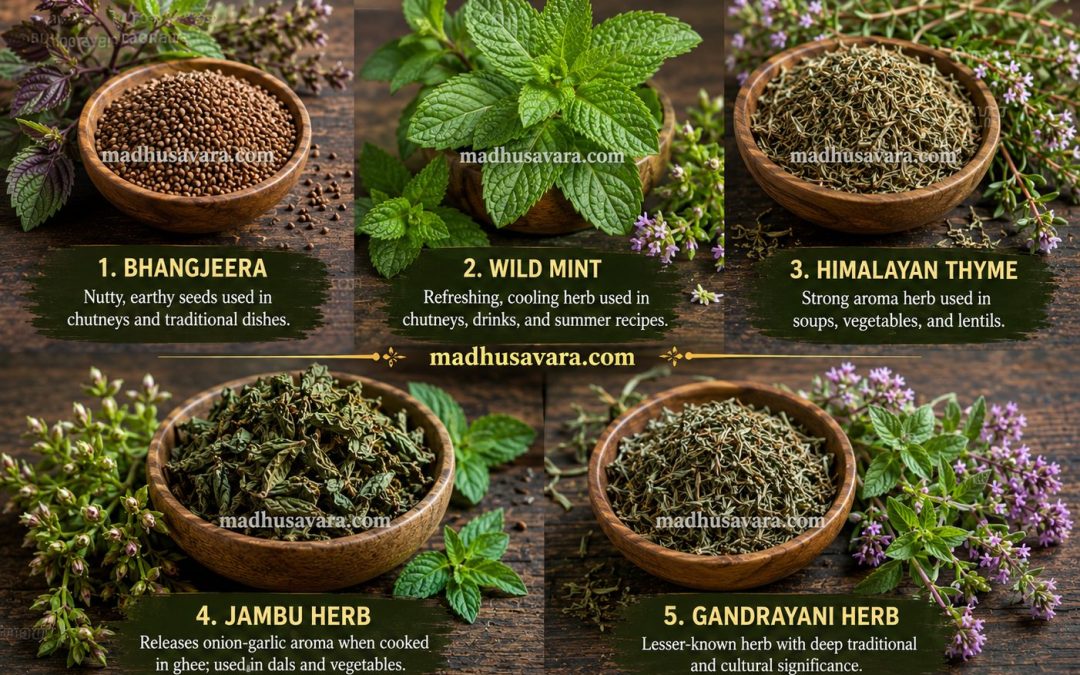
This article introduces five such forgotten aromatic herbs of the Himalayas, including Bhangjeera, Wild Mint, Himalayan Thyme, Jambu herb, and Gandrayani herb. It is an effort to document and preserve Himalayan food heritage for future generations while highlighting the importance of traditional Himalayan herbs in regional culture.
— Madhu Savara
A FRAGRANT JOURNEY THROUGH THE HIMALAYAS
The Himalayas are more than mountains. They are living ecosystems where herbs, forests, and communities have coexisted for centuries.
Before modern spices and packaged seasonings became common, Himalayan households depended entirely on wild and cultivated herbs for flavour, nutrition, and preservation. Every herb had a purpose, and every kitchen carried generations of knowledge.
Today, many of these traditional Himalayan herbs are slowly fading from daily use, though they continue to grow in forests, fields, and mountain slopes.
PREFACE
The Himalayan region is one of the richest biodiversity zones in the world. Among its most valuable natural resources are aromatic herbs that have shaped traditional Himalayan cuisine and food culture.
These herbs are not just ingredients. They are part of Himalayan identity, memory, and survival traditions.
1. BHANGJEERA – THE NUTTY HIMALAYAN HERB
Bhangjeera is one of the most important forgotten aromatic herbs of the Himalayas. It is widely found in Uttarakhand and the nearby Himalayan regions.
The seeds of Bhangjeera are roasted and ground into chutneys that are traditionally served with mandua roti, rice, and lentils. The flavour is nutty, earthy, and deeply aromatic.
For generations, Himalayan households have used Bhangjeera as a staple ingredient in daily meals. It represents both food tradition and cultural identity.
Even today, it remains one of the most valued traditional Himalayan herbs in local kitchens, though it is less known outside the region.
2. WILD MINT – THE REFRESHING MOUNTAIN HERB
Wild Mint grows naturally near streams, moist slopes, and fields across the Himalayas. It is one of the most widely used Himalayan herbs in traditional cooking.
Its fresh aroma makes it ideal for chutneys, herbal drinks, and summer cooling recipes. Wild Mint chutney is a staple in many mountain households.
This herb is an important part of the Himalayan food heritage, especially in seasonal diets where cooling and digestion-supporting foods are preferred.
3. HIMALAYAN THYME – THE HIGH-ALTITUDE AROMA HERB
Himalayan Thyme grows in rocky alpine regions and is known for its strong fragrance and flavour.
It is dried and used in small quantities to enhance soups, vegetables, and lentils. Even a small pinch can transform the taste of a dish.
Traditional Himalayan herbs like thyme were essential for winter cooking when fresh ingredients were unavailable.
Its aroma reflects the wild, untouched essence of Himalayan landscapes.
4. JAMBU HERB – THE SIGNATURE OF HIMALAYAN COOKING
Jambu herb is one of the most iconic Himalayan aromatic herbs used in traditional cooking.
When heated in ghee or oil, it releases a strong onion-garlic aroma. It is commonly used in dals, potatoes, and vegetable dishes.
Jambu plays an important role in preserving Himalayan food traditions, especially in high-altitude regions where dried herbs are essential for year-round cooking.
It remains a defining ingredient of Himalayan cuisine.
5. GANDRAYANI HERB – THE FORGOTTEN BOTANICAL HERITAGE
Gandrayani herb is one of the lesser-known, forgotten aromatic herbs of the Himalayas.
It has been part of traditional Himalayan knowledge systems for generations, though its usage has declined over time.
Elder communities still recall their importance in cultural and household practices.
Gandrayani represents the deep ethnobotanical heritage of the Himalayas and the importance of preserving traditional knowledge.
WHY THESE HIMALAYAN HERBS MATTER
These herbs are not just culinary ingredients. They represent:
- Traditional Himalayan herbs knowledge
- Forgotten Himalayan aromatic herbs
- Himalayan food heritage
- Sustainable mountain lifestyles
- Cultural biodiversity of the Himalayas
They are living reminders of how closely Himalayan communities lived with nature.
FREQUENTLY ASKED QUESTIONS
What are the forgotten aromatic herbs of the Himalayas?
They are traditional Himalayan herbs that were widely used in mountain cuisine and daily life, but are now less commonly known.
Are Himalayan herbs still used today?
Yes, many Himalayan herbs like Wild Mint and Bhangjeera are still used in villages and traditional cooking.
What is the Jambu herb used for?
Jambu herb is used to flavour lentils, vegetables, and traditional Himalayan dishes after being fried in oil or ghee.
Why are Himalayan herbs important?
They preserve Himalayan food heritage, traditional knowledge, and biodiversity.
CTA (CALL TO ACTION)
This article is part of an ongoing journey on Madhusavara.com to document Himalayan food heritage.
Detailed individual articles on each herb:
- Bhangjeera
- Wild Mint
- Himalayan Thyme
- Jambu herb
- Gandrayani herb
will be published soon with in-depth cultural, culinary, and traditional insights.
Stay connected with Madhusavara.com to explore more forgotten aromatic herbs of the Himalayas.
⚠️ DISCLAIMER
This article is intended for educational and informational purposes only.
It is based on traditional knowledge, cultural references, and ethnobotanical understanding of Himalayan herbs.
It does not provide medical, agricultural, or professional advice.
Readers should consult qualified experts before using any herb for health, medicinal, or cultivation purposes.
Madhusavara.com is dedicated to preserving Himalayan food heritage and traditional knowledge for educational awareness only.
