
Author’s Note:
As an agricultural enthusiast with a deep connection to India’s rich farming traditions and the promise of emerging technologies, I have closely studied the evolution of potato cultivation. This blog draws from credible sources, including research by ICAR-CPRI, the International Potato Centre (CIP), and recent scientific advancements to present a realistic, balanced, and evidence-based vision of the future of potato farming. It aims to inform farmers, policymakers, researchers, agronomists, and readers interested in sustainable agriculture.
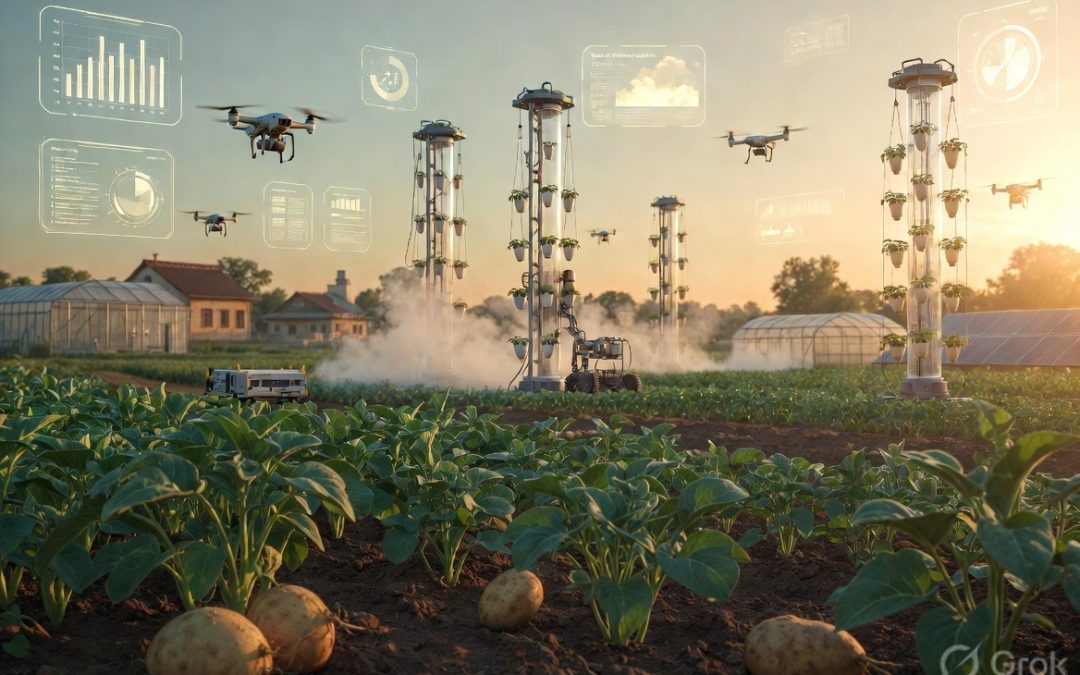
Storytelling: Imagine a potato farmer in Uttar Pradesh in the year 2045. Instead of depending entirely on the whims of the monsoon, he starts his day reviewing data from AI-powered drones flying over his fields of climate-resilient potatoes. In nearby peri-urban facilities, aeroponic vertical systems produce disease-free seeds, while CRISPR-edited varieties thrive under heat stress. What was once a labour-intensive, climate-vulnerable crop has become a highly productive, sustainable enterprise feeding millions. This transformation represents the exciting reality of potato farming 2030 2050.
Table of Contents
- Preface
- About Potato: The Humble Yet Mighty Crop
- Challenges Facing Potato Farming Today
- Technological Innovations Shaping the Future
- Vertical Farming for Potatoes: A Game Changer
- CRISPR Gene Editing: Precision Breeding for Tomorrow
- Climate Change Adaptation and Resilience
- Sustainable Practices in Potato Agriculture
- Role of Policy, Research, and India’s Position
- Economic and Food Security Implications 2030–2050
- FAQs
- Call to Action
- Conclusion
- Disclaimer
Preface: The future of potato farming 2030–2050 will be defined by the convergence of climate challenges, rapid technological progress, and a strong push toward sustainable potato agriculture. With India’s population and food demand growing, potatoes — nutritious, versatile, and high-yielding — will remain central to food security. This comprehensive blog explores how precision potato farming in India, climate-resilient potatoes, vertical farming, CRISPR advances, and supportive policies will reshape the sector.
About Potato: The Humble Yet Mighty Crop Potato (Solanum tuberosum), originating from the Andes mountains, is the world’s fourth most important food crop after rice, wheat, and maize. India is the second-largest producer globally, with annual production around 50-55 million tonnes, primarily in Uttar Pradesh, West Bengal, Bihar, and Gujarat. Rich in carbohydrates, vitamin C, potassium, and dietary fibre, potatoes provide affordable nutrition to millions. Their short growing cycle and adaptability make them ideal for both smallholder farmers and commercial operations. However, traditional potato farming faces increasing pressures from soil degradation, water scarcity, pests, and climate variability, highlighting the need for innovation in the coming decades.
Challenges Facing Potato Farming Today Current potato cultivation struggles with rising temperatures that impair tuber formation, erratic rainfall patterns, late blight disease, increasing labour shortages, and declining soil health. In India, these issues threaten consistent yields and farmer incomes, particularly in major producing regions. Without adaptation, climate change could significantly impact production by 2030, making sustainable potato agriculture and climate-resilient potatoes essential.
Technological Innovations Shaping the Future: Precision potato farming in India will lead the transformation through AI, IoT sensors, drones, and satellite imagery for real-time monitoring of soil moisture, nutrient levels, and pest outbreaks. Variable rate technology will optimise inputs, reducing costs and environmental impact. Robotics and automation will address labour shortages in planting, weeding, and harvesting. Big data analytics and blockchain will improve supply chain traceability and efficiency.
Vertical Farming for Potatoes: A Game Changer. Vertical farming offers a promising complement to traditional methods in the future of potato farming. Aeroponics, where plant roots are suspended in air and nourished by nutrient mist in a controlled environment, is particularly effective for seed potato production. Facilities in Uttar Pradesh (Kushinagar, Hapur) and other states, supported by CPRI and CIP, demonstrate their potential. A single plant can yield 45–50+ minitubers compared to 8–10 in conventional systems, with dramatic improvements in multiplication rates and disease-free quality.
Hydroponics with substrates and simple vertical towers or grow bags suit small-scale and home gardening. Key advantages include up to 95% water savings, year-round production, reduced pesticide use, and higher yields per square metre. Challenges such as high initial costs and energy requirements are expected to ease with technological improvements and renewable energy by 2030–2050. Vertical potato farming will play a vital role in addressing seed quality shortages and supporting urban and peri-urban supply chains.
CRISPR Gene Editing: Precision Breeding for Tomorrow CRISPR technology is revolutionising potato breeding by enabling precise genome edits without leaving foreign DNA, often resulting in transgene-free varieties. In India and globally, researchers are developing climate-resilient potatoes through:
- Enhanced resistance to late blight by editing susceptibility genes (e.g., StDMR6-1), reducing fungicide dependency.
- Improved drought and heat tolerance (e.g., StCBP80 edits in commercial cultivars like Spunta).
- Better processing qualities, such as reduced acrylamide formation and anti-browning traits for longer shelf life.
- Nutritional enhancements, including higher resistant starch and amylose content in varieties like Kufri Chipsona-I via SBE gene edits.
CPRI and collaborators are actively working on these traits. By overcoming the complexities of the potato’s tetraploid genome, CRISPR will deliver superior varieties faster than traditional breeding. Integrated with precision potato farming and vertical systems, gene editing will be central to sustainable potato agriculture in the future of potato farming 2030 2050.
Climate Change Adaptation and Resilience. Adaptation strategies include deploying climate-resilient potatoes, adopting conservation tillage, mulching, sensor-based drip irrigation, and integrated pest management. With proactive measures and technology adoption, models suggest potato production in India can not only be maintained but significantly enhanced despite warming trends.
Sustainable Practices in Potato Agriculture. Future farming will emphasise precision nutrient management, biological controls, crop rotation, agroforestry, renewable energy for storage and processing, and circular economy models that convert potato waste into bioenergy or feed. These practices will lower the environmental footprint while improving soil health and long-term productivity.
Role of Policy, Research, and India’s Position. Institutions like ICAR-CPRI, in partnership with CIP and state governments, are driving innovation. Supportive policies — subsidies for drip irrigation, aeroponic facilities, climate-resilient seeds, and farmer training — will be crucial. India is well-positioned to become a global leader in tropical-adapted, sustainable potato technologies and exports.
Economic and Food Security Implications 2030–2050 The future of potato farming promises higher rural incomes, new technology-driven jobs, expanded processing industries, and stronger nutritional security. Inclusive approaches ensuring smallholders benefit from precision potato farming in India and other advancements will be key to equitable growth.
FAQs
Q1: What is the future of potato farming in India by 2050? A: It will be driven by sustainable potato agriculture, climate-resilient potatoes, precision potato farming, vertical systems, and CRISPR-edited varieties, ensuring higher yields and resilience.
Q2: How suitable is vertical farming for potatoes? A: Highly suitable, especially aeroponics for high-quality seed production, offering major water savings and faster multiplication with growing adoption across India.
Q3: What role does CRISPR play in potato breeding? A: CRISPR enables precise development of disease-resistant, climate-resilient potatoes with improved nutritional and processing qualities, accelerating breeding for the future of potato farming.
Q4: How will climate change affect potato yields? A: Heat and erratic weather may reduce yields, but adaptation through gene editing, precision tools, and vertical farming can mitigate losses effectively.
Q5: How can small farmers prepare for 2030–2050? A: Adopt resilient varieties, simple vertical techniques, drip irrigation, join Farmer Producer Organisations, and seek training from Krishi Vigyan Kendras and extension services.
Call to Action Farmers: Begin integrating precision tools, explore aeroponic pilots, and plant climate-resilient potatoes through government schemes. Policymakers: Increase R&D funding and infrastructure support. Researchers: Continue innovations in CRISPR and vertical systems. Consumers: Support sustainable Indian potato products. Share this knowledge to build a resilient agricultural ecosystem.
Conclusion: The future of potato farming 2030–2050 holds tremendous potential through sustainable potato agriculture, climate-resilient potatoes, precision potato farming in India, vertical farming, and CRISPR advances. By harmonising traditional wisdom with cutting-edge science, India can secure abundant, nutritious potato harvests while safeguarding the environment for future generations.
Strong Disclaimer:r This blog is for informational and educational purposes only, based on research and projections available as of 2026. It does not constitute professional agronomic, financial, or legal advice. Agricultural practices and outcomes depend on local conditions, policies, and many variables. Farmers and readers should consult qualified experts, CPRI, ICAR, state agriculture departments, or FAO for region-specific recommendations. The author and platform assume no liability for any actions taken based on this content. Always verify with primary and latest sources.
