
Author’s Note
The story of Forgotten Foods That Sustained Himalayan Villages is not merely about food. It is a story of survival, wisdom, resilience, and the intimate relationship between people and their environment.
For centuries, Himalayan communities lived in remote valleys where roads were few, markets were distant, and winters could isolate entire villages for months. Long before packaged foods, supermarkets, and modern supply chains, these communities relied upon locally grown grains, wild edible plants, preserved foods, and traditional farming practices to sustain themselves.
Today, many of these remarkable foods are disappearing from fields and kitchens. Yet their nutritional value, environmental sustainability, and cultural significance remain more relevant than ever.
— Madhu Savara
Preface
The Himalayas are often celebrated for their majestic peaks, sacred rivers, and breathtaking landscapes. However, hidden within these mountains lies another extraordinary heritage: a food culture shaped by geography, climate, and necessity.
The people of the Himalayas developed highly specialised agricultural systems adapted to steep slopes, short growing seasons, unpredictable weather, and limited resources. Every grain harvested, every vegetable preserved, and every wild edible gathered played a vital role in sustaining communities through challenging conditions.
The history of Forgotten Foods That Sustained Himalayan Villages reveals how generations survived not through abundance but through knowledge. Their understanding of local crops, seasonal cycles, and food preservation created resilient food systems that modern societies can still learn from today.
Table of Contents
- Introduction
- Origin of Himalayan Food Traditions
- Significance of Forgotten Himalayan Foods
- Why These Foods Matter Today
- The Harsh Realities of Himalayan Village Life
- Ancient Grains That Sustained the Mountains
- Forgotten Pulses and Legumes
- Wild Edible Plants and Forest Foods
- Traditional Food Preservation Techniques
- Effects on Village Life and Community Survival
- Nutritional Significance
- Why These Foods Are Disappearing
- Can Forgotten Foods Make a Comeback?
- Frequently Asked Questions
- Conclusion
- Call to Action
- Disclaimer
Introduction
The phrase Forgotten Foods That Sustained Himalayan Villages refers to traditional crops, grains, legumes, wild plants, and preserved foods that formed the foundation of life in mountain communities for hundreds of years.
Unlike modern diets that often depend on imported ingredients and processed products, traditional Himalayan diets were deeply local. Families consumed foods that could withstand harsh climates, grow in poor soils, and provide reliable nutrition throughout the year.
These foods were not chosen because they were fashionable. They were chosen because they worked.
They fed families through severe winters.
They supported physical labour in difficult terrain.
They helped communities survive droughts, crop failures, and isolation.
Most importantly, they created self-sufficient food systems that endured for generations.
Origin of Himalayan Food Traditions
The origin of Himalayan food traditions can be traced back thousands of years to the earliest agricultural communities that settled along mountain valleys and terraced slopes.
Archaeological evidence and historical records suggest that mountain farmers gradually selected crops capable of surviving:
- High altitudes
- Cold temperatures
- Short growing seasons
- Limited irrigation
- Rocky soils
Over time, communities developed farming systems uniquely adapted to their environment.
These systems included:
- Terrace farming
- Mixed cropping
- Seed preservation
- Community grain storage
- Seasonal food preservation
The result was a remarkable agricultural heritage that balanced productivity with sustainability.
Significance of Forgotten Himalayan Foods
The significance of Forgotten Foods That Sustained Himalayan Villages extends far beyond nutrition.
These foods represent:
Ecological Knowledge
Generations understood how to cultivate crops without damaging fragile mountain ecosystems.
Food Security
Traditional crops often survived conditions that would destroy modern commercial varieties.
Cultural Identity
Many foods became deeply connected to local festivals, rituals, and family traditions.
Community Cooperation
Food production often relied upon collective labour and shared resources.
Sustainable Agriculture
Traditional farming practices maintained soil fertility while preserving biodiversity.
Why These Foods Matter Today
As climate change, biodiversity loss, and food insecurity become global concerns, traditional Himalayan foods offer valuable lessons.
Many forgotten crops are:
- Drought-tolerant
- Nutrient-dense
- Environmentally sustainable
- Adapted to harsh conditions
- Less dependent on chemical inputs
Researchers increasingly recognise that these traditional foods may play an important role in future food security.
The Harsh Realities of Himalayan Village Life
To understand the importance of Forgotten Foods That Sustained Himalayan Villages, one must first understand village life in the mountains.
For much of history, many Himalayan communities experienced:
- Limited transportation
- Severe winters
- Frequent landslides
- Isolation from markets
- Seasonal food shortages
In some regions, heavy snowfall could cut off entire villages for weeks or months.
Families, therefore, depended on food that could be:
- Stored for long periods
- Dried and preserved
- Produced locally
- Shared within the community
The success or failure of harvests often determined a family’s ability to survive the winter.
Food was never taken for granted.
Every grain mattered.
Every harvest mattered.
Every traditional recipe carries generations of survival knowledge.
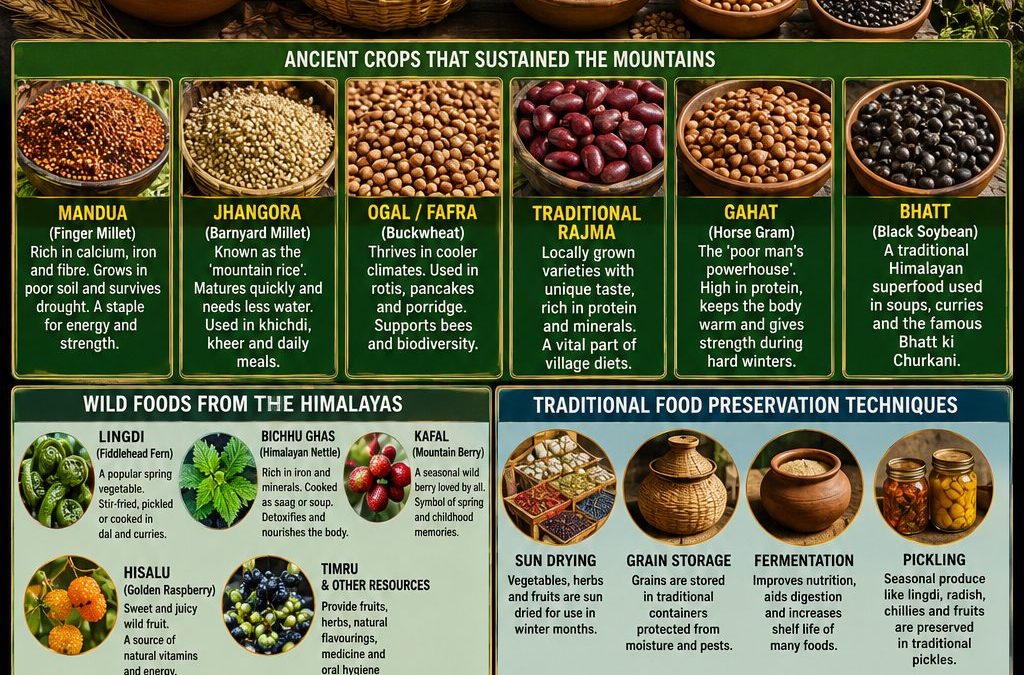
Ancient Crops That Sustained Himalayan Villages
The story of Forgotten Foods That Sustained Himalayan Villages cannot be told without understanding the remarkable crops that formed the backbone of mountain agriculture. These crops were not merely food sources. They were insurance against hunger, climate uncertainty, crop failure, and long winters.
Unlike modern commercial farming, which often depends upon a handful of high-yield varieties, traditional Himalayan agriculture relied upon diversity. Families cultivated multiple crops together so that if one failed, others could survive.
This approach protected communities for generations.
Mandua (Finger Millet): The Grain of Survival
Among the most important foods in the Himalayan region was Mandua, also known as Finger Millet.
In the hill districts of Uttarakhand and parts of Himachal Pradesh, Mandua was often called the grain that never abandoned the farmer.
Why Villagers Relied on Mandua
Mandua could:
- Grow in poor soils
- Tolerate drought conditions
- Survive erratic rainfall
- Thrive on mountain terraces
- Remain edible after long storage
For families living far from markets, these qualities were invaluable.
Traditional Uses
Mandua flour was commonly used to prepare:
- Thick rotis
- Porridge
- Festival dishes
- Winter meals
Many elderly villagers still recall carrying Mandua rotis while working in forests, fields, and high-altitude grazing areas.
Nutritional Importance
Mandua is naturally rich in:
- Calcium
- Dietary fibre
- Iron
- Amino acids
For physically demanding mountain lifestyles, it provided long-lasting energy and nourishment.
Jhangora (Barnyard Millet): The Mountain Rice
Another essential component of the Forgotten Foods That Sustained Himalayan Villages was Jhangora, commonly known as Barnyard Millet.
Before commercial rice became widely available, Jhangora often served as a staple grain in many Himalayan households.
Advantages of Jhangora
Villagers valued Jhangora because:
- It matured quickly
- Required relatively little water
- Adapted well to hilly terrain
- Could be stored for extended periods
Traditional Dishes
Jhangora was transformed into:
- Khichdi
- Sweet puddings
- Festival offerings
- Everyday meals
Even today, Jhangora kheer remains a cherished delicacy in parts of Uttarakhand.
A Crop for Difficult Times
When weather conditions affected other crops, Jhangora frequently ensured that families still had food available.
This reliability made it one of the most trusted crops in mountain agriculture.
Ogal and Fafra (Buckwheat)
Buckwheat occupied a special place in many Himalayan farming systems.
Known locally by various names, including Ogal and Fafra, buckwheat was cultivated in areas where conventional cereals struggled.
Why Buckwheat Was Important
Buckwheat:
- Grew quickly
- Tolerated cooler climates
- Supported pollinators
- Produced nutritious grain
Culinary Uses
Families prepared:
- Rotis
- Pancakes
- Porridges
- Festival foods
The crop also contributed to biodiversity by supporting bees and other beneficial insects.
Traditional Rajma Varieties
Today, most consumers recognise Rajma simply as kidney beans. However, Himalayan villages cultivated numerous local varieties, each adapted to specific valleys, elevations, and climatic conditions.
Characteristics of Traditional Rajma
These beans are often offered:
- Distinct flavour
- Unique colour patterns
- Superior cooking qualities
- Local adaptation
wide traditional varieties required fewer external inputs and performed well under mountain conditions.
Role in Village Diets
Rajma provided:
- Protein
- Minerals
- Dietary fibre
For households with limited access to animal protein, pulses played a vital nutritional role.
Gahat (Horse Gram): The Poor Man’s Powerhouse
Few crops better illustrate the resilience of Himalayan food systems than Gahat, also known as Horse Gram.
Although often overlooked today, Gahat was once a cornerstone of mountain nutrition.
Why Gahat Was Valued
Horse Gram could thrive where many other crops failed.
It tolerated:
- Dry conditions
- Poor soils
- Limited irrigation
Traditional Preparations
Popular dishes included:
- Gahat dal
- Traditional soups
- Winter broths
- Regional chutneys
Health Benefits Recognised by Villagers
Long before scientific studies examined its properties, villagers believed Gahat helped maintain strength during cold weather and physically demanding work.
Bhatt (Black Soybean)
Bhatt remains one of the most distinctive foods associated with Himalayan culinary traditions.
This small black soybean has nourished generations of mountain families.
Culinary Significance
Bhatt was commonly used in:
- Bhatt ki Churkani
- Soups
- Curries
- Winter meals
Nutritional Contribution
Bhatt provided:
- Plant protein
- Healthy fats
- Essential minerals
Its ability to store well also made it valuable during periods of isolation.
The Wisdom Behind Mixed Cropping
One of the most remarkable aspects of traditional Himalayan farming was the practice of mixed cropping.
Rather than planting a single crop across large areas, farmers often cultivated:
- Millets
- Pulses
- Oilseeds
- Vegetables
on the same terraces.
This system offered several advantages:
- Reduced risk of crop failure
- Improved soil fertility
- Better pest management
- Greater dietary diversity
The result was a resilient agricultural system capable of sustaining communities through difficult seasons.
How These Crops Shaped Village Life
The influence of these traditional foods extended far beyond the dinner table.
Agricultural calendars determined:
- Work schedules
- Community gatherings
- Religious festivals
- Marriage seasons
- Livestock management
Children learned farming skills from parents and grandparents.
Women played a central role in:
- Seed preservation
- Food storage
- Crop selection
- Household nutrition
The knowledge surrounding these crops was passed orally from generation to generation.
For many villages, food heritage and cultural identity became inseparable.
Food as Security, Not Commodity
Perhaps the most important lesson from the Forgotten Foods That Sustained Himalayan Villages is that food was viewed primarily as security rather than a commodity.
Families measured wealth not only in money but also in:
- Stored grain
- Preserved vegetables
- Seed stocks
- Livestock
- Community relationships
These resources provided stability during uncertain times and enabled villages to survive in some of the most challenging environments on Earth.
Wild Foods That Filled Himalayan Kitchens
The story of Forgotten Foods That Sustained Himalayan Villages extends far beyond cultivated crops. The forests, grasslands, riversides, and mountain slopes surrounding villages functioned as natural food stores.
Generations of villagers possessed remarkable knowledge about edible plants, seasonal fruits, medicinal herbs, and forest produce. This knowledge often determined whether a family could thrive during difficult times.
Lingdi (Fiddlehead Fern)
Lingdi is one of the most cherished wild vegetables of the Himalayas.
Harvested during spring, the young curled shoots of the fern were collected from forests and mountain slopes.
Traditional Uses
Villagers commonly:
- Stir-fried Lingdi with spices
- Preserved it through pickling
- Dried it for later use
Importance
Lingdi provided valuable nutrition during periods when fresh, cultivated vegetables were scarce.
Bichhu Ghas (Himalayan Nettle)
To outsiders, nettles appear undesirable because of their stinging leaves.
However, Himalayan communities transformed this wild plant into a highly nutritious food source.
Traditional Preparations
Bichhu Ghas was prepared as:
- Soups
- Saag
- Winter broths
Nutritional Benefits
The plant contains:
- Iron
- Calcium
- Potassium
- Vitamins
For many families, nettle soup provided important nourishment during harsh winters.
Kafal: The Beloved Mountain Berry
Few Himalayan fruits evoke as much nostalgia as Kafal.
Growing naturally in mid-altitude forests, these small red berries are eagerly awaited every year.
Cultural Importance
Children often spent hours collecting Kafal during the fruiting season.
The arrival of Kafal signalled:
- Spring’s arrival
- Forest abundance
- Community gathering
Even today, songs and folk traditions celebrate this cherished fruit.
Hisalu (Golden Himalayan Raspberry)
Hisalu is another treasured wild fruit found in many Himalayan regions.
Its sweet flavour made it a favourite among children and shepherds.
These berries offered:
- Natural sugars
- Vitamins
- Antioxidants
Long before packaged snacks became common, fruits like Hisalu provided healthy nourishment during long days outdoors.
Timru and Other Wild Resources
Various shrubs and trees supplied:
- Edible fruits
- Traditional medicines
- Natural flavourings
- Oral hygiene materials
Such resources reduced dependence on external markets and strengthened village self-reliance.
Traditional Food Preservation Techniques
One of the most fascinating aspects of Forgotten Foods That Sustained Himalayan Villages was the sophisticated system of food preservation developed over centuries.
In remote mountain settlements, preserving food was not optional—it was essential for survival.
Sun Drying
The most common preservation method involved drying foods under the mountain sun.
Families preserved:
- Pumpkin
- Bottle gourd
- Radish
- Fenugreek leaves
- Chillies
Dried vegetables provided nutrition during the winter months when fresh produce was unavailable.
Grain Storage
Traditional homes often contained specially designed grain storage areas.
These protected harvests from:
- Moisture
- Rodents
- Insects
Careful grain management often determined whether a household would have sufficient food until the next harvest.
Fermentation
Many Himalayan communities used fermentation to extend shelf life and improve nutrition.
Fermented foods offered:
- Better digestibility
- Enhanced flavour
- Improved preservation
These traditional techniques are increasingly appreciated by modern nutrition experts.
Pickling
Pickles served as an important means of preserving seasonal produce.
Families prepared pickles from:
- Lingdi
- Radish
- Turnip
- Chillies
- Local fruits
These preserved foods added flavour and variety during long winters.
Effects on Villagers’ Lives
The impact of Forgotten Foods That Sustained Himalayan Villages extended far beyond nutrition.
These foods shaped nearly every aspect of village life.
Survival During Harsh Winters
Heavy snowfall often isolates villages for weeks or even months.
Stored grains, pulses, dried vegetables, and preserved foods ensured survival during these periods.
Reduced Dependence on Markets
Because communities produced much of their own food, they remained less vulnerable to external disruptions.
Strong Community Bonds
Agriculture often involved collective effort.
Villagers worked together during:
- Sowing
- Harvesting
- Grain processing
- Food preservation
This cooperation strengthened social relationships.
Women’s Central Role
Women were the guardians of traditional food knowledge.
They managed:
- Seed preservation
- Food storage
- Household nutrition
- Traditional recipes
Without their knowledge, much of this food heritage would not have survived.
Better Dietary Diversity
Traditional diets included:
- Grains
- Pulses
- Wild foods
- Seasonal vegetables
- Forest fruits
This diversity often provided balanced nutrition despite limited resources.
Why These Traditional Foods Are Disappearing
Despite their remarkable value, many traditional Himalayan foods are gradually disappearing.
Changing Aspirations
Younger generations increasingly favour commercially marketed foods.
Market-Oriented Agriculture
Farmers often shift towards crops that generate higher immediate income.
Migration
Many young villagers move to towns and cities for education and employment.
Loss of Traditional Knowledge
As older generations pass away, valuable agricultural and culinary knowledge is often lost.
Changing Food Habits
Processed foods have replaced many traditional dishes.
Can Forgotten Foods Make a Comeback?
The answer is increasingly yes.
Researchers, nutritionists, chefs, and sustainable agriculture advocates are showing renewed interest in traditional Himalayan foods.
These foods offer solutions to modern challenges such as:
- Climate change
- Food insecurity
- Nutritional deficiencies
- Biodiversity loss
Many forgotten crops are now being recognised as climate-resilient foods capable of supporting sustainable agriculture.
Frequently Asked Questions
What are the forgotten foods that sustained the Himalayan Villages?
These are traditional grains, pulses, wild plants, fruits, and preserved foods that supported Himalayan communities for generations.
Why were millets important in Himalayan villages?
Millets could grow in difficult conditions, required fewer inputs, and provided dependable nutrition.
What is Mandua?
Mandua, or Finger Millet, is a traditional Himalayan grain valued for its nutritional richness and resilience.
What is Jhangora?
Jhangora is Barnyard Millet, traditionally used as a staple food in many Himalayan regions.
Why was food preservation important?
Preservation ensured food availability during long winters and periods of isolation.
What role did women play in preserving food traditions?
Women safeguarded seeds, recipes, preservation methods, and household nutrition.
Are these foods healthier than many modern processed foods?
Many traditional Himalayan foods are rich in fibre, minerals, and plant-based nutrients while being minimally processed.
Can these foods help address climate change?
Many traditional crops demonstrate remarkable resilience to drought, poor soils, and changing climatic conditions.
Are these foods still consumed today?
Yes, although their consumption has declined in many areas. Interest in them is now increasing.
Why should we preserve Himalayan food heritage?
Preserving traditional food systems protects biodiversity, cultural heritage, agricultural knowledge, and nutritional diversity.
Call to Action
Have you encountered any of these Forgotten Foods That Sustained Himalayan Villages in your travels, family traditions, or ancestral recipes?
Share your memories, experiences, and local food stories in the comments section below.
If you enjoyed this article, please share it with friends, researchers, food enthusiasts, and anyone interested in preserving India’s rich culinary heritage.
Together, we can help ensure that these remarkable traditions are not forgotten.
Conclusion
The story of Forgotten Foods That Sustained Himalayan Villages is ultimately a story of resilience.
Faced with isolation, harsh climates, rugged landscapes, and limited resources, Himalayan communities developed sophisticated food systems that sustained life for generations.
Through traditional grains such as Mandua and Jhangora, nutrient-rich pulses like Gahat and Bhatt, wild foods gathered from forests, and ingenious preservation techniques, villagers created food security long before modern supply chains existed.
Today, as the world confronts challenges related to sustainability, climate change, and nutrition, these forgotten foods offer valuable lessons. They remind us that true resilience often lies not in technological complexity but in local knowledge, biodiversity, and a deep understanding of nature.
Preserving these traditions is not merely about honouring the past. It is about securing wisdom for the future.
Strong Disclaimer
This article is intended for educational, cultural, and informational purposes only. Historical practices, traditional food uses, nutritional information, and local customs may vary across different Himalayan regions, communities, and time periods. Readers should not interpret this content as medical, nutritional, agricultural, or professional advice. Always consult qualified experts before making dietary, health, farming, or foraging decisions. Wild plants should never be consumed unless they have been accurately identified by knowledgeable professionals, as some species may be harmful or toxic. While every effort has been made to present accurate information, local traditions and historical records may differ across regions of the Himalayas.
