
Introduction
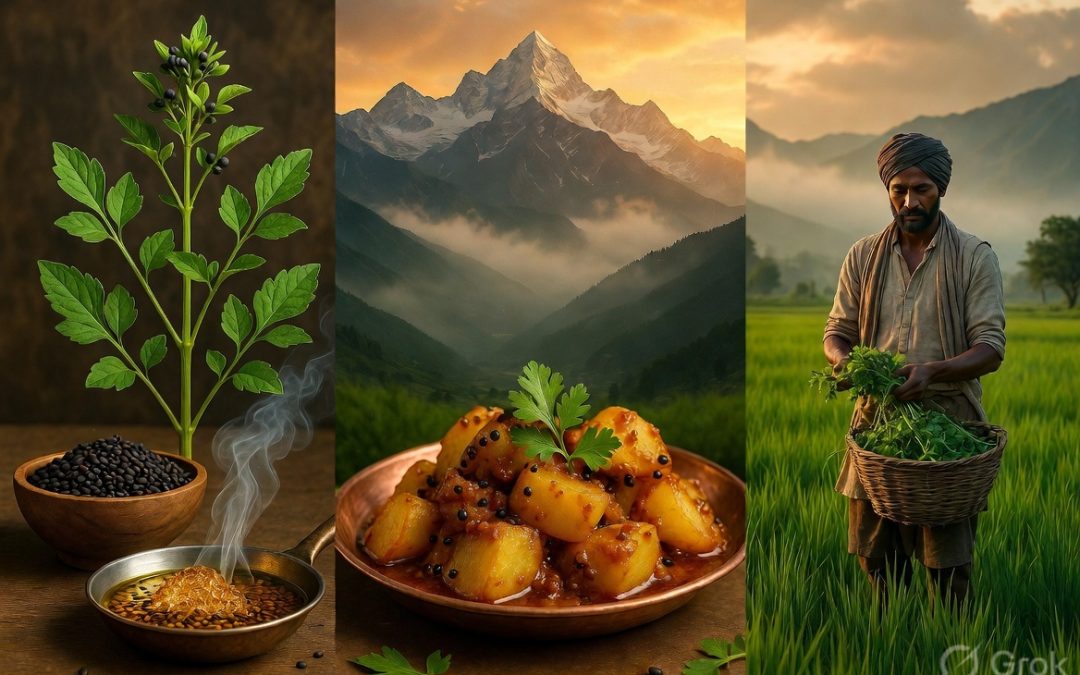
High in the serene hills of Uttarakhand, where the air carries the scent of pine and wild herbs, a humble seed has quietly ruled kitchens for generations. Villagers would heat mustard oil, and the moment Jakhya seeds hit the pan — crackle, pop, sizzle — an earthy, nutty aroma would fill the home, announcing that something delicious was being prepared.
What looks like ordinary tiny dark seeds is actually one of the most distinctive spices of the Himalayas — Jakhya, the wild mustard that transforms simple dal, aloo, and sabzi into authentic Pahadi flavours. Long overlooked by mainstream cuisine, this tiny powerhouse is now gaining recognition as a forgotten Himalayan super spice.
Table of Contents
- Preface
- Significance, Importance and Origin
- About Jakhya
- Where It Grows & Cultivation Story
- Commercial Cultivation & Benefits to Rural Farmers
- Nutritional Profile
- Phytochemical Composition
- Kitchen & Traditional Uses
- Detailed Recipe
- Health Benefits (Traditional + Modern Insights)
- Economic & Rural Livelihood Potential
- Storage, Marketing Scope & Challenges
- Frequently Asked Questions (FAQs)
- Conclusion
Preface
Continuing our series on forgotten Himalayan superfoods after Himalayan Nettle, we present a comprehensive profile of Jakhya (Cleome viscosa). This article is meticulously researched for accuracy and depth, suitable for food enthusiasts, researchers, chefs, and sustainable agriculture practitioners.
Significance, Importance and Origin
Jakhya holds immense cultural and culinary significance in Garhwali and Kumaoni cuisine. It is revered for imparting a unique nutty, pungent flavour and delightful crunch that defines authentic Himalayan tempering. Its importance extends beyond the kitchen to supporting rural livelihoods and preserving biodiversity.
Origin: Cleome viscosa, also known as Asian spiderflower or wild mustard, is native to tropical and subtropical regions of Asia and Africa. In India, it has been traditionally used for centuries in the Himalayan foothills, particularly in Uttarakhand.
About Jakhya
Jakhya, scientifically known as Cleome viscosa L., belongs to the Cleomaceae family. The small, dark brown to black seeds are harvested from an annual herbaceous plant. When heated in oil, they produce a characteristic crackling sound and release a distinctive earthy-pungent aroma, making them a signature tempering spice in Uttarakhand households.
Where It Grows & Cultivation Story
Jakhya thrives in the Himalayan foothills, Terai regions of Uttarakhand, and similar agro-climatic zones. It is a hardy, drought-tolerant annual that grows well in poor soils, wastelands, and forest margins with minimal inputs.
While largely wild-harvested or grown as a companion crop, organized cultivation is increasing through community initiatives. Its low-maintenance nature makes it ideal for sustainable and organic farming systems.
Commercial Cultivation & Benefits to Rural Farmers
Commercial cultivation of Jakhya (Cleome viscosa) is not only possible but highly promising. Studies have shown that when grown as a pure crop (pure stand), it can yield up to 600 kg of seeds per hectare, which is approximately three times higher than when grown as a mixed crop. The plant is well-suited for rainfed conditions, requires very low irrigation and chemical inputs, and performs excellently on marginal and degraded lands.
Key Agronomic Advantages:
- Short duration crop (90–120 days)
- Drought and heat tolerant
- Minimal pest attacks due to its natural sticky nature and chemical constituents
- Can be integrated into existing cropping systems or grown on fallow land
Benefits to Rural Farmers:
- High Income Potential: As a low-input, high-value spice, it offers better returns compared to traditional subsistence crops.
- Risk Mitigation: Its resilience to adverse weather makes it a reliable supplementary income source for small and marginal farmers.
- Women Empowerment: Seed collection, cleaning, and value addition (sorting, packaging, powder making) can be managed by women self-help groups (SHGs).
- Sustainability: Promotes soil conservation on marginal lands and reduces dependency on expensive external inputs.
- Market Linkage: Growing demand for authentic Himalayan and organic spices creates opportunities for direct marketing, farmer producer organizations (FPOs), and export.
Community-led initiatives in Uttarakhand are already promoting Jakhya as a viable cash crop, helping farmers diversify income while preserving traditional knowledge.
Nutritional Profile
Jakhya seeds are a good source of protein, dietary fibre, healthy fats, and essential minerals including iron, calcium, magnesium, and selenium.
Phytochemical Composition
Cleome viscosa is rich in diverse bioactive phytochemicals, including coumarino-lignans (Cleomiscosin A, B, C, D), flavonoids (quercetin, kaempferol), glucosinolates, phenolic compounds, terpenoids, and essential fatty acids. These compounds contribute to its strong antioxidant, anti-inflammatory, and antimicrobial properties.
Kitchen & Traditional Uses
In Himalayan kitchens, Jakhya is primarily used as a tadka (tempering) spice for vegetables, dals, potatoes, rice, and pickles.
Detailed Recipe: Jakhya Aloo (Traditional Uttarakhand Potato Stir-Fry)
Ingredients (Serves 4):
- 500g baby potatoes (boiled and crushed)
- 1.5 tbsp Jakhya seeds
- 2–3 tbsp mustard oil
- ½ tsp asafoetida (hing)
- 2–3 dry red chillies
- 4–5 garlic cloves, chopped
- ½ tsp turmeric powder
- Salt to taste
- Fresh coriander for garnish
- Lemon juice (optional)
Method:
- Heat mustard oil until smoking point. Reduce heat, add Jakhya seeds and allow them to crackle.
- Add hing, dry red chillies, and garlic. Sauté until aromatic.
- Add turmeric and crushed potatoes. Mix well.
- Cook on medium heat for 8–10 minutes until crispy.
- Season with salt, garnish with coriander and lemon juice.
- Serve hot with mandua roti or dal-rice.
Health Benefits (Traditional Knowledge + Modern Insights)
Traditional Knowledge: Used in Uttarakhand folk medicine for digestion, inflammation, respiratory issues, and as a general tonic.
Modern Insights: Scientific studies highlight its antioxidant, anti-inflammatory, antimicrobial, and potential hepatoprotective properties.
Economic & Rural Livelihood Potential
Jakhya presents strong opportunities for rural entrepreneurship in Uttarakhand. Women’s self-help groups can benefit from processing and marketing organic Jakhya seeds, powders, and value-added spice blends. Commercial cultivation further amplifies these opportunities.
Storage, Marketing Scope & Challenges
Storage: Keep in airtight containers in a cool, dry place for 12–18 months.
Marketing Scope: Growing demand for authentic regional and organic spices offers excellent domestic and export potential.
Challenges: Overharvesting of wild populations and climate variability.
Conservation Tips: Promote cultivated varieties and regulated sustainable harvesting.
Frequently Asked Questions (FAQs)
Q1: What makes Jakhya different from regular mustard seeds? A: Jakhya has a distinct earthy-nutty flavour, stronger crackling, and unique phytochemical profile compared to cultivated mustard.
Q2: Is Jakhya safe for regular culinary use? A: Yes, in moderate amounts as a spice. Consult a healthcare professional for therapeutic use.
Q3: Can Jakhya be cultivated at home or commercially? A: Yes. It is hardy and highly suitable for both home gardens and commercial farming on marginal lands.
Conclusion
Jakhya (Cleome viscosa) exemplifies how small, forgotten Himalayan ingredients carry immense culinary, nutritional, and economic value. As interest in regional superfoods grows, this wild spice is poised to reclaim its rightful place in Indian kitchens and beyond.
Call to Action: Have you ever used Jakhya in your cooking? Share your favourite recipe or experience in the comments. Try the authentic Jakhya Aloo recipe this week and tag us with #Jakhya. Support local Himalayan farmers by sourcing authentic Jakhya seeds. Share this article to help preserve and promote forgotten Himalayan spices.
Madhu Savara Exploring Himalayan Treasures | madhusavara.com
Disclaimer
The information provided in this article is for educational and informational purposes only, based on traditional knowledge and available scientific literature. It does not constitute medical, nutritional, or agricultural advice. Neither the author nor madhusavara.com assumes any responsibility or liability for any errors, omissions, or damages arising from the use of this information. Always consult a qualified healthcare professional before using Jakhya or any wild spice for medicinal purposes. Proper identification and sourcing are essential. The author and madhusavara.com shall not be held liable for any direct, indirect, incidental, consequential, or punitive damages resulting from the use or reliance on the content of this blog.
