
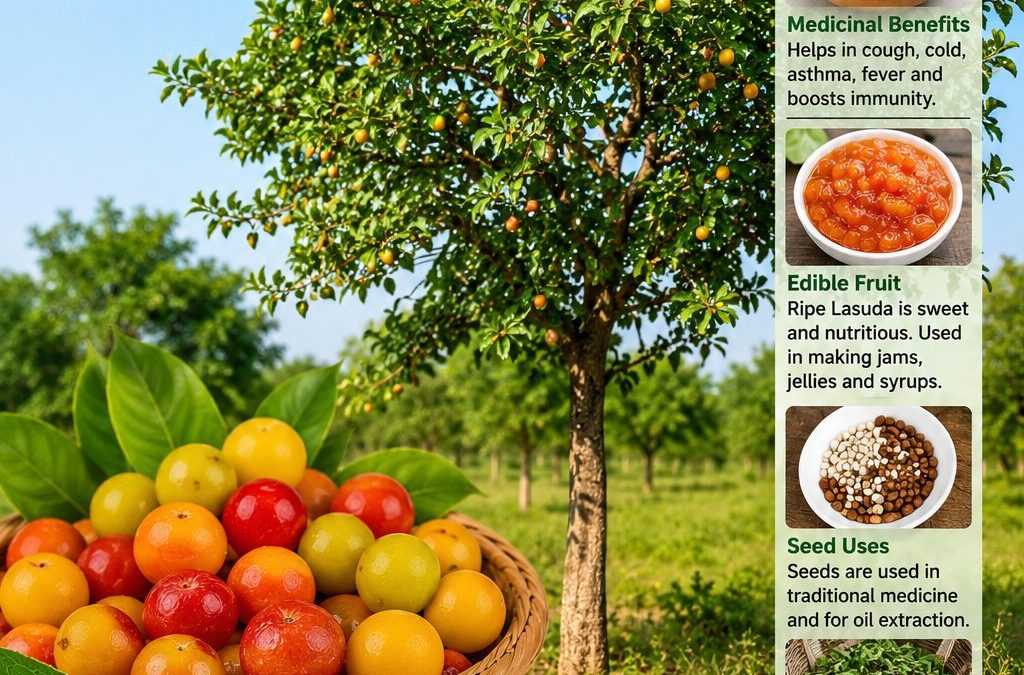
Why Lasura Deserves Our Attention Today
In the bustling villages of rural India, where the scorching summer sun beats down on dry fields, an unassuming tree has quietly stood for generations. Its branches droop with clusters of yellowish-green fruits that turn delightfully sticky and sweet when ripe. This is Lasura, also called Lasoda, Indian cherry, or Shleshmataka in Sanskrit — a true forgotten superfruit of our motherland.
I am writing this detailed guide because Lasura (Cordia dichotoma) holds immense untapped potential in today’s challenging times. With climate change bringing hotter days, erratic rains, and the need for resilient crops, this hardy tree offers a sustainable solution for farmers across India. It is nutrient-rich, medicinally valuable in Ayurveda, and its unique mucilage opens doors to modern industrial applications. Whether you are a farmer looking for low-input income, a student of horticulture, an Ayurveda enthusiast, or a health-conscious family, Lasura can be a game-changer. This article brings together scientific facts, practical cultivation tips, and real-world uses to help revive this gem of Indian biodiversity.
Table of Contents
- Preface
- Origin and Distribution of Lasura
- Botanical Classification and Significance
- About Lasura (Cordia dichotoma)
- Nutritional Profile of Lasura Fruit
- Cultivation Guide for Lasura in India
- Traditional and Modern Uses
- Industrial Applications of Lasura Mucilage
- Economic Importance and Market Potential
- Research-Backed Health Benefits
- FAQs
- Conclusion
- Disclaimer
Preface
Picture a hardy deciduous tree standing resilient amid scorching heat, poor soils, and erratic rainfall — its branches heavy with yellowish-green fruits that turn into sticky-sweet delights. This is Lasura (Cordia dichotoma), also revered as Indian cherry, Lasoda, Bhokar, Gonda, or Shleshmataka in Sanskrit — India’s truly forgotten superfruit. Once a cherished part of rural diets, pickles, and Ayurvedic formulations, it now holds immense promise for climate-resilient agriculture, nutrition security, and sustainable livelihoods.
This publication-quality, research-backed guide compiles verified data from peer-reviewed studies, agroforestry databases, and traditional Indian knowledge systems. It is designed for farmers, agriculture students, horticulture researchers, food enthusiasts, Ayurvedic practitioners, gardeners, and health-conscious readers.
Origin and Distribution
Cordia dichotoma is native to the Indomalayan realm. In India, it is widely distributed across tropical and subtropical regions — from sub-Himalayan tracts up to 1,500 m elevation, dry deciduous forests of Rajasthan, moist deciduous forests of the Western Ghats, and tidal forests. It also occurs in China, Southeast Asia, Australia, and the Pacific. In India, trees often grow singly in moist, shady ravines and valleys rather than in dense stands.
Botanical Classification and Significance
Scientific Classification:
- Kingdom: Plantae
- Division: Magnoliophyta
- Class: Dicotyledons
- Order: Lamiales
- Family: Boraginaceae (sometimes classified under Cordiaceae)
- Genus: Cordia
- Species: Cordia dichotoma G. Forst.
Its primary significance lies in exceptional adaptability to high temperatures (up to 49°C), drought, salinity, and poor soils, making it a prime candidate for climate-resilient farming, agroforestry, biodiversity conservation, and soil stabilisation.
Discover the Power of Lasura – From ancient Ayurvedic medicine to modern value-added products.
About Lasura (Cordia dichotoma)
Cordia dichotoma is a small to moderate-sized deciduous tree, 5–25 m tall, with a short bole, spreading crown, and greyish-brown bark. Leaves are broad, ovate (5–15 cm long), rough on both surfaces. Flowers are small, fragrant, white to pale pink, borne in cymes. Fruits are globose to ovoid drupes (1–2.5 cm diameter), yellowish-green when unripe, turning pinkish-orange to blackish when ripe, containing sweet, mucilaginous pulp and 1–3 seeds. The mucilage, a polysaccharide-rich hydrocolloid, is a defining feature with significant industrial value.
Nutritional Profile of Lasura Fruit
Lasura fruit is nutritionally rich:
- Proximate Composition (per 100g pulp, approximate): High carbohydrates (70–88%), dietary fibre & mucilage (polysaccharides), moderate protein.
- Seed Kernel: ~31% protein, ~46% fatty oil
- Minerals: Calcium (30–55 mg), Phosphorus (275 mg), Iron (6 mg), Potassium, Magnesium, Zinc, Chromium (supports blood sugar regulation).
- Vitamins & Phytochemicals: Vitamin C, flavonoids (quercetin, rutin, kaempferol), phenolics, terpenes, sterols (β-sitosterol), coumarins, saponins.
- Anti-nutritional Factors: Phytic acid (~355 mg), oxalic acid (~250 mg), phytate phosphorus (~100 mg).
- Leaves serve as excellent fodder with 12–15% crude protein.
Cultivation Guide for Lasura in India
Lasura is a low-maintenance, fast-growing tree ideal for marginal lands and agroforestry systems. It is highly adaptable but performs best under specific conditions.
Key Cultivation Parameters:
| Parameter | Details | Optimal Conditions / Notes |
|---|---|---|
| Climate | Tropical & Subtropical | Temp: 10–49°C; Rainfall: 250–3000 mm |
| Soil Type | Deep, moist, sandy loam preferred | Tolerates poor, sandy, saline, and various soils |
| Soil pH Requirements | 6.0–8.0+ | Optimal: 6.0–6.5; Tolerates very alkaline soils |
| Altitude | Up to 1,500 m | Best in plains and lower hills |
| Propagation | Seeds (primary), Cuttings, Budding | Soak seeds 24 hrs; germination 3–6 weeks |
| Planting Season | Monsoon (June–July) | Protect young plants from frost & browsing |
| Spacing | 6–8 m × 6–8 m (orchard); closer for boundaries | 100–150 trees/ha |
| Growth Rate | Fast-growing | 4 m height in 4 years on good sites |
| Irrigation | Minimal once established | Supplemental in dry spells |
| Fertilizer | Low requirement | Organic manure recommended |
| Harvest Time | June–August (North India); before May (South) | Immature for pickles; ripe for fresh use |
| Yield (Mature Tree) | 20–50+ kg fruit/tree/year | Varies with variety & management |
| Varieties | Maru Samridhi, Karan Lasora, Thar Bold | Improved high-yielding selections |
Management Practices: Prune for shape and airflow. Coppices and pollards well. Generally hardy with low pest incidence; occasional galls or fungal issues are managed by cultural practices. Excellent for boundary planting, windbreaks, and mixed farming systems. Sensitive to frost in early stages.
Traditional and Modern Uses
Traditional (Ayurveda, Unani, Siddha): Demulcent, expectorant, laxative, anti-inflammatory. Used for cough, colds, respiratory issues, ulcers, digestive disorders, fever, skin ailments, and Pitta pacification. Leaves and bark for wound healing and as diuretics.
Modern Culinary: Unripe fruits for popular pickles; ripe fruits eaten fresh or in chutneys. Leaves as high-protein fodder; wood for implements and fuel.
Industrial Applications of Lasura Mucilage
The mucilage from Cordia dichotoma fruits is a polysaccharide-rich (primarily arabinoglucan) hydrocolloid with excellent gelling, thickening, emulsifying, and film-forming properties. Recent research highlights its potential as a sustainable, biodegradable alternative to synthetic additives.
Key Industrial Applications:
- Pharmaceuticals: Acts as a tablet binder, disintegrant, emulsifier, suspending agent, and matrix former for sustained-release drug delivery systems. It has been successfully used in oral thin films and matrix tablets (e.g., for glimepiride). Its pH compatibility and physicochemical stability make it an effective natural excipient.
- Food Industry: Functions as a thickener and stabiliser in sauces, soups, dairy products (e.g., yoghurt for improved viscosity and stability), beverages, and bakery items to enhance texture and extend shelf life. It serves as a partial palm oil substitute in chocolates and can form edible, biodegradable films for food packaging that protect against moisture and oxygen. It is also explored for probiotic encapsulation.
- Other Emerging Uses: Green extraction yields nanomucilage for advanced applications. It shows promise for bioactive packaging films (e.g., when combined with flaxseed oil to extend bread shelf life) and as a natural polymer in cosmetics and nutraceuticals.
Its biodegradability, low cost, and renewable nature position Lasura mucilage as an eco-friendly hydrocolloid for multiple industries.
Economic Importance and Market Potential
Mature Lasura trees yield 20–50 kg of fruit annually with minimal inputs, generating income through fresh sales, pickles, value-added products, and mucilage extraction. It supports rural economies in arid/semi-arid regions and has growing demand in nutraceuticals, natural gums, superfruit markets, and industrial biopolymers. Improved varieties enhance commercial viability.
Research-Backed Health Benefits
Scientific studies validate:
- Strong antioxidant and anti-inflammatory activity due to flavonoids and phenolics.
- Hypoglycemic effects (beneficial chromium content).
- Hepatoprotective, anti-ulcer, antimicrobial, and wound-healing properties.
- Potential prebiotic effects from mucilage.
Evidence primarily from in vitro, animal, and ethnopharmacological studies; more large-scale human trials are encouraged.
FAQs
Q1: What are the primary benefits of the Lasura fruit? A: Supports respiratory health, digestion, antioxidant protection, and blood sugar regulation.
Q2: How do I start Lasura cultivation at home or on a farm? A: Use soaked seeds or cuttings planted in monsoon at 6–8 m spacing in well-drained soil with pH 6.0–8.0.
Q3: Is Lasura safe for daily consumption? A: Yes, in moderate amounts as part of a balanced diet; consult professionals for medicinal use.
Q4: Can Lasura help in diabetes management? A: Preliminary research indicates potential support, but it is not a substitute for medical treatment.
Q5: What are the industrial uses of Lasura mucilage? A: It serves as a binder in pharmaceuticals, a thickener/stabiliser in food, and for biodegradable packaging films.
Q6: Where can I source quality Lasura planting material in India? A: Agricultural universities, ICAR institutes, or regional nurseries in Punjab, Rajasthan, and Maharashtra.
Conclusion
Lasura (Cordia dichotoma) represents a perfect blend of traditional wisdom, nutritional excellence, climate resilience, and industrial potential, all derived from its valuable mucilage. As India’s forgotten superfruit, it offers tremendous opportunities for sustainable farming, rural development, natural health solutions, and green industries. By planting and promoting Lasura, farmers, researchers, and enthusiasts can contribute to biodiversity, nutrition security, and a greener future.
CTA: Share this comprehensive guide with fellow farmers and enthusiasts. Subscribe to Madhusavara.com for more flagship, research-backed agricultural content. Plant a Lasura tree today and be part of India’s superfruit revival!
Disclaimer
This article is compiled for educational and informational purposes only, based on peer-reviewed scientific literature, agroforestry data, and traditional knowledge available as of 2026. It does not constitute medical, agricultural, or professional advice. Consult qualified healthcare providers, Ayurvedic practitioners, or certified agronomists before using Lasura for therapeutic purposes or commercial cultivation. Individual results may vary depending on soil, climate, and management practices. Authors and Madhusavara.com disclaim any liability for outcomes arising from the application of information in this guide. Always verify local regulations and conduct site-specific trials.
