
Author’s Note – Madhu Savara, Owner of madhusavara.com
Some foods fill the stomach, and then there are foods that tell a story.
Red rice and black rice belong to the second category.
During my journeys through different parts of India, I have often noticed a common pattern. The healthiest traditional foods are usually the ones that modern society has almost forgotten. They are quietly preserved by farmers, village communities, and families who continue to value tradition over trends.
Many years ago, while enjoying a traditional meal in Kerala, I was introduced to Kerala Matta Rice. It was unlike the polished white rice that most of us grew up eating. It was earthy, satisfying, and surprisingly flavourful. Hours later, I still felt energised and full.
Later, I encountered Chak Hao, the famous black rice of Manipur. The rice looked almost magical as it cooked, turning from black to deep purple. Its aroma filled the kitchen, and its taste was rich enough to stand proudly beside any premium grain in the world.
Those experiences inspired me to learn more about these extraordinary traditional rice varieties.
Today, when diabetes, obesity, fatty liver disease, and heart problems are affecting millions of Indians, red rice and black rice are once again attracting attention—not because they are fashionable, but because they represent nutritional wisdom that has survived for centuries.
This article explores the fascinating world of red rice and black rice, their history, cultivation, nutritional value, health benefits, and the science behind why they deserve a place in modern kitchens.
— Madhu Savara
Owner, madhusavara.com
Table of Contents
- Preface
- The Forgotten Wisdom Hidden in Every Grain
- What is Red Rice?
- What is Black Rice?
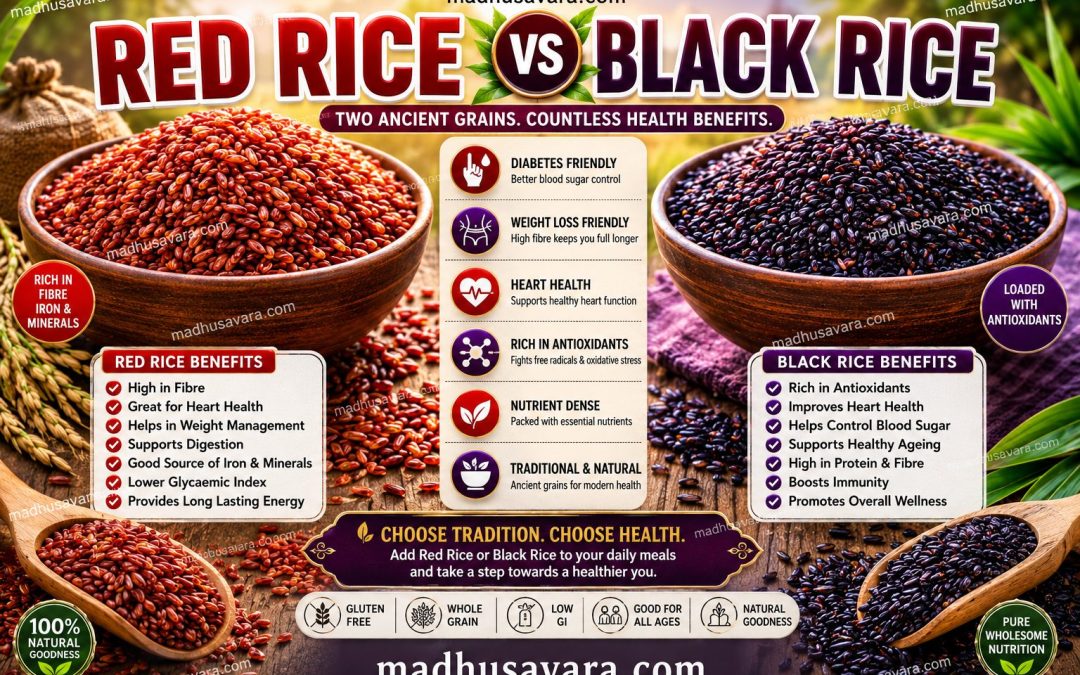
- Red Rice vs Black Rice at a Glance
- Origin, Importance and Cultural Significance
- History and Traditional Cultivation
- Why Their Colours Matter
- Nutritional Comparison Table
- Red Rice Benefits
- Black Rice Benefits
- Red Rice vs Black Rice for Diabetes
- Glycaemic Index and Glycaemic Load Explained
- Red Rice vs Black Rice for Weight Loss
- Which Rice Has More Antioxidants?
- Which Rice Has More Protein?
- Which Rice Do I Personally Recommend?
Preface
Imagine walking through a village nearly fifty years ago.
There are no packaged foods, no diet plans, no calorie-counting applications, and no supermarket shelves filled with imported “superfoods.”
Yet people worked longer hours, walked greater distances, and often maintained healthier body weights than many of us do today.
What was different?
Part of the answer lies in the food they ate.
Traditional diets relied heavily on whole foods that were minimally processed. Rice was not polished until it became white and nutrient-poor. Instead, families consumed rice varieties that retained their natural bran layers, preserving valuable fibre, vitamins, minerals, and antioxidants.
Red rice and black rice are living examples of that forgotten nutritional wisdom.
Today, these traditional rice varieties are making a remarkable comeback as people search for healthier alternatives to refined grains.
But are they truly better?
The answer may surprise you.
The Forgotten Wisdom Hidden in Every Grain
A farmer once told me something I have never forgotten.
He held a handful of red rice in his palm and said:
“People think modern food is better because it looks better. But nature never intended rice to be perfectly white.”
His words stayed with me.
The outer layers removed during polishing contain many of the nutrients that make rice valuable.
When rice is stripped of its bran, much of its fibre, minerals, and antioxidants disappear as well.
Red rice and black rice preserve these natural layers.
As a result, they offer nutritional advantages that polished rice often cannot match.
Perhaps our ancestors understood something that modern science is only beginning to explain.
What is Red Rice?
Red rice is a traditional whole-grain rice variety characterised by its reddish outer bran layer.
Unlike white rice, red rice retains its natural coating, which contains beneficial nutrients and antioxidants.
Popular varieties include:
- Kerala Matta Rice
- Rakthashali Rice
- Bhutanese Red Rice
- Himalayan Red Rice
- Traditional South Indian Red Rice
Red rice has a distinctive nutty flavour and slightly chewy texture.
Many people who switch from white rice to red rice initially notice the difference in taste. However, after a few weeks, the deeper flavour often becomes one of its biggest attractions.
For generations, red rice has been a staple food among farming communities, labourers, and households seeking long-lasting energy.
What is Black Rice?
Black rice is one of the most remarkable grains cultivated anywhere in the world.
Often called Forbidden Rice, black rice was historically reserved for nobility and royalty in parts of Asia because of its rarity and perceived health benefits.
India’s most famous black rice variety is Chak Hao, cultivated in Manipur for centuries.
Unlike red rice, black rice appears almost jet black before cooking.
Once cooked, however, it develops a stunning deep purple colour.
Its aroma, appearance, and nutritional profile have earned it a reputation as one of the world’s most nutrient-dense grains.
Red Rice vs Black Rice at a Glance
| Feature | Red Rice | Black Rice |
|---|---|---|
| Colour | Red-Brown | Black-Purple |
| Fibre | High | High |
| Protein | Good | Slightly Higher |
| Antioxidants | High | Extremely High |
| Diabetes Friendly | Excellent | Excellent |
| Weight Loss Friendly | Excellent | Very Good |
| Heart Health | Excellent | Excellent |
| Cost | Moderate | Higher |
| Availability | Easy | Limited |
| Daily Use | Ideal | Occasional Rotation |
Origin, Importance and Cultural Significance
The story of red rice and black rice is deeply connected to human civilisation.
Long before commercial agriculture existed, communities selected seeds based on survival, nutrition, flavour, and adaptability.
These selections eventually produced the traditional rice varieties we know today.
The Story of Red Rice
Red rice flourished in regions where farmers required hardy crops capable of surviving challenging conditions.
It became especially popular in:
- Kerala
- Karnataka
- Tamil Nadu
- Assam
- Bhutan
- Sri Lanka
For many communities, red rice was more than food.
It represented security.
Families depended on it to sustain long working days and support physically demanding lifestyles.
The Story of Black Rice
Black rice carries an even more fascinating history.
Ancient records suggest that certain black rice varieties were considered so valuable that ordinary citizens were prohibited from consuming them.
Hence the name:
Forbidden Rice
Whether every historical claim is accurate remains debated, but there is little doubt that black rice occupied a special position in traditional societies.
Even today, Chak Hao remains an important cultural symbol in Manipur.
History and Traditional Cultivation
Traditional farmers were remarkably skilled observers.
They selected seeds not only for yield but also for flavour, resilience, and nutritional value.
Why Farmers Preserved Red Rice
Red rice remained popular because:
- It adapted well to local climates.
- It tolerated varying rainfall patterns.
- It required fewer agricultural inputs.
- It provided reliable nourishment.
Many traditional farming communities viewed red rice as a dependable staple rather than a luxury.
Why Farmers Preserved Black Rice
Black rice demanded patience.
Yields were often lower.
Cultivation required greater care.
Yet communities continued growing it because of its:
- Distinctive flavour
- Cultural significance
- Nutritional richness
- Ceremonial importance
The fact that black rice survived centuries of agricultural change speaks volumes about its value.
Why Their Colours Matter
Nature rarely creates colour without purpose.
The vibrant shades found in red rice and black rice are signs of powerful plant compounds.
Understanding Anthocyanins
Anthocyanins are natural pigments responsible for the colours of:
- Blueberries
- Blackberries
- Purple grapes
- Red cabbage
- Black rice
These compounds act as antioxidants.
In plants, they protect against environmental stress.
In human nutrition, they are valued for their antioxidant properties.
Why Black Rice Is Called the Blueberry of Grains
Nutrition experts often describe black rice as the “blueberry of grains.”
The reason is simple.
Few grains contain anthocyanins in concentrations as high as black rice.
This makes black rice unique among cereal grains.
What Gives Red Rice Its Colour?
Red rice derives its colour primarily from anthocyanins and proanthocyanidins.
These compounds contribute to its nutritional profile while creating its distinctive appearance.
Nutritional Comparison Table
(Approximate values per 100 grams cooked rice)
| Nutrient | Red Rice | Black Rice |
|---|---|---|
| Calories | 110–130 kcal | 120–140 kcal |
| Protein | 2.5–3.5 g | 3–4 g |
| Carbohydrates | 23–26 g | 24–28 g |
| Fibre | 2–3 g | 2–4 g |
| Iron | High | High |
| Magnesium | Good Source | Good Source |
| Zinc | Moderate | Moderate |
| Antioxidants | High | Very High |
| Anthocyanins | Moderate | Extremely High |
Red Rice Benefits
The benefits of red rice extend far beyond basic nutrition.
Supports Digestive Health
Its fibre content promotes regular digestion and helps support gut health.
Provides Long-Lasting Energy
Traditional labourers often preferred red rice because it supplied sustained energy rather than quick bursts followed by fatigue.
Supports Heart Health
Red rice contains minerals and antioxidants that contribute to cardiovascular wellness.
Helps Control Hunger
Many people report feeling fuller for longer after consuming red rice compared with refined white rice.
Rich in Essential Nutrients
Red rice naturally contains:
- Iron
- Magnesium
- Zinc
- Phosphorus
- Manganese
Easy to Incorporate into Daily Meals
Unlike many specialised health foods, red rice fits naturally into Indian cuisine.
Black Rice Benefits
While red rice has traditionally been a staple in many households, black rice has earned a reputation as one of the most nutrient-dense grains available today.
Its deep purple-black colour is a visible sign of its rich antioxidant content.
1. Exceptionally Rich in Antioxidants
Among all rice varieties, black rice contains one of the highest concentrations of anthocyanins.
These antioxidants help protect cells from oxidative stress caused by free radicals.
This is one of the primary reasons black rice is often called the “Blueberry of Grains.”
2. Supports Heart Health
Black rice contains fibre, magnesium, and antioxidant compounds that support cardiovascular wellness.
A balanced diet containing antioxidant-rich foods may contribute to overall heart health.
3. Supports Healthy Ageing
Oxidative stress is one of the factors associated with ageing.
The antioxidant profile of black rice makes it a valuable addition to a nutrient-rich diet.
4. Better Satiety
The combination of fibre and protein can help people feel fuller for longer periods.
This makes black rice attractive for individuals attempting to manage body weight.
5. Naturally Gluten-Free
Like most rice varieties, black rice is naturally gluten-free and can be enjoyed by individuals who avoid gluten-containing grains.
6. Supports Nutritional Diversity
One of the simplest ways to improve dietary quality is to diversify food choices.
Black rice introduces additional nutrients and phytochemicals that may not be present in large amounts in conventional grains.
Red Rice vs Black Rice for Diabetes
Diabetes has become one of the most significant health concerns in India.
Consequently, one of the most frequently asked questions is:
“Which rice is better for diabetes: red rice or black rice?”
The answer depends on individual goals and eating patterns.
Why Red Rice Is Popular Among Diabetics
Red rice offers:
- Higher fibre than white rice
- Better satiety
- Slower digestion
- Greater affordability
- Easier availability
Many families find it practical for everyday use.
Why Black Rice Appeals to Diabetics
Black rice provides:
- High antioxidant content
- Whole-grain nutrition
- Anthocyanin-rich profile
- Better nutrient density
Its antioxidant richness makes it particularly attractive to health-conscious consumers.
Diabetes Expert Verdict
If affordability and daily use are important, red rice often becomes the preferred choice.
If nutritional diversity and antioxidant intake are priorities, black rice is an excellent addition.
Important Reminder for Diabetics
No rice is completely “free” from affecting blood sugar.
Portion control remains essential.
Even healthy rice should be consumed as part of a balanced meal containing:
- Vegetables
- Protein
- Healthy fats
Glycaemic Index and Glycaemic Load Explained
Many people focus exclusively on the Glycaemic Index (GI).
However, Glycaemic Load (GL) is equally important.
What Is Glycaemic Index?
GI measures how quickly a food raises blood sugar levels.
Foods with lower GI values generally produce slower increases in blood glucose.
What Is Glycaemic Load?
GL considers:
- Glycaemic Index
- Portion size
This means that even lower-GI foods can affect blood sugar if consumed in excessive quantities.
Practical Diabetes Plate Method
A practical meal plate often looks like:
Half Plate
Vegetables
Quarter Plate
Protein
Quarter Plate
Red rice or black rice
This approach helps create a more balanced meal.
Red Rice vs Black Rice for Weight Loss
People often search for the best rice for weight loss.
The reality is that no rice causes weight loss on its own.
Weight loss occurs when calorie expenditure exceeds calorie intake.
However, food choices influence hunger, satisfaction, and dietary adherence.
Red Rice for Weight Loss
Advantages include:
- Good fibre content
- Greater satiety
- Affordable daily use
- Reduced hunger between meals
For many Indian households, red rice is easier to sustain long-term.
Black Rice for Weight Loss
Advantages include:
- Rich flavour
- Higher antioxidant content
- Excellent nutritional density
- Better meal variety
Its distinctive taste often encourages mindful eating.
Weight Loss Winner
For practical daily use:
Red Rice Wins
For antioxidant superiority:
Black Rice Wins
For overall lifestyle success:
Both can be excellent choices when consumed in moderation.
Red Rice vs Black Rice for Heart Health
Heart disease remains one of the leading causes of death worldwide.
Diet plays an important role in maintaining cardiovascular wellness.
How Red Rice Supports Heart Health
Red rice contains:
- Dietary fibre
- Magnesium
- Antioxidants
These nutrients contribute to a heart-conscious eating pattern.
How Black Rice Supports Heart Health
Black rice offers:
- Anthocyanins
- Fibre
- Magnesium
- Plant compounds
Its antioxidant profile is particularly noteworthy.
Heart Health Verdict
Both rice varieties are significantly better choices than heavily refined grains.
For antioxidant protection, black rice has a slight edge.
For daily practicality, red rice remains a strong contender.
Red Rice vs Black Rice for Cholesterol
A diet rich in whole grains is generally preferred over refined grains.
The fibre found in red rice and black rice may support healthy cholesterol management when combined with an overall balanced lifestyle.
Because black rice contains higher antioxidant levels, many health-conscious individuals include it as part of a heart-friendly eating pattern.
Which Rice Has More Antioxidants?
This comparison has a clear winner.
Winner: Black Rice
Black rice contains significantly higher anthocyanin concentrations.
Anthocyanins are responsible for:
- Deep purple colour
- Antioxidant activity
- Nutritional uniqueness
If antioxidants are your primary goal, black rice deserves serious consideration.
Which Rice Has More Protein?
Protein differences between the two are relatively small.
However:
Winner: Black Rice
Black rice generally contains slightly more protein than red rice.
For complete protein nutrition, pair either rice with:
- Dal
- Lentils
- Chickpeas
- Paneer
- Eggs
- Fish
Who Should Eat Red Rice?
Red rice may be particularly suitable for:
- Families seeking a daily staple
- Individuals pursuing weight management
- People transitioning away from white rice
- Active adults
- Traditional Indian households
Its affordability and availability make it practical for regular use.
Who Should Eat Black Rice?
Black rice may be particularly suitable for:
- Health enthusiasts
- Antioxidant-focused diets
- Fitness-conscious individuals
- People seeking dietary variety
- Consumers interested in traditional superfoods
Which Rice Do I Personally Recommend?
This is perhaps the most important question in the entire article.
After studying traditional foods, nutritional science, and practical household usage, my recommendation is straightforward.
For Everyday Use
Choose red rice.
It is:
- Affordable
- Nutritious
- Easy to find
- Easy to cook
- Suitable for regular meals
For Maximum Nutritional Density
Choose black rice.
It provides:
- Exceptional antioxidants
- Greater nutritional diversity
- Unique flavour
- Distinctive culinary appeal
My Personal Approach
In my own kitchen, red rice appears more frequently because it integrates effortlessly into daily meals.
Black rice is reserved for special occasions, salads, grain bowls, festive dishes, and days when I want additional nutritional variety.
The true lesson is not choosing one over the other.
The real health improvement comes from replacing heavily refined grains with traditional whole-grain foods that have nourished communities for generations.
How to Cook Red Rice Perfectly
One reason many people stop using red rice is simple—they cook it incorrectly.
Unlike polished white rice, red rice retains its bran layer and therefore requires more time and water.
The reward, however, is a richer flavour, better texture, and improved nutritional value.
Ingredients
- 1 cup red rice
- 3 to 4 cups of water
- Optional pinch of salt
Method
Step 1: Wash Thoroughly
Rinse the rice two to three times until the water becomes relatively clear.
Step 2: Soak
Soak for 4 to 8 hours.
This helps:
- Improve texture
- Reduce cooking time
- Enhance digestibility
Step 3: Cook
Add soaked rice and water to a pressure cooker or heavy-bottomed pot.
Pressure Cooker Method
Cook for 5–6 whistles.
Open Pot Method
Cook for approximately 35–45 minutes until tender.
Step 4: Rest
Allow the rice to rest for 10 minutes before serving.
How to Cook Black Rice Perfectly
Black rice requires patience, but the results are worth it.
Ingredients
- 1 cup black rice
- 3 cups water
Method
Step 1: Wash
Rinse gently two to three times.
Step 2: Soak
Soak for 6–8 hours.
This significantly improves texture.
Step 3: Cook
Add rice and water to a pot.
Cook for approximately 35–40 minutes.
The grains should become tender while retaining slight firmness.
Step 4: Rest
Allow resting for 10 minutes before fluffing.
As the rice cooks, its colour transforms into a beautiful deep purple.
Can You Mix Red Rice and Black Rice?
Absolutely.
In fact, combining red rice and black rice creates a nutritionally diverse meal.
Benefits include:
- Better flavour complexity
- Improved visual appeal
- Wider range of antioxidants
- Enhanced nutrient diversity
Many health-conscious cooks now prepare mixed-grain rice bowls using:
- Red rice
- Black rice
- Millets
- Quinoa
Red Rice vs Black Rice During Pregnancy
Pregnancy requires increased nutritional awareness.
Both red rice and black rice can be part of a balanced pregnancy diet.
Why Red Rice May Be Helpful
Red rice provides:
- Iron
- Magnesium
- Fibre
These nutrients are valuable during pregnancy.
Why Black Rice May Be Helpful
Black rice contributes:
- Antioxidants
- Fibre
- Minerals
Important Note
Pregnant women should always discuss dietary changes with their healthcare provider, especially if they have gestational diabetes or other medical conditions.
Red Rice vs Black Rice for PCOS
Many women with PCOS seek foods that support stable energy and balanced eating habits.
Because both rice varieties contain more fibre than polished white rice, they may fit better into a PCOS-friendly eating pattern.
Red Rice Advantages
- Practical daily use
- Better affordability
- Greater availability
Black Rice Advantages
- Antioxidant richness
- Nutritional diversity
A balanced lifestyle remains the most important factor in PCOS management.
Red Rice vs Black Rice for Senior Citizens
As people age, nutrient-dense foods become increasingly important.
Red Rice for Seniors
Advantages include:
- Familiar taste
- Easy meal integration
- Fibre content
Black Rice for Seniors
Advantages include:
- Antioxidant support
- Nutrient density
Cooking rice until properly softened improves comfort and digestibility.
Red Rice vs Black Rice for Children
Children benefit from dietary variety.
Red rice and black rice can be introduced gradually through:
- Khichdi
- Rice bowls
- Vegetable pulao
- Rice porridge
Their colourful appearance often encourages curiosity and acceptance.
Red Rice vs Black Rice for Athletes
Athletes require both energy and nutrition.
Why Athletes Choose Red Rice
- Sustained carbohydrate release
- Good satiety
- Practical daily use
Why Athletes Choose Black Rice
- Antioxidant support
- Slightly higher protein
- Nutrient density
Many athletes alternate between both varieties.
Best Time to Eat Red Rice and Black Rice
There is no universal rule.
However, many people prefer consuming these grains during:
Lunch
Supports sustained energy throughout the day.
Early Dinner
Allows sufficient digestion before bedtime.
Avoid Excessive Late-Night Portions
Large servings immediately before sleep may cause discomfort for some individuals.
How Much Red Rice or Black Rice Should You Eat Daily?
Individual needs vary.
General guidelines:
Sedentary Adults
½ to 1 cup cooked rice per meal
Active Adults
1 to 2 cups cooked rice per meal
Athletes
Requirements vary according to activity levels.
Portion control remains important regardless of rice variety.
Storage Guidelines
Proper storage preserves freshness.
Store In
- Airtight containers
- Cool locations
- Dry cupboards
Avoid
- Moisture
- Direct sunlight
- Excessive heat
Properly stored rice can remain usable for several months.
Buying Guide: How to Choose Quality Red Rice and Black Rice
When purchasing:
Look For
- Uniform grains
- Natural colour
- Clean aroma
- Reliable suppliers
Avoid
- Artificial colouring
- Excessive broken grains
- Damp odour
- Poor packaging
Traditional and organic varieties are often preferred by health-conscious consumers.
Frequently Asked Questions
Is red rice healthier than white rice?
Red rice generally contains more fibre, minerals, and antioxidants than polished white rice.
Is black rice healthier than white rice?
Black rice offers significantly higher antioxidant levels and better nutrient density.
Can diabetics eat red rice?
Many diabetics include red rice as part of balanced meals, although portion control remains important.
Can diabetics eat black rice?
Yes, black rice can also be included in a balanced dietary plan.
Which rice is better for weight loss?
Red rice is often preferred for practical daily use, while black rice offers additional antioxidant benefits.
Which rice has more antioxidants?
Black rice contains substantially higher anthocyanin levels.
Which rice has more protein?
Black rice generally contains slightly more protein.
Can I eat red rice every day?
Most healthy individuals can enjoy red rice regularly as part of a balanced diet.
Can I eat black rice every day?
Yes, though many households use it several times per week because of cost and availability.
Can I mix red rice and black rice?
Absolutely. Many people enjoy the combination of flavour and nutritional diversity.
Red Rice vs Black Rice: Which Is Better?
Red rice is generally better for everyday use because it is affordable, widely available, rich in fibre, and suitable for regular meals. Black rice contains higher antioxidant levels and offers exceptional nutritional value. The best choice depends on individual goals and preferences.
Which Rice Is Better for Diabetes?
Both red rice and black rice are generally preferable to refined white rice because they retain their fibre-rich bran layers.
Which Rice Is Better for Heart Health?
Both support heart-conscious eating patterns, though black rice contains higher antioxidant levels.
Conclusion
The story of red rice and black rice is ultimately a story about returning to nutritional wisdom.
Long before the arrival of modern diet trends, these traditional grains nourished families, farmers, labourers, and entire communities.
Today, science is helping us understand what previous generations instinctively knew.
Red rice offers practicality, affordability, fibre, and everyday versatility.
Black rice offers extraordinary antioxidants, nutritional diversity, and a unique culinary experience.
Rather than viewing them as competitors, it is more helpful to view them as complementary foods.
Together, they represent some of the finest examples of traditional whole-grain nutrition available today.
By choosing red rice, black rice, or a combination of both, you are not simply changing your diet—you are reconnecting with a rich agricultural heritage that has stood the test of time.
Call To Action
Have you tried red rice or black rice in your kitchen?
Share your experience in the comments below and let us know your favourite way to enjoy these traditional grains.
For more authentic food guides, traditional recipes, nutrition articles, and forgotten culinary treasures, continue exploring Madhusavara.com.
Strong Disclaimer
This article is intended solely for educational and informational purposes.
It should not be considered medical advice, diagnosis, or treatment.
Nutritional needs vary from person to person depending on age, health conditions, medications, allergies, activity levels, and other factors.
Individuals with diabetes, kidney disease, heart disease, digestive disorders, pregnancy-related conditions, or any other medical concerns should consult a qualified healthcare professional before making significant dietary changes.
The author and Madhusavara.com assume no responsibility for decisions made based on the information presented in this article.
Always seek personalised medical advice from your physician, dietitian, or healthcare provider.
If antioxidant-rich foods interest you, our Himalayan superfoods collection introduces several traditional ingredients worth adding to your kitchen.
KafuliTimruRagichaulaiBer Indian Jujube
lasura, lingri, monkey jackfruit, bathu, bicchu buti, lost superfoods, bhangjeera, kala jeer
