


Ambur Chicken Biryani Recipe | Authentic Ambur Biryani | Tamil Nadu Star Ambur Dum Chicken Biryani
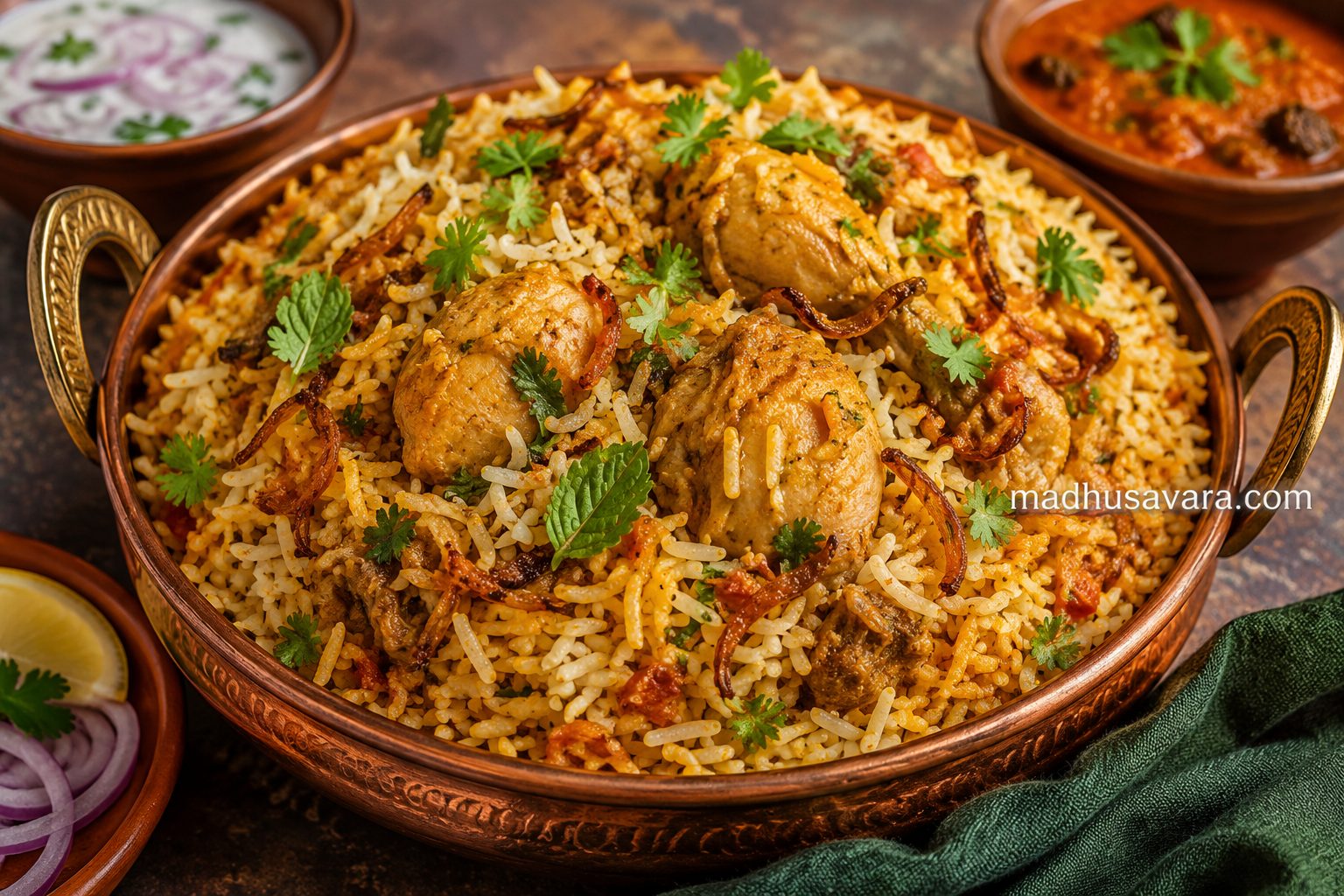
Authentic Ambur Chicken Biryani served in a traditional copper handi with tender chicken pieces, aromatic seeraga samba rice, fried onions, fresh coriander, mint leaves, raita, and curry,

Author’s Note

Vanakkam and Namaste!

I am Madhu Savara, founder and creator of Madhusavara.com.

Some recipes become famous because of royal patronage, while others achieve legendary status through generations of dedicated cooks. Ambur Chicken Biryani belongs to the latter category. During my exploration of India’s regional food heritage, I became fascinated by how a small town in Tamil Nadu earned worldwide recognition through a single dish.

Unlike the rich saffron-laden biryanis of Hyderabad or the delicate aromas of Lucknow, Ambur Biryani embraces simplicity. Every ingredient serves a purpose. The fragrance of seeraga samba rice, the warmth of dried red chillies, the tenderness of slow-cooked chicken, and the subtle tang of yoghurt come together in perfect harmony.

Today, I am sharing a traditional Ambur Chicken Biryani recipe that celebrates the authentic flavours of Tamil Nadu while remaining practical for home cooks.

Ambur Chicken Biryani is a famous South Indian biryani originating from the historic town of Ambur in Tamil Nadu. It is distinguished by its use of seeraga samba rice instead of basmati rice, a restrained spice profile, and a cooking technique that allows the rice and chicken to absorb flavours gradually.

Unlike many northern biryanis that rely heavily on garam masala and saffron, Ambur Biryani derives its unique character from dried red chilli paste, yoghurt-marinated chicken, and aromatic whole spices.

The result is a biryani that is lighter, deeply flavourful, and remarkably balanced.

Origin and Significance of Ambur Biryani

Historical Origin

The origins of Ambur Biryani date back to the Nawabs of Arcot during the eighteenth century. The royal cooks developed a distinct style of biryani that combined Mughlai influences with local Tamil ingredients and cooking traditions.

Over time, Ambur became synonymous with this unique biryani style, eventually becoming one of India’s most celebrated regional rice dishes.

Cultural Significance

Ambur Biryani remains an integral part of:

Today, it represents one of Tamil Nadu’s most treasured culinary traditions.

Table of Contents

  1. Author’s Note
  2. Description of Ambur Chicken Biryani
  3. Origin and Significance
  4. Preparation Details
  5. Nutritional Information
  6. Comparison with Other Biryanis
  7. Ingredients
  8. Equipment Needed
  9. Detailed Cooking Method
  10. Allergen Information
  11. Tips and Variations
  12. Things to Avoid
  13. Storage Instructions
  14. FAQs
  15. Call to Action
  16. Author Bio
  17. References

Servings

6 persons

Preparation Time:

30 minutes marination 1 hour

Cooking Time:

55 minutes

Calories

575

Ingredients

For Chicken Marinade

  • 1 kg chicken, bone-in
  • 1 cup thick yogurt
  • Salt to taste
  • 1 tsp turmeric powder

For Chilli Paste

  • 15 dried red chillies
  • 8 garlic cloves
  • 1 inch ginger

For Biryani

  • 750 g seeraga samba rice
  • 4 medium onions, sliced
  • 3 tomatoes, chopped
  • ½ cup mint leaves
  • ½ cup coriander leaves
  • 4 tbsp vegetable oil
  • 2 tbsp ghee
  • 4 green cardamoms
  • 4 cloves
  • 1 cinnamon stick
  • 2 bay leaves
  • 2 star anise
  • Salt as required
  • Water as needed

For Garnishing

  • Fresh coriander leaves
  • Mint leaves

Equipment Needed

  • Heavy-bottomed biryani pot
  • Large cooking vessel
  • Blender
  • Measuring cups
  • Measuring spoons
  • Knife
  • Chopping board
  • Wooden spatula
  • Rice strainer

Nutrition Information

(Per Serving)

Nutrient Amount
Calories 575 kcal
Protein 32 g
Carbohydrates 55 g
Fat 24 g
Saturated Fat 8 g
Fibre 2.8 g
Sodium 690 mg
Potassium 510 mg
Calcium 140 mg
Iron 3.9 mg

Comparison with Other Biryanis

Biryani Type Unique Feature
Ambur Biryani Seeraga samba rice and red chilli paste
Hyderabadi Biryani Raw meat dum cooking
Lucknowi Biryani Delicate aromatic spices
Kolkata Biryani Potato inclusion
Malabar Biryani Kerala spices and ghee richness
Dindigul Biryani Tangier flavour profile

Step by Step Instructions

Step 1: Prepare the Chilli Paste

Soak dried red chillies in warm water for 20 minutes.

Blend with ginger and garlic into a smooth paste.

Set aside.

Step 2: Marinate the Chicken

Combine:

  • Chicken
  • Yogurt
  • Salt
  • Turmeric

Mix thoroughly.

Rest for one hour.

Step 3: Prepare the Rice

Wash seeraga samba rice thoroughly.

Soak for 20 minutes.

Drain completely.

Step 4: Cook the Masala

Heat oil and ghee.

Add:

  • Cardamom
  • Cloves
  • Cinnamon
  • Bay leaves
  • Star anise

Sauté until aromatic.

Add sliced onions.

Cook until golden.

Add chilli paste.

Cook for 5 minutes.

Add tomatoes.

Cook until softened.

Add mint and coriander.

Step 5: Cook the Chicken

Add marinated chicken.

Cook on medium heat until chicken releases moisture.

Continue cooking for 15–20 minutes.

Step 6: Add Rice

Add soaked rice.

Mix gently.

Pour measured hot water.

Adjust salt.

Bring to a boil.

Step 7: Dum Cooking

Cover tightly.

Cook on low heat for 20–25 minutes.

Allow resting for 10 minutes before opening.

Step 8: Serve

Fluff gently.

Serve hot with:

  • Brinjal curry
  • Onion raita
  • Boiled eggs
  • Lemon wedges

Tips and Variations

Contains:

  • Dairy (yoghurt, ghee)

May contain traces of:

  • Tree nuts depending upon spice processing facilities.

Suitable for:

  • Gluten-free diets when prepared using pure spices.

Allergen Information

Contains:

  • Dairy (yoghurt, ghee)

May contain traces of:

  • Tree nuts depending upon spice processing facilities.

Suitable for:

  • Gluten-free diets when prepared using pure spices.
Other Essentials

Things to Avoid

  • Using basmati rice for authentic Ambur style.
  • Overcooking rice.
  • Excessive garam masala.
  • Skipping marination.
  • High heat cooking.
  • Too much water.

Storage Instructions

Refrigerator

Store for up to 3 days.

Freezer

Freeze for up to 1 month.

Reheating

Steam gently with a few drops of water.

Avoid repeated reheating.

Frequently Asked Questions

Why is Ambur Biryani famous?

Its unique use of seeraga samba rice and red chilli paste creates a flavour profile unlike any other biryani in India.

What rice is used in Ambur Biryani?

Traditional Ambur Biryani uses seeraga samba rice.

Is Ambur Biryani spicy?

It is moderately spicy and relies on dried red chillies for depth rather than excessive heat.

What is the difference between Ambur and Hyderabadi Biryani?

Ambur Biryani uses seeraga samba rice and cooked chicken masala, while Hyderabadi Biryani traditionally uses basmati rice and dum-cooked raw marinated meat.

Can I make it with basmati rice?

Yes, but it will not be considered authentic Ambur Biryani.

Why is seeraga samba rice preferred?

Its small grains absorb flavours exceptionally well and provide the traditional texture associated with Ambur Biryani.

Can I prepare Ambur Biryani in advance?

Yes. It remains delicious when reheated properly.

What side dish pairs best?

Traditional brinjal curry and onion raita are classic accompaniments.

Call to Action

If you enjoy discovering authentic regional Indian recipes, explore the growing collection of traditional dishes, festive foods, biryanis, and culinary heritage articles at Madhusavara.com. Every recipe is carefully researched and crafted to preserve the true flavours of Indian cuisine for future generations.

Author Bio

Madhu Savara

Madhu Savara is the founder of Madhusavara.com and a passionate food writer dedicated to preserving India’s culinary heritage. Through detailed recipes, cultural storytelling, and traditional cooking methods, she brings authentic regional cuisines from every corner of India to home kitchens worldwide.

Authenticated References

  1. Achaya, K.T. Indian Food: A Historical Companion. Oxford University Press.
  2. Sen, Colleen Taylor. Feasts and Fasts: A History of Food in India.
  3. Peter, K.V. Handbook of Herbs and Spices. DOI: 10.1533/9781855738354
  4. Peter, K.V. Handbook of Herbs and Spices Volume 2. DOI: 10.1533/9781845691713
  5. National Institute of Nutrition. Indian Food Composition Tables (2017).
  6. Gopalan, C., Rama Sastri, B.V., Balasubramanian, S.C. Nutritive Value of Indian Foods.
  7. Tamang, J.P. Ethnic Fermented Foods and Beverages of India. DOI: 10.1007/978-81-322-2800-4
  8. Krishnamoorthy, B., et al. Traditional Rice Varieties of South India and Their Nutritional Importance. DOI: 10.1007/s40003-015-0184-8
  9. Devi, P. Traditional Culinary Heritage of Tamil Nadu. DOI: 10.5958/0976-4666.2016.00058.4
  10. Food and Agriculture Organisation (FAO). Traditional Foods and Culinary Heritage Documentation. DOI: 10.4060/cb3995en
Disclaimer

Important Notice: Read Before Proceeding

The recipes, preparation methods, nutritional details, and related content published on Madhu Savara’s website, social media, and associated platforms are intended solely for general informational and educational purposes. While every effort has been made to ensure accuracy and reliability, we make no guarantees regarding the results, safety, or accuracy of any recipe presented here.

We are not licensed nutritionists, dieticians, or medical professionals. The nutritional values provided are estimates only, calculated using third-party tools, and should not be used for medical diagnosis, dietary treatment, or allergy management. If you have any medical conditions, dietary restrictions, or food allergies, please consult your doctor or certified dietitian before attempting any recipe.

Cooking inherently involves sharp tools, high heat, and the risk of injury or fire. You assume full responsibility for your kitchen practices. Madhu Savara, the website, and all contributors shall not be held liable for any damage, injury, loss, or adverse outcome resulting directly or indirectly from the preparation, consumption, or interpretation of any content herein.

By using this website and attempting any recipe, you agree to hold harmless and indemnify Madhu Savara and her team from any liability, legal claim, or damages arising from the use of this content. You are encouraged to exercise independent judgment and take full responsibility for your health, kitchen safety, and actions.


Authentic Ambur Chicken Biryani served in a traditional copper handi with tender chicken pieces, aromatic seeraga samba rice, fried onions, fresh coriander, mint leaves, raita, and curry,
Print

Ambur Chicken Biryani Recipe | Authentic Ambur Biryani | Traditional Tamil Nadu Ambur Dum Chicken Biryani

This Authentic Ambur Chicken Biryani Recipe showcases the legendary flavours of Tamil Nadu’s famous Ambur Biryani. Made with seeraga samba rice, succulent chicken, dried red chillies, yogurt, and fragrant spices, this traditional Ambur Chicken Biryani delivers restaurant-style results with simple home-cooking techniques.
Course Main Course
Cuisine Indian, Tamilnadu
Keyword Ambur Biryani Recipe, Ambur Chicken Biryani Recipe, Ambur Star Biryani Style Recipe, Authentic Ambur Biryani, Authentic Tamil Biryani S, Chicken Biryani Recipe, Seeraga Samba Rice Biryani, South Indian Chicken Biryani, Tamil Nadu Biryani, Traditional Ambur Chicken Biryani
Prep Time 30 minutes
Cook Time 1 hour
Marination Time 1 hour
Total Time 2 hours 30 minutes
Servings 6 People
Calories 575kcal
Author Madhu Savara
Cost NA

Equipment

  • Ambur Chicken Biryani Recipe, Authentic Ambur Biryani, Ambur Biryani Recipe, Tamil Nadu Biryani, Traditional Ambur Chicken Biryani, Seeraga Samba Rice Biryani, South Indian Chicken Biryani, Ambur Star Biryani Style Recipe, Chicken Biryani Recipe, Authentic Tamil Biryani

Ingredients

  • Ambur Chicken Biryani Recipe Authentic Ambur Biryani, Ambur Biryani Recipe, Tamil Nadu Biryani, Traditional Ambur Chicken Biryani, Seeraga Samba Rice Biryani, South Indian Chicken Biryani, Ambur Star Biryani Style Recipe, Chicken Biryani Recipe, Authentic Tamil Biryani
  • S

Instructions

  • Step 1: Prepare the Chilli Paste
  • Soak dried red chillies in warm water for 20 minutes.
  • Blend with ginger and garlic into a smooth paste.
  • Set aside.
  • Step 2: Marinate the Chicken
  • Combine:
  • Chicken
  • Yogurt
  • Salt
  • Turmeric
  • Mix thoroughly.
  • Rest for one hour.
  • Step 3: Prepare the Rice
  • Wash seeraga samba rice thoroughly.
  • Soak for 20 minutes.
  • Drain completely.
  • Step 4: Cook the Masala
  • Heat oil and ghee.
  • Add:
  • Cardamom
  • Cloves
  • Cinnamon
  • Bay leaves
  • Star anise
  • Sauté until aromatic.
  • Add sliced onions.
  • Cook until golden.
  • Add chilli paste.
  • Cook for 5 minutes.
  • Add tomatoes.
  • Cook until softened.
  • Add mint and coriander.
  • Step 5: Cook the Chicken
  • Add marinated chicken.
  • Cook on medium heat until chicken releases moisture.
  • Continue cooking for 15–20 minutes.
  • Step 6: Add Rice
  • Add soaked rice.
  • Mix gently.
  • Pour measured hot water.
  • Adjust salt.
  • Bring to a boil.
  • Step 7: Dum Cooking
  • Cover tightly.
  • Cook on low heat for 20–25 minutes.
  • Allow resting for 10 minutes before opening.
  • Step 8: Serve
  • Fluff gently.
  • Serve hot with:
  • Brinjal curry
  • Onion raita
  • Boiled eggs
  • Lemon wedges

Notes

Rice Selection

Always use authentic seeraga samba rice.

Chilli Balance

Use dried red chillies for authentic flavour rather than excessive chilli powder.

Moisture Control

Avoid adding too much water.

Cooking Method

Cook on low heat to preserve rice texture.

Variations

Mutton Ambur Biryani

Replace chicken with goat meat.

Ambur Egg Biryani

Use boiled eggs instead of chicken.

Extra Spicy Version

Increase dried red chilli quantity.

Festival Style Biryani

Add fried onions and extra ghee.

Things to Avoid

  • Using basmati rice for authentic Ambur style.
  • Overcooking rice.
  • Excessive garam masala.
  • Skipping marination.
  • High heat cooking.
  • Too much water.

Storage Instructions

Refrigerator

Store for up to 3 days.

Freezer

Freeze for up to 1 month.

Reheating

Steam gently with a few drops of water.
Avoid repeated reheating.

Frequently Asked Questions

Why is Ambur Biryani famous?

Its unique use of seeraga samba rice and red chilli paste creates a flavour profile unlike any other biryani in India.

What rice is used in Ambur Biryani?

Traditional Ambur Biryani uses seeraga samba rice.

Is Ambur Biryani spicy?

It is moderately spicy and relies on dried red chillies for depth rather than excessive heat.

What is the difference between Ambur and Hyderabadi Biryani?

Ambur Biryani uses seeraga samba rice and cooked chicken masala, while Hyderabadi Biryani traditionally uses basmati rice and dum-cooked raw marinated meat.

Can I make it with basmati rice?

Yes, but it will not be considered authentic Ambur Biryani.

Why is seeraga samba rice preferred?

Its small grains absorb flavours exceptionally well and provide the traditional texture associated with Ambur Biryani.

Can I prepare Ambur Biryani ahead of time?

Yes. It remains delicious when reheated properly.

What side dish pairs best?

Traditional brinjal curry and onion raita are classic accompaniments.