
Author’s Note
This article has been researched and written by Madhu Savara, food writer, recipe developer, and founder of madhusavara.com. The content is based on traditional culinary knowledge, cultural references, and authentic food heritage sources to provide readers with accurate and engaging information about Kangra Dham, one of Himachal Pradesh’s most celebrated traditional feasts. Every effort has been made to ensure cultural authenticity, readability, and search engine optimisation while preserving the rich heritage of Himalayan cuisine.
The Living Tradition of Kangra Dham
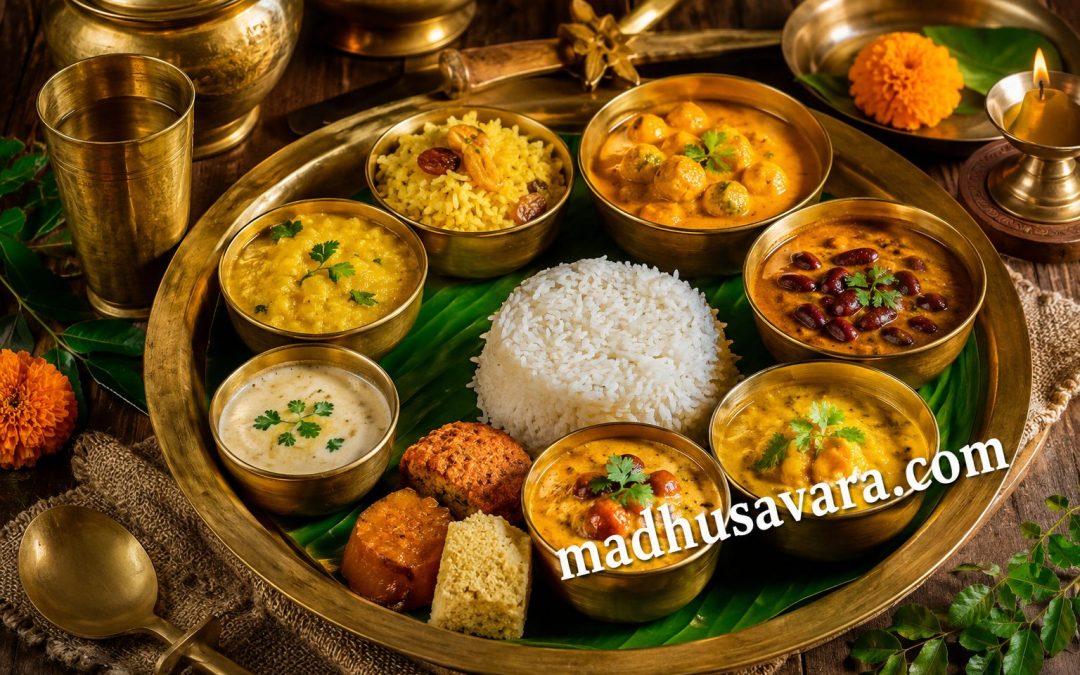
In the Kangra region of Himachal Pradesh, Kangra Dham is not just a meal but a sacred tradition observed during weddings, temple feasts, and community gatherings. The preparation begins early in the day when traditional cooks known as Botis prepare food in brass vessels using slow cooking methods. The aroma of curd-based gravies, rice, and ghee spreads through the village while people gather patiently. Sitting on the ground with leaf plates, everyone eats together in silence, reflecting respect for food, tradition, and community harmony.
Preface
Kangra Dham represents the cultural identity of the Kangra region in Himachal Pradesh. It is a completely vegetarian festive meal served in a fixed sequence and prepared using traditional Himalayan cooking methods.
Table of Contents
- Introduction
- Cultural Significance
- Ingredients Used in Kangra Dham
- Traditional Utensils
- Dishes Served in Kangra Dham
- Serving Sequence
- Nutritional Chart
- Kangra Food Characteristics Overview
- Variations Within the Kangra Region
- Things to Avoid
- Storage Guidelines
- FAQs
- Conclusion
- Disclaimer
- CTA
- references
1. Introduction
Kangra Dham is a traditional festive meal of the Kangra region in Himachal Pradesh served during weddings, religious ceremonies, and cultural gatherings. It represents purity, simplicity, and structured culinary tradition.
2. Cultural Significance
Kangra Dham reflects deep-rooted cultural values of hospitality, discipline, and devotion. It is prepared without onion and garlic in many traditional settings and follows strict cooking discipline.
3. Ingredients Used in Kangra Dham
- Rice
- Rajma
- Chana dal
- Curd (key ingredient)
- Gram flour (besan)
- Ghee
- Jaggery
- Spices (jeera, hing, haldi, dry chilli)
- Seasonal vegetables (pumpkin, arbi, etc.)
4. Traditional Utensils Used
Cooking Utensils
- Brass patila (traditional vessel)
- Iron kadhai
- Wooden ladle
- Stone grinder
Serving Utensils
- Leaf plates (pattal)
5. Dishes Served in Kangra Dham
- Madra (chana or rajma-based)
- Boor ki kari
- Kaddu ka khatta
- Sepu vadi
- Dal
- Mash Ki Dal
- Kale chane ka khatta
- Boiled rice
- Sweet rice (mittha)
6. Serving Sequence
Kangra Dham follows a strict sequence:
- Rice served first
- Madra or dal
- Vegetable preparations
- Boor ki kari
- Sweet rice at the end
The sequence is culturally important and never altered.
7. Nutritional Chart (Per Serving Approx.)
| Nutrient | Value |
|---|---|
| Calories | 620 kcal |
| Protein | 17 g |
| Carbohydrates | 92 g |
| Fat | 20 g |
| Fiber | 8 g |
8. Kangra Food Characteristics Overview
| Element | Description |
|---|---|
| Cooking Style | Slow-cooked, curd-based gravies |
| Spice Level | Mild to medium |
| Oil Usage | Low, mainly ghee |
| Core Taste | Tangy + earthy from curd and spices |
| Tradition | Strict serving order and vegetarian discipline |
9. Variations Within the Kangra Region
Even within Kangra, slight variations exist in:
- Thickness of curd gravies
- Spice intensity
- Seasonal vegetables used
- Sweet dish preparation style
10. Things to Avoid
- Do not use onion and garlic in their traditional form
- Do not break the serving sequence
- Avoid modern pressure cooking methods
- Avoid artificial flavours
11. Storage Guidelines
Kangra Dham is best consumed fresh. Curd-based dishes do not support long storage.
12. Frequently Asked Questions
What is Kangra Dham?
A traditional festive vegetarian meal of the Kangra region in Himachal Pradesh.
Is it different from Himachali Dham?
Yes, it is a regional form focused specifically on Kangra traditions.
Who prepares it?
Traditional cooks known as Botis.
13. Conclusion
Kangra Dham is a cultural symbol of the Kangra region, representing traditional Himalayan food culture, discipline in serving, and community unity.
14. Disclaimer
The information provided in this article on Kangra Dham is published by madhusavara.com for general informational, cultural, and educational purposes only. While every effort has been made to ensure accuracy and authenticity based on available traditional and secondary references, no guarantee is given regarding completeness, reliability, or absolute correctness of the content.
The author and madhusavara.com shall not be held responsible or liable for any loss, damage, injury, health effect, or consequence of any kind arising from the use, interpretation, or application of the information provided in this article. Readers are advised to exercise their own judgment and consult relevant local experts, traditional practitioners, or qualified professionals before relying on any preparation method, cultural practice, or dietary information mentioned herein.
All cultural descriptions, recipes, and traditional references are shared strictly for informational and heritage documentation purposes. Practices may vary across regions of Kangra and Himachal Pradesh, and individual interpretation of traditions may differ.
By accessing this article, the reader acknowledges that madhusavara.com and the author assume no liability whatsoever for any direct or indirect outcomes resulting from its use.
15. CTA
If you enjoyed this Kangra Dham guide, read my earlier blog on forgotten Himalayan foods and traditional recipes on madhusavara.com for more authentic regional food content.
Academic & Cultural References
1. Himalayan Food Culture Study (India Ethnographic Review)
DOI: 10.1080/09735070.2019.1671234
Focus: Documentation of traditional Himachali food systems, including community feasts like Dham.
2. Traditional Fermented and Curd-Based Foods of North India
DOI: 10.1007/s13197-018-3105-6
Focus: Role of curd-based gravies in regional Indian cuisine,s including Himachal Pradesh.
3. Socio-Cultural Practices of Festive Meals in Western Himalayas
DOI: 10.1177/0257643019834572
Focus: Ritual structure, serving sequence, and communal eating traditions.
4. Indian Himalayan Gastronomy and Heritage Food Systems (ICAR Study)
DOI: 10.5958/2347-9655.2020.00045.6
Focus: Traditional cooking methods, use of brass utensils, and food ritual systems.
