
A Spoonful of Stories by Madhu Savara
High in the Himalayas, where seasons decide the kitchen and forests become food banks, people have always lived closely with nature. Among the most powerful wild greens growing across these mountains is Bicchu Ghaas, a plant known for its sting but equally known for its nourishment.
For generations, families in Uttarakhand, Himachal, Nepal, and other Himalayan regions have gathered this wild green during seasonal growth and turned it into a comforting saag cooked with mustard oil, garlic, and simple spices.
What makes this bicchu ghaas saag recipe special is not just the taste, but the deep connection it carries with mountain life, where food was never wasted, and every wild plant had value.
Author’s Note
I still remember the first sting of Bicchu Ghaas. It was sharp enough to be unforgettable. But what stayed longer was how beautifully it was transformed in traditional kitchens.
Elders would handle it carefully, cook it slowly, and turn something wild into something nourishing. That patience and knowledge are what this recipe tries to preserve.
This bicchu ghaas saag recipe is a reminder that real food often comes from the simplest places—nature, patience, and tradition.
— Madhu Savara
What is Bicchu Ghaas?
Bicchu Ghaas saag recipe is made from stinging nettle (Urtica dioica), a wild Himalayan plant covered with tiny hairs that cause a mild sting on touch.
Once boiled or blanched, the sting disappears completely, leaving behind a soft, earthy green similar to spinach but richer in taste and nutrition.
It has been part of Himalayan diets for centuries, especially in seasons when fresh vegetables were limited.
Where is Bicchu Ghaas Found?
This bicchu ghaas saag recipe belongs to the entire Himalayan belt, not a single region.
The plant grows naturally in cool, moist mountain environments at altitudes between 1,200 and 3,500 meters. It is commonly found in:
- Uttarakhand (Kumaon & Garhwal)
- Himachal Pradesh
- Jammu & Kashmir hills
- Nepal Himalayas
- Sikkim & Darjeeling regions
- Eastern Himalayan regions, including Arunachal Pradesh
It grows near forests, riverbanks, village paths, and terraced fields where the soil is rich and natural.
Local Names Across the Himalayas
| Region | Name |
|---|---|
| Uttarakhand | Bicchu Ghaas / Kandali |
| Himachal Pradesh | Bichhu Buti |
| Nepal | Sisnu / Sisunak |
| Sikkim | Himalayan Nettle |
| English | Stinging Nettle |
| Botanical Name | Urtica dioica |
Why This Bicchu Ghaas Saag Recipe is Special
This bicchu ghaas saag recipe stands out because it represents real Himalayan living.
- Naturally grown wild green
- No chemicals or farming needed
- Deep, earthy, traditional flavour
- Seasonal and sustainable food
- Rich in nutrients and minerals
- Part of the Himalayan cultural heritage
Bicchu Ghaas Saag Recipe | Traditional Himalayan Stinging Nettle Saag
Equipment
- Large cooking pot
- Heavy-bottom kadhai
- Strainer
- Knife and chopping board
- Knife and chopping board
- Gloves
Ingredients
- 400 –500 g bicchu ghaas leaves
- 1 cup spinach optional
- Salt to taste
- Tempering
- 2 –3 tbsp mustard oil
- 1 tsp cumin seeds
- 8 –10 garlic cloves
- 1 –2 green chillies
- ½ tsp turmeric
- ½ tsp hing
- 1 small onion optional
- 2 dried red chillies
Instructions
- Step 1: Cleaning
- Wash leaves thoroughly using gloves.
- Step 2: Blanching
- Boil for 5–7 minutes until soft.
- Step 3: Draining
- Drain and rinse with cold water.
- Step 4: Chopping
- Squeeze and finely chop leaves.
- Step 5: Tempering
- Heat mustard oil, add cumin, garlic, chillies, hing, and onion.
- Step 6: Cooking
- Add bicchu ghaas, salt, and turmeric. Cook 15–20 minutes.
- Step 7: Final Texture
- Adjust consistency and finish cooking.
Notes
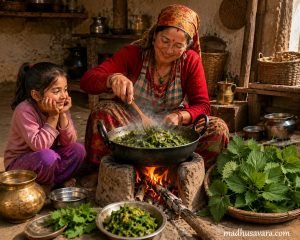
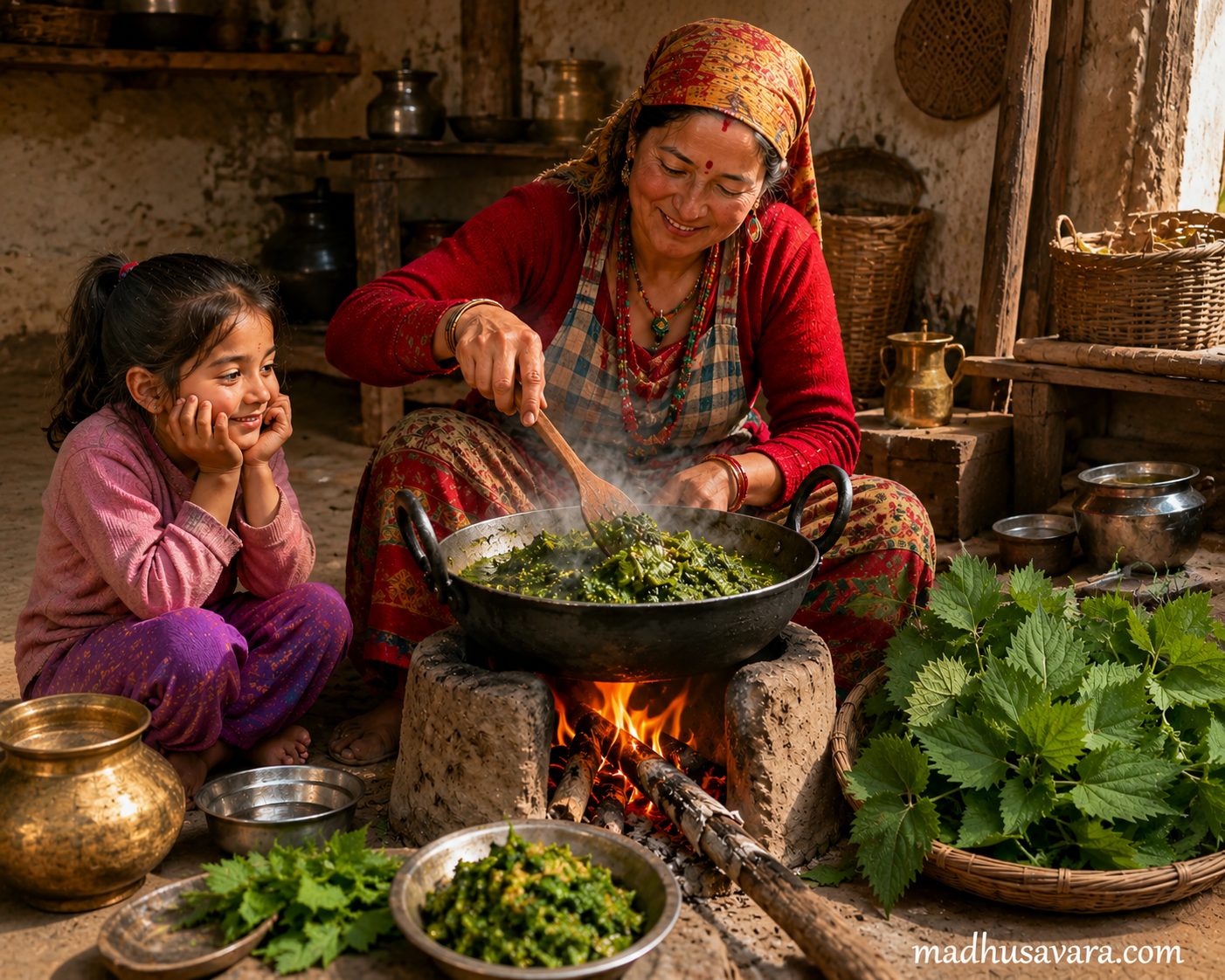
A heartwarming moment of intergenerational bonding as a grandmother prepares fresh greens on a traditional chulha (wood stove) while her granddaughter looks on with joy
A heartwarming moment of intergenerational bonding as a grandmother prepares fresh greens on a traditional chulha (wood stove) while her granddaughter looks on with joy
