
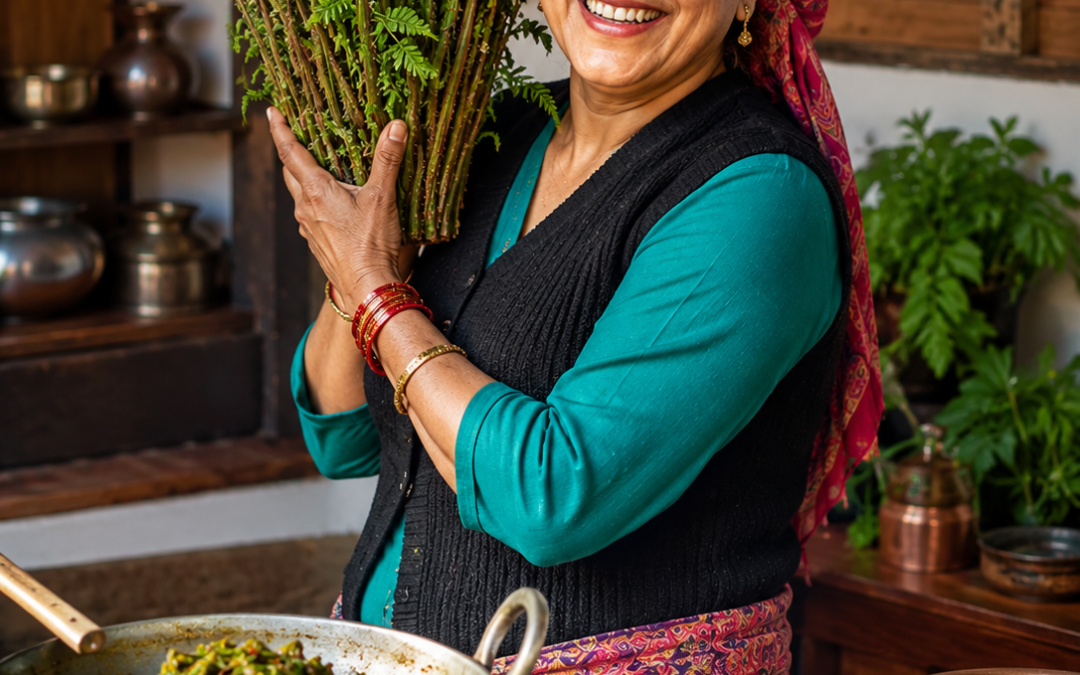
Author’s Note
Namaste. I am Madhu Savara, author and owner of madhusavara.com. I have always been fascinated by the traditional foods of our hills, especially those seasonal ingredients that are familiar to local families but are still little known outside their region.
Kasrod Chamba is one such seasonal delicacy of Chamba. It is a tender Himachali fiddlehead fern that appears for a short period and is traditionally cooked as Kasrod sabzi or preserved as Kasrod pickle.
In this article, I have brought together information about Kasrod, its local names, seasonal availability, traditional use, preparation, recipes, preservation and place in Himachali food culture. My aim is simple: to help readers understand this interesting Himalayan vegetable and the traditional ways in which it is enjoyed.
What Is Kasrod?
Kasrod is the name commonly used for the tender fiddlehead fern collected in parts of Chamba. The edible young fronds of Diplazium esculentum are tightly curled when they first emerge, giving the vegetable its characteristic fiddlehead appearance.
In Himachal Pradesh and neighbouring Himalayan regions, the same or similar fern may be known by different local names, including Lingad, Lingri and Lungdu. In different parts of Jammu and the Himalayas, other local names are also used.
The young fronds are collected while they are still tender and tightly curled. Once the fern grows older and the fronds open fully, the texture changes considerably.
Fresh Kasrod Chamba is a seasonal ingredient. Its limited availability is one reason it continues to be regarded as a special part of the traditional food of Chamba.
Kasrod Chamba and Its Seasonal Availability
Kasrod appears during the warmer months when the young fern shoots emerge in suitable natural surroundings.
The plant generally grows in moist and shaded places, particularly around stream banks, damp slopes, forest edges and other areas where sufficient moisture is available.
The exact season can vary according to altitude, weather and local conditions. In many Himalayan areas, the fresh shoots are associated with the spring and early summer period.
For people who collect Kasrod Himachal, knowing the right season and identifying the tender shoots are part of traditional knowledge.
Because fresh Kasrod is available only for a limited period, it is commonly cooked when in season. Some families also preserve it as Kasrod pickle so that the flavour can be enjoyed later.
Kasrod – A Traditional Himachali Vegetable
The food traditions of Himachal Pradesh include many seasonal vegetables and wild greens that do not remain available throughout the year.
Kasrod is one such traditional Himachali vegetable.
Unlike vegetables such as potato, cauliflower or spinach that can be purchased for much of the year, fresh Kasrod is closely linked with its natural growing season.
The tender fronds are cleaned carefully before cooking. Depending on the household and local method, the fronds may be blanched before they are prepared as a vegetable.
The finished Kasrod sabzi has a mild, distinctive taste and a pleasant texture when properly cooked. Its flavour is not overpowering, which makes it suitable for simple preparations with everyday Indian spices.
Traditional Kasrod in Chamba
Food habits naturally differ from one Himalayan region to another. Even when the same ingredient is available, the name, preparation and combination of spices may change.
In Chamba, Kasrod Chamba is associated with simple traditional cooking. The fresh fronds may be cooked with mustard oil, cumin and everyday spices to make a dry sabzi.
Some households also prepare the fern with curd, giving the dish a mild and slightly tangy character.
The beauty of traditional Kasrod recipe preparations is their simplicity. The fern itself remains the main ingredient rather than being covered with a heavy masala.
Kasrod and Regional Names
One interesting feature of this Himachali fiddlehead fern is the variety of names used in different areas.
Kasrod is strongly associated with Chamba and parts of the Jammu region. In other areas of Himachal Pradesh, people may know fiddlehead ferns as Lingad, Lingri or Lungdu.
Names can also change across the wider Himalayas.
This variety of names can sometimes create confusion for people searching for the vegetable outside its traditional growing areas. Searching for terms such as Kasrod Chamba, Kasrod Himachal, fiddlehead fern Chamba and Diplazium esculentum can help readers understand the different names associated with the ingredient.
Nutritional Value of Kasrod
Like many green vegetables, young fern shoots contain water, dietary fibre and various nutrients. Diplazium esculentum has also been studied for its nutrient composition, including minerals and naturally occurring plant compounds.
The nutritional composition of Kasrod can vary depending on the growing environment, maturity of the fern and method of preparation.
It is therefore better to enjoy Kasrod Himachal as one of the many seasonal vegetables in a varied diet rather than treating it as a special food with guaranteed health benefits.
The traditional value of Kasrod lies not only in its food value but also in its seasonal availability and place in the cuisine of the hills.
Kasrod and Traditional Food Culture
Seasonal foods have an important place in Indian kitchens. Before modern food distribution made many vegetables available throughout the year, families naturally cooked according to what was growing locally.
Kasrod Chamba reflects this traditional relationship between the kitchen and the season.
When the young fiddleheads appear, they are collected, cleaned and cooked while fresh. A portion may be preserved as pickle for later use.
This pattern is familiar across the Himalayan region, where many foods are enjoyed only during a particular part of the year.
For those familiar with Chamba cuisine, Kasrod is therefore more than an unusual vegetable. It is a taste associated with a particular season and place.
Preserving Kasrod for Later
Fresh Kasrod has a short season, so preservation provides a practical way of keeping it for longer.
One method is drying. Properly cleaned and prepared fern can be dried and stored, then rehydrated before cooking.
Another traditional method is Kasrod pickle.
Preservation methods can differ between households. The most important points are proper cleaning, sufficient drying, clean storage and following a reliable preservation method.
Kasrod in Modern Kitchens
Interest in traditional Indian ingredients has encouraged many people to rediscover vegetables and greens that were once mainly known within particular regions.
Kasrod fiddlehead fern can be used in modern kitchens while still respecting its traditional character.
It can be prepared as a simple stir-fry, included in a mixed vegetable dish or served as a side with an Indian meal.
However, for many people in Chamba, the most familiar ways of enjoying it remain Kasrod sabzi and Kasrod pickle.
Its limited seasonal availability also makes fresh Kasrod quite different from vegetables that are available throughout the year.
Sustainable Collection of Kasrod
Anyone collecting a wild edible fern should first be certain about its identity and local suitability for consumption.
Only the appropriate young fronds should be collected, and excessive harvesting from one location should be avoided. Leaving enough plants and shoots in the natural habitat helps maintain the resource for future seasons.
People unfamiliar with wild plants should not collect a fern for eating simply because it resembles a photograph found online. Local knowledge and correct identification are important.
Final Thoughts
Kasrod Chamba is a beautiful example of the seasonal foods found in the Himalayas. The tender Himachali fiddlehead fern has a short growing season, a distinctive appearance and an established place in the traditional food of Chamba and neighbouring regions.
Whether prepared as Kasrod sabzi, preserved as Kasrod pickle or simply remembered as a seasonal delicacy of Chamba, this humble wild vegetable carries the flavour of the hills.
For readers interested in traditional Himachali food, Kasrod is worth knowing not because it is exotic, but because it represents the everyday food wisdom of a region where people have long cooked according to the season and what the surrounding landscape provides.
Disclaimer
This article is intended for general information only. Kasrod is a wild edible plant, and correct identification is important before consumption. Different fern species can look similar, and readers should not collect or eat an unfamiliar wild plant based only on information or photographs available online.
Traditional names, harvesting practices and recipes may vary between regions and households. Readers should follow reliable local guidance and applicable local rules when collecting wild plants.
The information provided here should not be taken as medical, medicinal or therapeutic advice.
