Boondi Ka Meetha Recipe | Authentic Himachali Mandyalli Dham Sweet
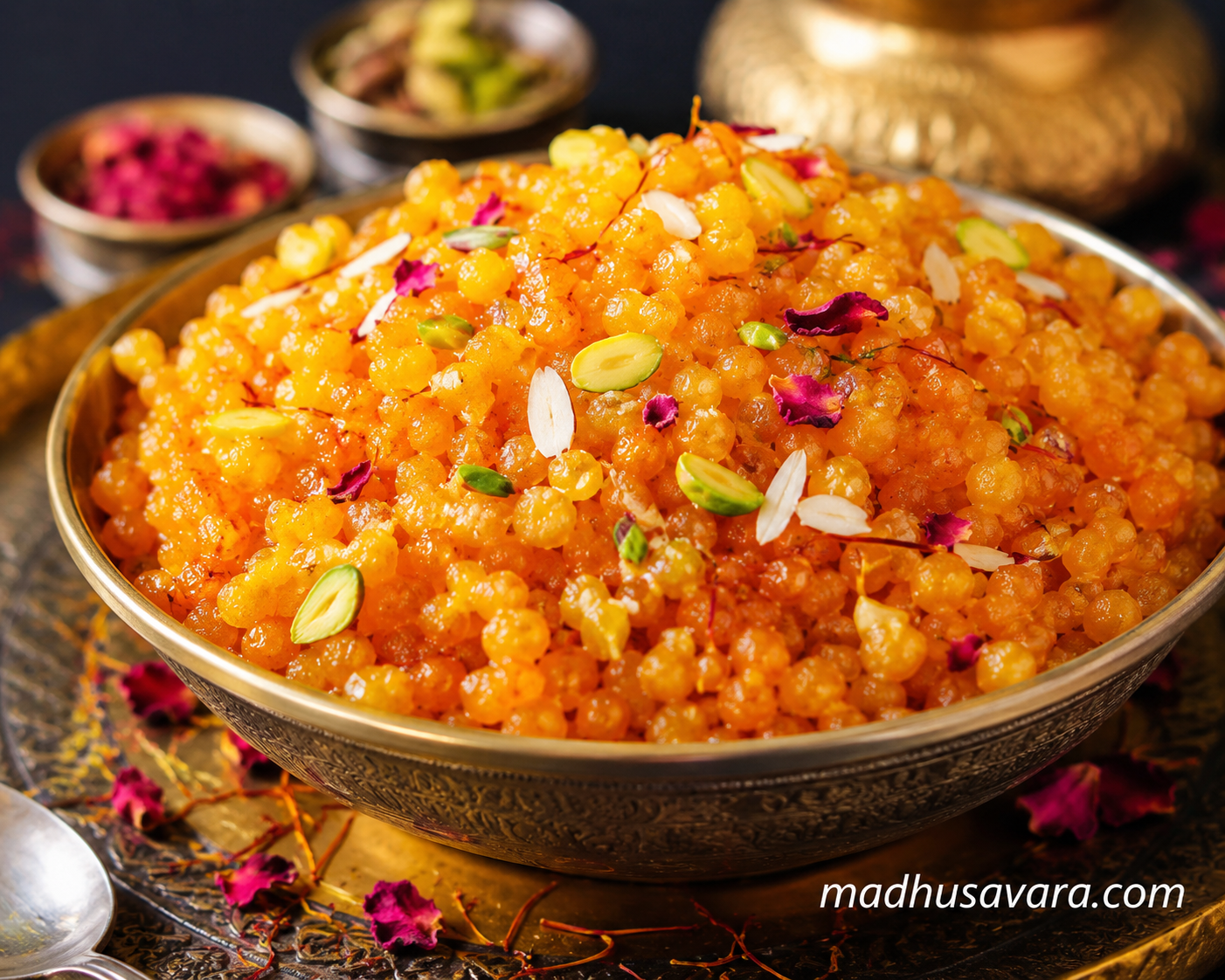
Boondi Ka Meetha served in a traditional brass bowl, garnished with saffron, almonds and pistachios,

Author’s Note

By Madhu Savara, Founder of madhusavara.com

Namaste!

Some sweets become popular because they are rich, while others are remembered because they are woven into family traditions. Boondi Ka Meetha belongs to the second kind. It is a simple dessert, yet it carries the warmth of celebrations, community feasts and happy gatherings.

Whenever I think of traditional Himachali dhams, I remember the large brass utensils, the aroma of freshly cooked food and the excitement of waiting for the sweet dish to arrive. Freshly fried boondi, soaked patiently in fragrant sugar syrup flavoured with cardamom and saffron, always brought a satisfying end to the meal. Every spoonful was soft, juicy and comforting without being overly rich.

What I love most about this recipe is that it needs only a handful of everyday ingredients. There is no complicated method or expensive ingredient, yet the result is a dessert that has delighted generations. Whether you prepare it for a festival, a family celebration or simply because you are craving an Indian sweet, this recipe never fails to bring smiles around the table.

Boondi Ka Meetha Recipe is the traditional sweet that begins an authentic Mandi or Mandyalli Dham, making it the first dish served before the elaborate feast. Prepared with delicate pearls of gram flour soaked in fragrant cardamom and saffron sugar syrup, it symbolises a sweet and auspicious beginning to weddings, religious feasts and festive gatherings in the Mandi region of Himachal Pradesh. Loved for its soft, juicy texture, gentle sweetness and simple ingredients, this timeless Himachali dessert continues to hold a place of honour on every traditional dham menu.

Table of Contents

  • Origin & Significance
  • Why You’ll Love This Recipe
  • Ingredients
  • Equipment Needed
  • Step-by-Step Instructions
  • Recipe Card
  • Nutritional Information
  • Allergen Information
  • Madhu Savara’s Tips
  • Variations
  • Things to Avoid
  • Storage Instructions
  • Frequently Asked Questions
  • Final Thoughts
  • Author’s Bio

Servings

8 people

Preparation Time:

15 Minutes and resting time 1 Hour

Cooking Time:

25 minutes

Calories

300

Ingredients

For the Boondi

  • 1 cup gram flour (besan)
  • ½–¾ cup water (adjust as needed)
  • A pinch of salt
  • ¼ tsp baking soda (optional, for lighter boondi)
  • A pinch of turmeric or a few drops of natural orange food colour (optional)
  • Ghee or neutral cooking oil, for deep frying

For the Sugar Syrup

  • 1½ cups sugar
  • ¾ cup water
  • 4–5 green cardamom pods, lightly crushed
  • 10–12 saffron strands, soaked in 1 tbsp warm milk
  • 1 tsp rose water or kewra water (optional)
  • 1 tbsp desi ghee
  • 2 tbsp slivered almonds
  • 2 tbsp slivered pistachios

Equipment Needed

Gather all the equipment before you begin to make the cooking process smooth and organised.

  • Large mixing bowl
  • Balloon whisk or hand whisk
  • Measuring cups and measuring spoons
  • Boondi jhara (traditional boondi ladle) or a fine perforated ladle
  • Deep, heavy-bottomed kadai for frying
  • Heavy-bottomed saucepan for preparing the sugar syrup
  • Slotted spoon for removing the fried boondi
  • Wire rack or a plate lined with kitchen paper to drain excess oil
  • Heat-resistant spatula or ladle for gently mixing the boondi with the syrup
  • Serving bowl for presenting the finished Boondi Ka Meetha

Nutrition Information

per serving

Nutrient Amount
Calories 300 kcal
Carbohydrates 45 g
Protein 6 g
Fat 12 g
Saturated Fat 3 g
Sugar 35 g
Fibre 2 g
Sodium 60 mg

These values are approximate and may vary depending on the ingredients used.

Step by Step Instructions

Step 1: Prepare the Boondi Batter

Sift the gram flour into a mixing bowl. Add the salt and baking soda, if using. Gradually add the water while whisking continuously until the batter becomes smooth and lump-free. The consistency should be free-flowing but slightly thicker than dosa batter. Cover and rest the batter for 10 minutes.

Step 2: Fry the Boondi

Heat ghee or oil in a deep kadai over a medium flame. Hold the boondi jhara a few inches above the hot oil and pour a ladleful of batter onto it. Tap the ladle gently so that tiny droplets fall evenly into the oil.

Fry the boondi for 40–60 seconds until they are lightly cooked and just begin to turn pale golden. They should remain soft inside and should not become crisp or dark. Remove with a slotted spoon and drain on kitchen tissue. Repeat with the remaining batter.

Step 3: Prepare the Sugar Syrup

In a heavy-bottomed saucepan, combine the sugar and water. Cook over a medium flame until the sugar dissolves completely. Simmer until the syrup reaches a one-string consistency.

Add the crushed cardamom, saffron milk, rose water or kewra water, and stir in the desi ghee. Switch off the heat, keeping the syrup warm.

Step 4: Soak the Boondi

Add the warm boondi directly to the warm sugar syrup. Fold gently with a spatula until every pearl is evenly coated. Cover and leave it to rest for 30–45 minutes, allowing the boondi to absorb the syrup completely while remaining soft and juicy.

Step 5: Garnish and Serve

Transfer the Boondi Ka Meetha to a serving bowl. Garnish with slivered almonds, pistachios and a few saffron strands, if desired.

Serve warm or at room temperature as the traditional opening sweet of Mandyalli Dham, or enjoy it during festivals, weddings and family celebrations.

Tips and Variations

Madhu Savara’s Tips

  • Use fresh besan for the best flavour and colour.
  • The batter should flow smoothly through the boondi jhara. If it is too thick, the boondi will become uneven, while a thin batter will produce flat boondi.
  • Fry the boondi over a medium flame to keep it light and evenly cooked.
  • A one-string sugar syrup gives the perfect texture without making the dessert overly sticky.
  • Add the boondi while the syrup is warm, not boiling.
  • Allow enough resting time so that every pearl absorbs the syrup evenly.
  • A teaspoon of pure desi ghee added to the syrup enhances both flavour and aroma.

Variations

  • Add a few raisins along with the nuts for extra richness.
  • Garnish with edible silver leaf (varak) for festive occasions.
  • A pinch of crushed fennel seeds can be added to the syrup for a subtle traditional flavour.
  • Reduce the sugar slightly if you prefer a mildly sweet dessert.
  • The same warm boondi mixture can also be shaped into delicious Boondi Ladoos before it cools completely.

Allergen Information

Allergen Information

Before serving Boondi Ka Meetha, keep the following allergens in mind, especially if preparing it for guests or family members with food allergies.

  • Gram Flour (Besan): The main ingredient in this recipe. Although naturally gluten-free, some commercially packed besan may be processed in facilities that also handle wheat.
  • Tree Nuts: Almonds and pistachios used for garnishing may trigger nut allergies. Omit them if required.
  • Milk: If saffron is soaked in warm milk or ghee is used, the recipe contains dairy.
  • Gluten: This recipe is naturally gluten-free when made with pure besan. Always use certified gluten-free gram flour if cooking for someone with coeliac disease or severe gluten sensitivity to avoid cross-contamination.
  • Food Colour (Optional): If using food colour, choose a food-grade brand and check the label for any allergen declarations.
Other Essentials

Things to Avoid

  • Do not prepare a runny batter, as the boondi will lose its round shape.
  • Avoid frying on a high flame, which can brown the boondi before it cooks evenly.
  • Do not overcook the sugar syrup beyond one-string consistency.
  • Never pour the boondi into vigorously boiling syrup.
  • Avoid stirring too vigorously after adding the boondi, as it may break into small pieces.

Storage Instructions

Store the prepared Boondi Ka Meetha in an airtight container.

  • Room Temperature: Up to 2 days in cool weather.
  • Refrigerator: 4–5 days.
  • Bring it to room temperature or warm it gently before serving for the best taste and texture.

Frequently Asked Questions

Can I prepare Boondi Ka Meetha a day in advance?

Yes. In fact, the flavour improves after a few hours as the boondi absorbs the syrup completely. Store it in the refrigerator and bring it to room temperature before serving.

Can I use jaggery instead of sugar?

Traditional Boondi Ka Meetha is prepared with sugar syrup. Jaggery gives a different flavour and colour, so it is not commonly used for this recipe.

Why did my boondi become hard?

This usually happens when the batter is too thick, the boondi is over-fried, or the sugar syrup has become too thick. Maintaining the correct batter consistency and one-string syrup helps achieve soft, juicy boondi.

Can I make this recipe without food colour?

Absolutely. The food colour is entirely optional. A small pinch of turmeric gives a gentle golden colour, or you can leave it out altogether for a natural appearance.

Which festivals is Boondi Ka Meetha commonly prepared for?

It is popularly enjoyed during Diwali, Holi, weddings, religious ceremonies, family celebrations and festive community feasts. It is also an excellent dessert for special weekend meals.

Serving Suggestions

Boondi Ka Meetha tastes best when served slightly warm or at room temperature. It pairs beautifully with a traditional festive meal and can also be enjoyed after simple Indian lunches or dinners. Garnish with freshly sliced almonds, pistachios and a few saffron strands just before serving for an elegant presentation.

Final Thoughts

Some recipes become family favourites because they are elaborate, while others earn their place through simplicity. Boondi Ka Meetha Recipe belongs to the latter. With everyday ingredients, a straightforward method and timeless flavours, it has been bringing sweetness to festive tables for generations.

Whether you are preparing it for a family celebration, a festival, or simply to enjoy a homemade Indian dessert, this recipe is sure to be appreciated. I hope it brings the same warmth and happiness to your home that it has always brought to mine.

If you try this Boondi Ka Meetha Recipe, I’d love to hear how it turned out. Your feedback, tips and family memories make our community at madhusavara.com even more special.

Author Bio

Madhu Savara is the founder of madhusavara.com, where she shares authentic Indian recipes inspired by regional traditions and home cooking. Passionate about preserving India’s rich culinary heritage, she combines trusted family recipes with practical techniques, helping home cooks recreate timeless dishes with confidence and authenticity.


Disclaimer

Important Notice: Read Before Proceeding

The recipes, preparation methods, nutritional details, and related content published on Madhu Savara’s website, social media, and associated platforms are intended solely for general informational and educational purposes. While every effort has been made to ensure accuracy and reliability, we make no guarantees regarding the results, safety, or accuracy of any recipe presented here.

We are not licensed nutritionists, dieticians, or medical professionals. The nutritional values provided are estimates only, calculated using third-party tools, and should not be used for medical diagnosis, dietary treatment, or allergy management. If you have any medical conditions, dietary restrictions, or food allergies, please consult your doctor or certified dietitian before attempting any recipe.

Cooking inherently involves sharp tools, high heat, and the risk of injury or fire. You assume full responsibility for your kitchen practices. Madhu Savara, the website, and all contributors shall not be held liable for any damage, injury, loss, or adverse outcome resulting directly or indirectly from the preparation, consumption, or interpretation of any content herein.

By using this website and attempting any recipe, you agree to hold harmless and indemnify Madhu Savara and her team from any liability, legal claim, or damages arising from the use of this content. You are encouraged to exercise independent judgment and take full responsibility for your health, kitchen safety, and actions.


Boondi Ka Meetha served in a traditional brass bowl, garnished with saffron, almonds and pistachios,
Print

Boondi Ka Meetha Recipe | Authentic Himachali Mandyalli Dham Sweet

Boondi Ka Meetha Recipe is the traditional sweet that begins an authentic Mandi or Mandyalli Dham, making it the first dish served before the elaborate feast. Prepared with delicate pearls of gram flour soaked in fragrant cardamom and saffron sugar syrup, it symbolises a sweet and auspicious beginning to weddings, religious feasts and festive gatherings in the Mandi region of Himachal Pradesh. Loved for its soft, juicy texture, gentle sweetness and simple ingredients, this timeless Himachali dessert continues to hold a place of honour on every traditional dham menu.
Course Desert
Cuisine Himachali Dham, North India
Keyword Boondi Ka Meetha, Boondi Ka Meetha Recipe, Himachali Dham sweet, Mandyalli Dham meetha, Meethi Boondi recipe
Prep Time 15 minutes
Cook Time 25 minutes
Resting Time 1 hour
Total Time 1 hour 40 minutes
Servings 8 People
Author Madhu Savara

Equipment

  • Large mixing bowl Balloon whisk or hand whiskMeasuring cups and measuring spoonsBoondi jhara (traditional boondi ladle) or a fine perforated ladleDeep, heavy-bottomed kadai for fryingHeavy-bottomed saucepan for preparing the sugar syrupSlotted spoon for removing the fried boondiWire rack or a plate lined with kitchen paper to drain excess oilHeat-resistant spatula or ladle for gently mixing the boondi with the syrupServing bowl for presenting the finished Boondi Ka Meetha

Ingredients

  • For the Boondi
  • 1 cup gram flour besan
  • ½ –¾ cup water adjust as needed
  • A pinch of salt
  • ¼ tsp baking soda optional, for lighter boondi
  • A pinch of turmeric or a few drops of natural orange food colour optional
  • Ghee or neutral cooking oil for deep frying
  • For the Sugar Syrup
  • cups sugar
  • ¾ cup water
  • 4 –5 green cardamom pods lightly crushed
  • 10 –12 saffron strands soaked in 1 tbsp warm milk
  • 1 tsp rose water or kewra water optional
  • 1 tbsp desi ghee
  • 2 tbsp slivered almonds
  • 2 tbsp slivered pistachios

Instructions

  • Step 1: Prepare the Boondi Batter
  • Sift the gram flour into a mixing bowl. Add the salt and baking soda, if using. Gradually add the water while whisking continuously until the batter becomes smooth and lump-free. The consistency should be free-flowing but slightly thicker than dosa batter. Cover and rest the batter for 10 minutes.
  • Step 2: Fry the Boondi
  • Heat ghee or oil in a deep kadai over a medium flame. Hold the boondi jhara a few inches above the hot oil and pour a ladleful of batter onto it. Tap the ladle gently so that tiny droplets fall evenly into the oil.
  • Fry the boondi for 40–60 seconds until they are lightly cooked and just begin to turn pale golden. They should remain soft inside and should not become crisp or dark. Remove with a slotted spoon and drain on kitchen tissue. Repeat with the remaining batter.
  • Step 3: Prepare the Sugar Syrup
  • In a heavy-bottomed saucepan, combine the sugar and water. Cook over a medium flame until the sugar dissolves completely. Simmer until the syrup reaches a one-string consistency.
  • Add the crushed cardamom, saffron milk, rose water or kewra water, and stir in the desi ghee. Switch off the heat, keeping the syrup warm.
  • Step 4: Soak the Boondi
  • Add the warm boondi directly to the warm sugar syrup. Fold gently with a spatula until every pearl is evenly coated. Cover and leave it to rest for 30–45 minutes, allowing the boondi to absorb the syrup completely while remaining soft and juicy.
  • Step 5: Garnish and Serve
  • Transfer the Boondi Ka Meetha to a serving bowl. Garnish with slivered almonds, pistachios and a few saffron strands, if desired.
  • Serve warm or at room temperature as the traditional opening sweet of Mandyalli Dham, or enjoy it during festivals, weddings and family celebrations.

Notes

Madhu Savara’s Tips

  • Use fresh besan for the best flavour and colour.
  • The batter should flow smoothly through the boondi jhara. If it is too thick, the boondi will become uneven, while a thin batter will produce flat boondi.
  • Fry the boondi over a medium flame to keep it light and evenly cooked.
  • A one-string sugar syrup gives the perfect texture without making the dessert overly sticky.
  • Add the boondi while the syrup is warm, not boiling.
  • Allow enough resting time so that every pearl absorbs the syrup evenly.
  • A teaspoon of pure desi ghee added to the syrup enhances both flavour and aroma.

Variations

  • Add a few raisins along with the nuts for extra richness.
  • Garnish with edible silver leaf (varak) for festive occasions.
  • A pinch of crushed fennel seeds can be added to the syrup for a subtle traditional flavour.
  • Reduce the sugar slightly if you prefer a mildly sweet dessert.
  • The same warm boondi mixture can also be shaped into delicious Boondi Ladoos before it cools completely.