
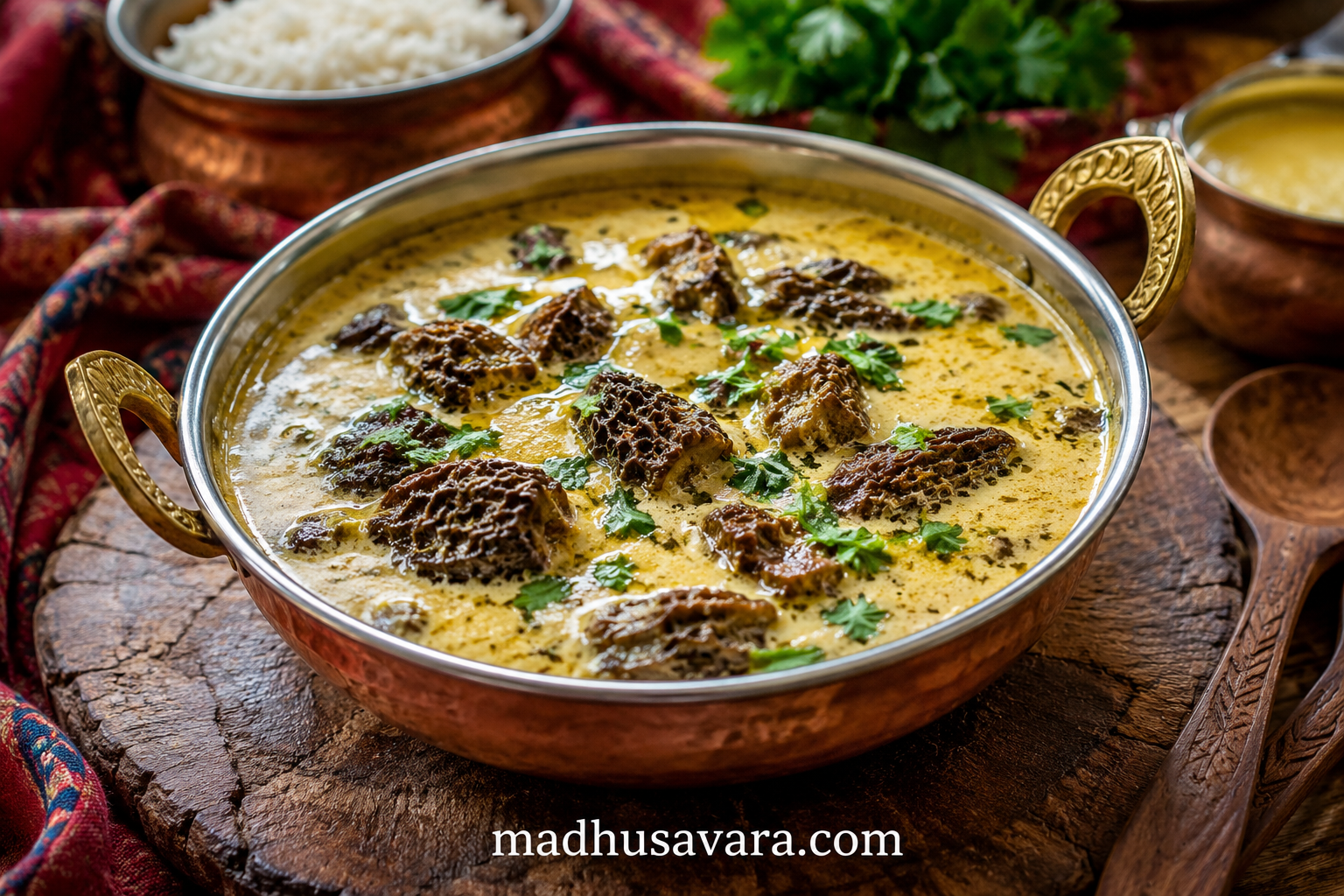
Authentic Gucchi Mushroom Madra Recipe | Traditional Chambyalli Dham Delicacy
Gucchi Mushroom Madra is one of the most luxurious dishes prepared during Chambyalli Dham, the traditional ceremonial feast of Chamba district in Himachal Pradesh. Unlike ordinary mushroom curries, this Madra highlights the earthy aroma and delicate texture of wild Himalayan Gucchi mushrooms, also known as morels.
Servings 4 People
Calories 295kcal
Equipment
- Heavy-bottomed kadai or thick panMixing bowlSmall whiskSlotted spoonMeasuring spoonsWooden spatula
Ingredients
- For the Madra
- 50 g dried Gucchi mushrooms wild Himalayan morels
- 2 cups thick curd fresh and well whisked
- 3 tbsp desi ghee
- 2 tbsp gram flour besan
- 1 tsp fennel powder saunf
- ½ tsp dry ginger powder saunth
- ¼ tsp turmeric powder optional, for a light golden colour
- Salt to taste
- Whole Spices
- 1 bay leaf
- 1- inch cinnamon stick
- 4 green cardamoms
- 2 black cardamoms
- 4 cloves
- 6 –8 black peppercorns
- 1 tsp cumin seeds
- A pinch of asafoetida hing
- Garnish
- 1 tsp finely chopped fresh coriander optional
- A drizzle of desi ghee before serving
Instructions
- How to Prepare Gucchi Mushrooms
- Proper preparation is the secret to an authentic Gucchi Mushroom Madra Recipe.
- Place the dried Gucchi mushrooms in a large bowl.
- Pour enough warm water to completely cover them.
- Soak for 25–30 minutes until they become soft and plump.
- Lift the mushrooms gently instead of pouring them out, as sand and forest debris settle at the bottom.
- Rinse each mushroom carefully under running water, especially inside the hollow cap.
- Strain the soaking water through a muslin cloth or fine sieve. Reserve about one cup of this liquid, as it carries the natural earthy flavour of Gucchi and can be added while cooking.
- Step-by-Step Cooking Method
- Step 1: Prepare the Curd Base
- Whisk the curd until completely smooth. Add gram flour, fennel powder, dry ginger powder and turmeric, if using. Whisk again until there are no lumps.
- This helps the curd remain smooth and prevents it from splitting during cooking.
- Step 2: Temper the Ghee
- Heat desi ghee in a heavy-bottomed kadai over a low flame.
- Add:
- Bay leaf
- Cinnamon
- Green cardamoms
- Black cardamoms
- Cloves
- Peppercorns
- Cumin seeds
- Let the spices release their aroma for about a minute.
- Finally, add a pinch of hing and stir immediately.
- The fragrance of these whole spices forms the traditional flavour base of Chambyalli Dham Madra.
- Step 3: Cook the Gucchi
- Add the cleaned Gucchi mushrooms to the kadai.
- Cook gently in the spiced ghee for 4–5 minutes.
- Avoid high heat, as wild morels are delicate and can become chewy if overcooked.
- Step 4: Add the Curd Mixture
- Reduce the flame to the lowest setting.
- Slowly pour the whisked curd mixture into the kadai while stirring continuously in one direction.
- Continuous stirring is essential to prevent the curd from curdling.
- Allow the mixture to cook gently until it begins to thicken.
- Step 5: Simmer Slowly
- Add half to one cup of the reserved strained soaking water according to the consistency you prefer.
- Mix well.
- Cover the pan and cook over a low flame for 18–20 minutes, stirring every few minutes.
- The gravy gradually becomes creamy, glossy and aromatic while the Gucchi absorbs the rich flavours of the yoghurt and spices.
- Step 6: Adjust the Consistency
- Taste and adjust the salt.
- If the gravy becomes too thick, add a few tablespoons of hot water.
- If it is too thin, simmer uncovered for another 4–5 minutes.
- The authentic Madra should have a rich, coating consistency rather than a watery gravy.
- Step 7: Finish and Serve
- Switch off the flame.
- Allow the Madra to rest for 5 minutes before serving.
- Finish with a drizzle of warm desi ghee.
- Serve hot with steamed rice as part of a traditional Chambyalli Dham meal.
Notes
Tips and Variations
Madhu Savara’s Tips
- Always use full-fat fresh curd for a rich and silky gravy.
- Never discard the strained soaking water, as it adds the signature forest aroma to the dish.
- Cook only on a low flame from the time the curd is added.
- Stir continuously while adding the curd to avoid curdling.
- Use desi ghee instead of oil to retain the authentic Dham flavour.
- Do not overpower the Gucchi with excessive spices. Its natural earthy taste is the star of this recipe.
- Allow the Madra to rest for a few minutes before serving so the flavours settle beautifully.
