Authentic Himachali Babru Recipe | Traditional Urad Dal Stuffed Bread
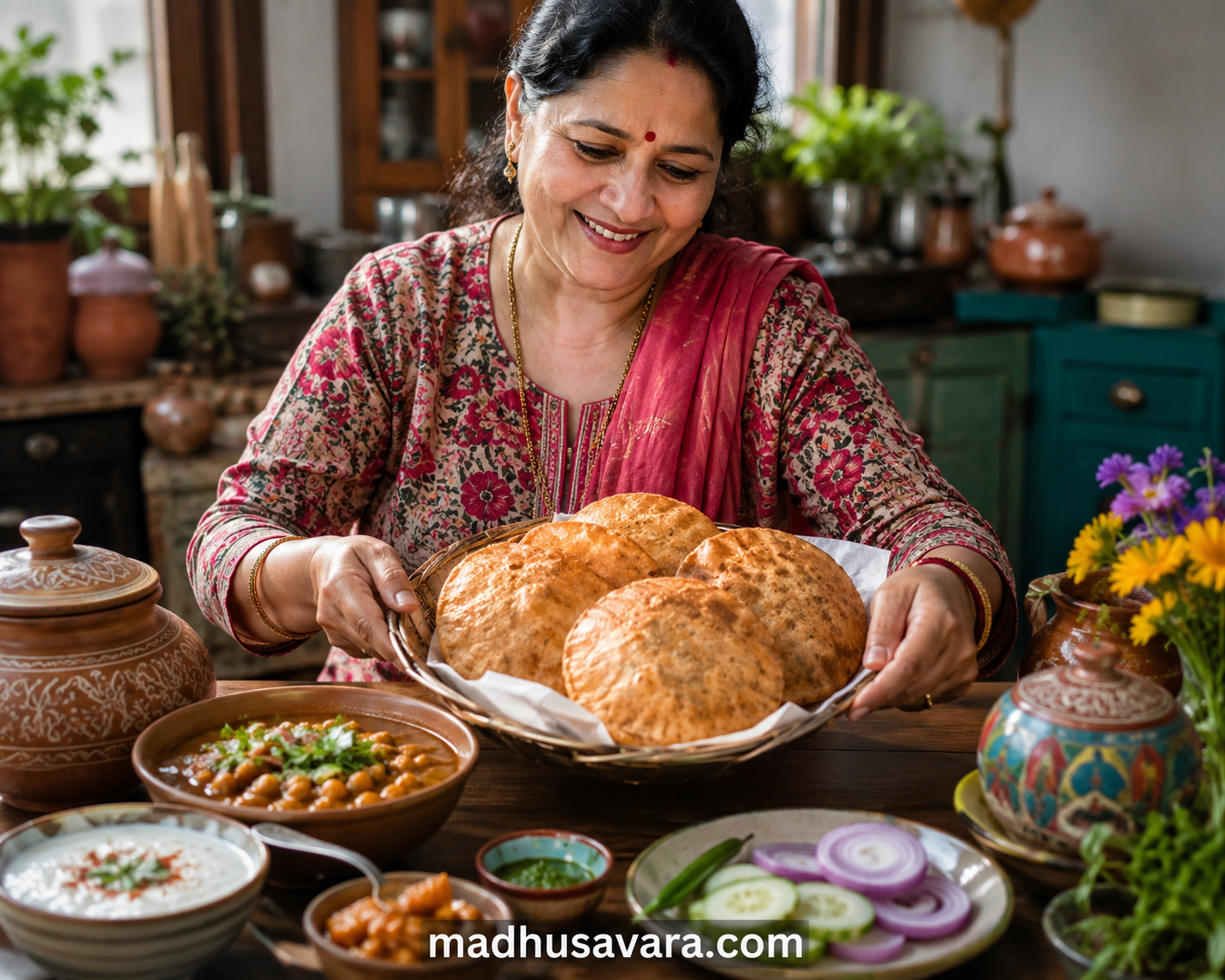
A joyful Indian woman prepares and serves Authentic Himachali Babru in a traditional kitchen. Crispy golden urad dal stuffed breads are served with Chana Madra, curd, green chutney and fresh salad on a rustic wooden table.

Author’s Note

I am Madhu Savara, owner of madhusavara.com. My interest in Himachali cuisine comes from the variety of traditional recipes that use everyday ingredients and simple cooking methods to create unique flavours.

Babru is a traditional Himachali stuffed bread prepared with wheat flour dough and a savoury filling of coarsely ground urad dal. The combination of a crisp outer layer and spiced dal filling gives this dish its distinctive taste and texture.

This Himachali Babru Recipe follows a simple preparation method with carefully balanced spices and a well-prepared urad dal filling. It is a wonderful recipe for anyone who enjoys discovering regional Indian dishes and exploring the traditional foods of Himachal Pradesh.

Description

Babru is a traditional Himachali stuffed bread made with wheat flour dough and a savoury filling of coarsely ground black urad dal. Deep fried until crisp and golden, this Authentic Himachali Babru Recipe has a crunchy outer layer and a soft, flavourful filling. Popular across parts of Himachal Pradesh, especially Kangra, Mandi and Chamba, Babru is enjoyed for breakfast, as an evening snack or with a simple meal. It is commonly served with Chana Madra, curd or chutney, making it one of the best-known breads in traditional Himachali cuisine.

Origin

The exact origin of Babru is not clearly documented, but it has been prepared in different parts of Himachal Pradesh for many years. It is particularly associated with the food traditions of Kangra, Mandi and Chamba, where it continues to be prepared in homes as well as by local sweet shops and traditional food vendors. Although some regions prepare a sweet version, the savoury Urad Dal Stuffed Babru is the variation most commonly enjoyed in everyday meals.

Significance

Traditional Babru reflects the practical style of cooking found in the hills of Himachal Pradesh. Made with wheat flour and black urad dal, it uses ingredients that are easily available and filling enough for a satisfying meal. It is often prepared for family breakfasts, festive occasions and community gatherings, where it is served with dishes such as Chana Madra, curd or chutney. Its continued popularity has made Himachali Babru an important part of the region’s traditional food culture.

Why You’ll Love This Authentic Himachali Babru Recipe

  • Made with simple ingredients commonly found in Indian kitchens.
  • Crispy outside with a flavourful urad dal stuffed centre.
  • A traditional Himachali bread that is easy to prepare at home.
  • Pairs beautifully with Chana Madra, curd, pickle or chutney.
  • Suitable for breakfast, evening snacks or festive meals.
  • A great recipe for anyone who enjoys exploring authentic regional Indian cuisine.

Table of Contents

  1. Author’s Note
  2. What is Babru?
  3. Origin of Babru
  4. Significance of Babru in Himachali Cuisine
  5. Why You’ll Love This Authentic Himachali Babru Recipe
  6. Recipe Details
  7. Ingredients
  8. Kitchen Equipment Required
  9. Step-by-Step Himachali Babru Recipe
  10. Nutritional Information
  11. Allergen Information
  12. Madhu Savara’s Tips
  13. Things to Avoid
  14. Serving Suggestions
  15. Storage Tips
  16. Frequently Asked Questions
  17. Final Thoughts
  18. About the Author

Servings

4 person

Preparation Time:

20 minutes (plus overnight soaking)

Cooking Time:

55 minutes

Calories

540

Ingredients

(Makes 12 Babru | Serves 4)

For the Urad Dal Filling

  • 1 cup whole black urad dal (sabut urad), soaked overnight
  • Salt, to taste
  • A small pinch of hing (asafoetida) (optional)

For the Dough

  • 2 cups whole wheat flour (atta)
  • ½ teaspoon salt, or to taste
  • ¼ teaspoon baking powder (optional)
  • 1 teaspoon oil
  • ¾–1 cup water, or as required to knead a firm dough

For Deep Frying

  • Oil, as required for deep frying (mustard oil or refined oil)

Equipment Needed

  • Large mixing bowl
  • Mixer grinder (for grinding the soaked urad dal)
  • Chakla and rolling pin (or a clean rolling board and rolling pin)
  • Deep kadai or heavy-bottomed frying pan
  • Slotted spoon
  • Kitchen tissue or a wire rack for draining excess oil

Nutrition Information

(Approximate per serving – 3 Babru)

Nutrient Amount Amount (Approx.)
Calories 540 kcal
Carbohydrates 66 g
Protein 18 g
Total Fat 27 g
Saturated Fat 5 g
Dietary Fibre 9 g
Total Sugars 4 g
Sodium 450 mg*
Calcium 90 mg
Iron 5.5 mg
Potassium 540 mg
Magnesium 120 mg
Phosphorus 300 mg
Folate 120 mcg

*Sodium may vary depending on the amount of salt used.

The nutritional values are approximate and may vary depending on the ingredients used, the size of the Babru, and the amount of oil absorbed during frying.

Step by Step Instructions

Step-by-Step Himachali Babru Recipe

Step 1: Soak the Urad Dal

Wash the whole black urad dal thoroughly and soak it in enough water for 6–8 hours or overnight.

Step 2: Prepare the Filling

Drain the soaked dal completely. Grind it to a coarse mixture without adding water unless necessary. The filling should retain a little texture and should not become a smooth paste. Add salt and a pinch of hing, if using, and mix well.

Step 3: Prepare the Dough

In a large mixing bowl, combine the whole wheat flour, salt and baking powder, if using. Add the oil and mix well. Gradually add water and knead into a firm, smooth dough, similar to poori dough. Knead for 4–5 minutes, cover with a damp cloth and let it rest for 20–30 minutes.

Step 4: Divide the Dough

Divide the rested dough into 12 equal portions and roll each portion into a smooth ball.

Step 5: Stuff the Babru

Flatten one dough ball into a small disc. Place about 1 heaped teaspoon of the prepared urad dal filling in the centre. Bring the edges together and seal them well. Gently roll into a round disc about 3–4 inches in diameter, keeping it slightly thicker than a poori. Cover the prepared Babru with a clean kitchen cloth while shaping the remaining pieces.

Step 6: Deep Fry

Heat oil in a deep kadai over medium heat. To check the temperature, drop a tiny piece of dough into the oil. If it rises steadily without turning brown immediately, the oil is ready.

Carefully slide one Babru into the hot oil. Press it gently with a slotted spoon to help it puff slightly. Fry until both sides turn light golden brown. Avoid overcrowding the kadai, as it lowers the oil temperature and affects even cooking.

Step 7: Drain and Serve

Remove the fried Babru using a slotted spoon and place it on kitchen tissue or a wire rack to drain excess oil. Serve hot with Chana Madra, curd, mint chutney, tamarind chutney or a cup of hot tea.

Cooking Tip: Once the urad dal has been soaked, the entire preparation—from grinding the filling to frying the Babru—takes approximately 40–45 minutes.

Tips and Variations

Madhu Savara’s Tips

  • Use a firm dough similar to poori dough. This helps the Babru hold its shape and prevents excess oil absorption.
  • Grind the soaked black urad dal to a coarse mixture, not a smooth paste. The coarse texture gives Authentic Himachali Babru its traditional taste.
  • Seal the edges carefully after stuffing so the filling does not come out during rolling or frying.
  • Roll each Babru gently and keep it slightly thicker than a poori for the best texture.
  • Fry on medium heat to ensure the outside turns crisp while the filling cooks evenly.
  • If using mustard oil, heat it until it reaches frying temperature, then reduce to medium heat before adding the Babru.
  • Serve Himachali Babru hot with Chana Madra, curd, mint chutney or pickle for a traditional meal.

Variations

  • Add a small quantity of ajwain to the urad dal filling for a subtle flavour.
  • Finely chopped green chilli can be added for a mildly spicy variation.
  • Shallow fry on a tawa using less oil for a lighter version, although the traditional Babru Recipe is deep fried.
  • A Sweet Babru is also prepared in some parts of Himachal Pradesh using jaggery and other ingredients. It is a different recipe from the savoury Urad Dal Stuffed Babru.

Allergen Information

Allergen Information

  • Contains gluten due to the use of whole wheat flour.
  • Contains black urad dal (legume) and is not suitable for those with legume allergies.
  • Deep fried in oil; use an oil suitable for your dietary needs or food sensitivities.
  • Naturally free from dairy, provided no dairy ingredients are added during serving.
  • Contains no eggs.
  • Contains no nuts in the traditional recipe.
  • Contains no soy in the basic recipe.
  • If preparing for someone with food allergies, always check the labels of packaged ingredients to avoid potential cross-contamination.
Other Essentials

Things to Avoid

  • Do not grind the soaked urad dal into a smooth paste. A coarse filling gives Babru its authentic texture.
  • Avoid adding excess water while grinding the dal, as a wet filling may burst during stuffing or frying.
  • Do not knead a soft dough. The dough should be firm, similar to poori dough.
  • Do not overfill the Babru, as the stuffing may come out while rolling or frying.
  • Avoid rolling the Babru too thin. A slightly thicker layer keeps the filling secure.
  • Do not fry on high heat. Medium heat allows the Babru to cook evenly and turn crisp without burning.
  • Avoid overcrowding the kadai. Fry only a few Babru at a time for even cooking.
  • Do not leave the shaped Babru uncovered, as the dough may dry and crack before frying.

Storage Tips

  • Babru is best enjoyed hot and freshly prepared.
  • Store leftovers in an airtight container at room temperature for up to 8–10 hours.
  • Refrigerate for up to 2 days.
  • Reheat on a tawa, in an air fryer or in a preheated oven until warm and crisp.
  • Freezing is not recommended, as it affects the texture of the bread.

Serving Suggestions

Himachali Babru tastes delicious with:

  • Chana Madra
  • Aloo Palda
  • Boondi Raita or plain curd
  • Mint or coriander chutney
  • Mango pickle or mixed vegetable pickle
  • Kaddu Ka Khatta
  • A hot cup of tea for breakfast or evening snacks

Frequently Asked Questions

Can I use split urad dal instead of whole black urad dal?
Whole black urad dal is traditionally used for Babru and gives a better texture. Split urad dal can be used if required, but the taste and texture will be different.

How long should I soak the urad dal?
Soak the dal for 6–8 hours or overnight for the best results.

Why did my Babru open while frying?
This usually happens if the filling is too wet, the edges are not sealed properly, or the dough has been rolled too thin.

Is baking powder necessary?
No. Baking powder is optional. Many traditional Himachali Babru Recipes are prepared without it.

Can I prepare the dough in advance?
Yes. Refrigerate the dough for a few hours and bring it to room temperature before stuffing.

Is Babru the same as Kachori?
No. Although both are stuffed and deep-fried, Babru is traditionally prepared with whole wheat flour and a simple urad dal filling, giving it a distinct taste and texture.

How can I check if the oil is ready for frying?
Drop a small piece of dough into the oil. If it rises steadily without turning dark immediately, the oil is ready.

Call to Action

If you prepare this Authentic Himachali Babru Recipe, share your experience in the comments on madhusavara.com. Your suggestions, serving ideas and family variations help keep traditional Himachali recipes alive for future generations. If you enjoyed this recipe, don’t forget to explore more authentic regional recipes from Himachal Pradesh and across India.

Final Thoughts

Babru is a traditional Himachali stuffed bread that continues to be enjoyed for its crisp texture, flavourful urad dal filling and simple preparation. Whether served with Chana Madra, curd, chutney or a cup of tea, this Authentic Himachali Babru Recipe is a wonderful way to experience the traditional flavours of Himachal Pradesh at home.

About the Author

Madhu Savara is the founder of madhusavara.com. A homemaker based in Chandigarh, she is passionate about documenting authentic Indian home cooking, Himalayan regional cuisine and traditional recipes. Through carefully tested recipes and practical cooking methods, she shares regional dishes that celebrate India’s rich culinary traditions.

Disclaimer

Important Notice: Read Before Proceeding

The recipes, preparation methods, nutritional details, and related content published on Madhu Savara’s website, social media, and associated platforms are intended solely for general informational and educational purposes. While every effort has been made to ensure accuracy and reliability, we make no guarantees regarding the results, safety, or accuracy of any recipe presented here.

We are not licensed nutritionists, dieticians, or medical professionals. The nutritional values provided are estimates only, calculated using third-party tools, and should not be used for medical diagnosis, dietary treatment, or allergy management. If you have any medical conditions, dietary restrictions, or food allergies, please consult your doctor or certified dietitian before attempting any recipe.

Cooking inherently involves sharp tools, high heat, and the risk of injury or fire. You assume full responsibility for your kitchen practices. Madhu Savara, the website, and all contributors shall not be held liable for any damage, injury, loss, or adverse outcome resulting directly or indirectly from the preparation, consumption, or interpretation of any content herein.

By using this website and attempting any recipe, you agree to hold harmless and indemnify Madhu Savara and her team from any liability, legal claim, or damages arising from the use of this content. You are encouraged to exercise independent judgment and take full responsibility for your health, kitchen safety, and actions.


A joyful Indian woman prepares and serves Authentic Himachali Babru in a traditional kitchen. Crispy golden urad dal stuffed breads are served with Chana Madra, curd, green chutney and fresh salad on a rustic wooden table.
Print

Authentic Himachali Babru Recipe | Traditional Urad Dal Stuffed Bread

Babru is a traditional Himachali stuffed bread made with wheat flour dough and a savoury filling of coarsely ground black urad dal. Deep fried until crisp and golden, this Authentic Himachali Babru Recipe has a crunchy outer layer and a soft, flavourful filling. Popular across parts of Himachal Pradesh, especially Kangra, Mandi and ChambaBabru is enjoyed for breakfast, as an evening snack or with a simple meal. It is commonly served with Chana Madra, curd or chutney, making it one of the best-known breads in traditional Himachali cuisine.
Course Himachal, Main Course, North India
Cuisine Himachal, Vegetarian
Keyword authentic Himachali Babru, Babru, Babru from Himachal, Babru recipe, Himachali Babru, Himachali bread, Himachali stuffed bread, traditional Babru, urad dal stuffed Babru
Prep Time 20 minutes
Cook Time 55 minutes
Over Night Soaking 12 hours
Total Time 13 hours 15 minutes
Servings 4 People
Calories 540kcal
Author Madhu Savara

Equipment

  • Large mixing bowl, Mixer grinder (for grinding the soaked urad dal), Chakla and rolling pin (or a clean rolling board and rolling pin), Deep kadai or heavy-bottomed frying pan, Slotted spoon, Kitchen tissue or a wire rack for draining excess oil

Ingredients

  • For the Urad Dal Filling
  • 1 cup whole black urad dal sabut urad, soaked overnight
  • Salt to taste
  • A small pinch of hing asafoetida (optional)
  • For the Dough
  • 2 cups whole wheat flour atta
  • ½ teaspoon salt or to taste
  • ¼ teaspoon baking powder optional
  • 1 teaspoon oil
  • ¾ –1 cup water or as required to knead a firm dough
  • For Deep Frying
  • Oil as required for deep frying (mustard oil or refined oil)

Instructions

  • Step-by-Step Himachali Babru Recipe
  • Step 1: Soak the Urad Dal
  • Wash the whole black urad dal thoroughly and soak it in enough water for 6–8 hours or overnight.
  • Step 2: Prepare the Filling
  • Drain the soaked dal completely. Grind it to a coarse mixture without adding water unless necessary. The filling should retain a little texture and should not become a smooth paste. Add salt and a pinch of hing, if using, and mix well.
  • Step 3: Prepare the Dough
  • In a large mixing bowl, combine the whole wheat flour, salt and baking powder, if using. Add the oil and mix well. Gradually add water and knead into a firm, smooth dough, similar to poori dough. Knead for 4–5 minutes, cover with a damp cloth and let it rest for 20–30 minutes.
  • Step 4: Divide the Dough
  • Divide the rested dough into 12 equal portions and roll each portion into a smooth ball.
  • Step 5: Stuff the Babru
  • Flatten one dough ball into a small disc. Place about 1 heaped teaspoon of the prepared urad dal filling in the centre. Bring the edges together and seal them well. Gently roll into a round disc about 3–4 inches in diameter, keeping it slightly thicker than a poori. Cover the prepared Babru with a clean kitchen cloth while shaping the remaining pieces.
  • Step 6: Deep Fry
  • Heat oil in a deep kadai over medium heat. To check the temperature, drop a tiny piece of dough into the oil. If it rises steadily without turning brown immediately, the oil is ready.
  • Carefully slide one Babru into the hot oil. Press it gently with a slotted spoon to help it puff slightly. Fry until both sides turn light golden brown. Avoid overcrowding the kadai, as it lowers the oil temperature and affects even cooking.
  • Step 7: Drain and Serve
  • Remove the fried Babru using a slotted spoon and place it on kitchen tissue or a wire rack to drain excess oil. Serve hot with Chana Madra, curd, mint chutney, tamarind chutney or a cup of hot tea.
  • Cooking Tip: Once the urad dal has been soaked, the entire preparation—from grinding the filling to frying the Babru—takes approximately 40–45 minutes.

Notes

Madhu Savara's Tips

  • Use a firm dough similar to poori dough. This helps the Babru hold its shape and prevents excess oil absorption.
  • Grind the soaked black urad dal to a coarse mixture, not a smooth paste. The coarse texture gives Authentic Himachali Babru its traditional taste.
  • Seal the edges carefully after stuffing so the filling does not come out during rolling or frying.
  • Roll each Babru gently and keep it slightly thicker than a poori for the best texture.
  • Fry on medium heat to ensure the outside turns crisp while the filling cooks evenly.
  • If using mustard oil, heat it until it reaches frying temperature, then reduce to medium heat before adding the Babru.
  • Serve Himachali Babru hot with Chana Madra, curd, mint chutney or pickle for a traditional meal.

Variations

  • Add a small quantity of ajwain to the urad dal filling for a subtle flavour.
  • Finely chopped green chilli can be added for a mildly spicy variation.
  • Shallow fry on a tawa using less oil for a lighter version, although the traditional Babru Recipe is deep fried.
  • A Sweet Babru is also prepared in some parts of Himachal Pradesh using jaggery and other ingredients. It is a different recipe from the savoury Urad Dal Stuffed Babru.